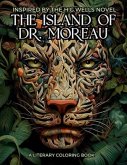
H.G. Wells (1866-1946) wrote some of the great classics of speculative fiction in English, including The Island of Doctor Moreau (1896), which might be said to be about unholy genetics. The work's biological and sociopolitical ideas are still current (such were the range and depth of Wells' ideas). Wells continued to work on Doctor Moreau for nearly thirty years after its initial publication in London (the New York first edition added a subtitle A Possibility), finally letting go of the work after the publication of the Atlantic Edition in 1924. Annotated by the premier Wellsian scholar, this…mehr
H.G. Wells (1866-1946) wrote some of the great classics of speculative fiction in English, including The Island of Doctor Moreau (1896), which might be said to be about unholy genetics. The work's biological and sociopolitical ideas are still current (such were the range and depth of Wells' ideas). Wells continued to work on Doctor Moreau for nearly thirty years after its initial publication in London (the New York first edition added a subtitle A Possibility), finally letting go of the work after the publication of the Atlantic Edition in 1924. Annotated by the premier Wellsian scholar, this is an exhaustive critical edition, examining the historical, medical, philosophical and literary contexts of the story.
H.G. Wells (1866-1946) was an author of science-fiction works-including The War of the Worlds and Star Begotten-who had significant influence on society's vision of the future.H.G. Wells was born Herbert George Wells on September 21, 1866, in Bromley, England. He was educated at a private school in Bromley, Midhurst Grammar School; and the Normal School of Science, now the Royal College of Science, London University.His parents were shopkeepers from a working-class background. His father's shop failed and the family struggled financially. His two older brothers were apprenticed to a draper and his mother was employed on an estate as a housekeeper. It was there that H.G. discovered, in the owner's extensive library, the works of Jonathan Swift and other important writers of the Enlightenment, including Voltaire.As a teen-ager, Wells was apprenticed as a draper, but eventually quit. He became a teacher and won a scholarship to the Normal School of Science, London University, where he studied a variety of subjects, including physics, chemistry, astronomy and biology.Wells' first novel, The Time Machine, became an overnight literary success when it was published in 1895. It was quickly followed by The Island of Dr. Moreau (1896), The Invisible Man (1897) and The War of the Worlds (1898). These are all considered to be early examples of science fiction and today, many consider him to be the "father" of the literary genre.H.G. Wells died on August 13, 1946 in London, England.
Inhaltsangabe
Table of Contents Preface Introduction 1. The Text 2. Nature and Nurture 3. Noble's Isle 4. Chance, Waste, and Pain 5. Chronolatry 6. The Sphinx of Sin 7. Pig Philosophy 8. Vivisection Morality The Island of Doctor Moreau (1896) (Annotated text of the first London edition) Epilogue: The Coming Terror Appendices I. a. "The Province of Pain" (1894) b. Excerpt from Text-Book of Biology (1893, Part I-Vertebrata) II. "The Limits of Individual Plasticity" (1895c) III. a. "Human Evolution, An Artificial Process" (1896c) b. "Mr. Wells Replies" (1897b) c. "The Acquired Factor" (1897a) IV. a. "The Influence of Islands on Variation" (1895e) b. "To the Editor of the Saturday Review" (1896d) V. "Morals and Civilisation" (1897c) VI. Excerpt from Wilkie Collins, Heart and Science (1883) Bibliography Index
Table of Contents Preface Introduction 1. The Text 2. Nature and Nurture 3. Noble's Isle 4. Chance, Waste, and Pain 5. Chronolatry 6. The Sphinx of Sin 7. Pig Philosophy 8. Vivisection Morality The Island of Doctor Moreau (1896) (Annotated text of the first London edition) Epilogue: The Coming Terror Appendices I. a. "The Province of Pain" (1894) b. Excerpt from Text-Book of Biology (1893, Part I-Vertebrata) II. "The Limits of Individual Plasticity" (1895c) III. a. "Human Evolution, An Artificial Process" (1896c) b. "Mr. Wells Replies" (1897b) c. "The Acquired Factor" (1897a) IV. a. "The Influence of Islands on Variation" (1895e) b. "To the Editor of the Saturday Review" (1896d) V. "Morals and Civilisation" (1897c) VI. Excerpt from Wilkie Collins, Heart and Science (1883) Bibliography Index
Es gelten unsere Allgemeinen Geschäftsbedingungen: www.buecher.de/agb
Impressum
www.buecher.de ist ein Internetauftritt der buecher.de internetstores GmbH
Geschäftsführung: Monica Sawhney | Roland Kölbl | Günter Hilger
Sitz der Gesellschaft: Batheyer Straße 115 - 117, 58099 Hagen
Postanschrift: Bürgermeister-Wegele-Str. 12, 86167 Augsburg
Amtsgericht Hagen HRB 13257
Steuernummer: 321/5800/1497
USt-IdNr: DE450055826