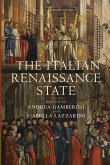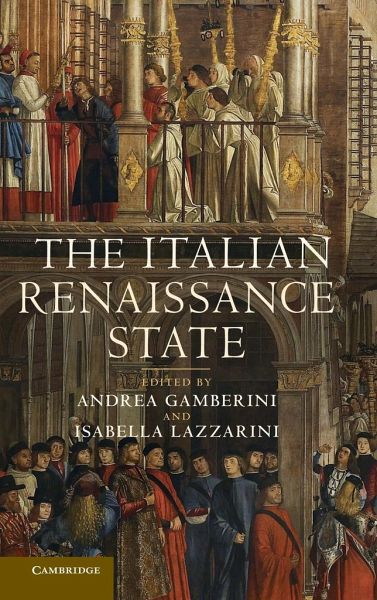
This magisterial study proposes a revised and innovative view of the political history of Renaissance Italy. Drawing on comparative examples from across the peninsula and the kingdoms of Sicily, Sardinia and Corsica, an international team of leading scholars highlights the complexity and variety of the Italian world from the fourteenth to early sixteenth centuries, surveying the mosaic of kingdoms, principalities, signorie and republics against a backdrop of wider political themes common to all types of state in the period. The authors address the contentious problem of the apparent weakness…mehr
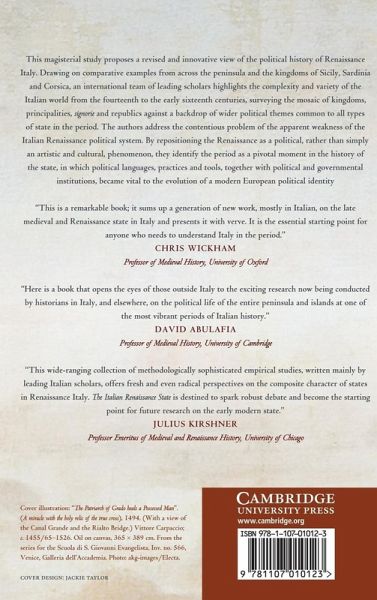
This magisterial study proposes a revised and innovative view of the political history of Renaissance Italy. Drawing on comparative examples from across the peninsula and the kingdoms of Sicily, Sardinia and Corsica, an international team of leading scholars highlights the complexity and variety of the Italian world from the fourteenth to early sixteenth centuries, surveying the mosaic of kingdoms, principalities, signorie and republics against a backdrop of wider political themes common to all types of state in the period. The authors address the contentious problem of the apparent weakness of the Italian Renaissance political system. By repositioning the Renaissance as a political, rather than simply an artistic and cultural phenomenon, they identify the period as a pivotal moment in the history of the state, in which political languages, practices and tools, together with political and governmental institutions, became vital to the evolution of a modern European political identity.
Introduction Andrea Gamberini and Isabella Lazzarini Part I. The Italian States: 1. The Kingdom of Sicily Fabrizio Titone 2. The Kingdom of Naples Francesco Senatore 3. The Kingdom of Sardinia and Corsica Olivetta Schena 4. The papal state Sandro Carocci 5. Tuscan states: Florence and Siena Lorenzo Tanzini 6. Ferrara and Mantua Trevor Dean 7. Venice and the Terraferma Michael Knapton 8. Lombardy under the Visconti and the Sforza Federico Del Tredici 9. The feudal principalities: the west (Monferrato, Saluzzo, Savoy, Savoy-Acaia) Alessandro Barbero 10. The feudal principalities: the east (Trent, Bressanone/Brixen, Aquileia, Tyrol and Gorizia) Marco Bellabarba 11. Genoa, Christine Shaw Part II. Themes and Perspectives: 12. The collapse of city-states and the role of urban centres in the new political geography of Renaissance Italy Francesco Somaini 13. The rural communities Massimo Della Misericordia 14. Lordships, fiefs 'small states' Federica Cengarle 15. Factions and parties: problems and perspectives Marco Gentile 16. State, orders and social distinction E. Igor Mineo 17. Women and the state Serena Ferente 18. Offices and officials Guido Castelnuovo 19. Public written records Gian Maria Varanini 20. The language of politics and the process of statebuilding: approaches and interpretations Andrea Gamberini 21. Renaissance diplomacy Isabella Lazzarini 22. Regional states and economic development Franco Franceschi and Luca Molà 23. The papacy and the Italian states Giorgio Chittolini 24. Justice Andrea Zorzi Bibliography.
Es gelten unsere Allgemeinen Geschäftsbedingungen: www.buecher.de/agb
Impressum
www.buecher.de ist ein Internetauftritt der buecher.de internetstores GmbH
Geschäftsführung: Monica Sawhney | Roland Kölbl | Günter Hilger
Sitz der Gesellschaft: Batheyer Straße 115 - 117, 58099 Hagen
Postanschrift: Bürgermeister-Wegele-Str. 12, 86167 Augsburg
Amtsgericht Hagen HRB 13257
Steuernummer: 321/5800/1497
USt-IdNr: DE450055826