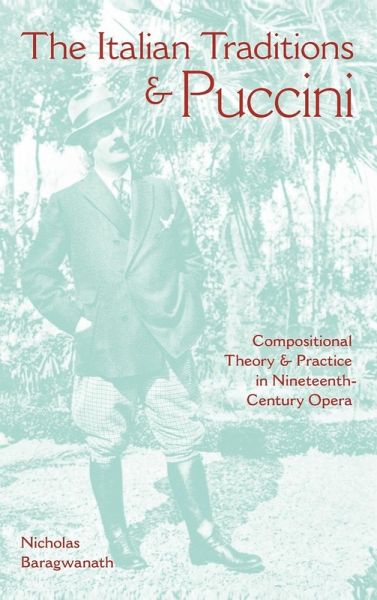
In this groundbreaking survey of the fundamentals, methods, and formulas that were taught at Italian music conservatories during the 19th century, Nicholas Baragwanath explores the compositional significance of tradition in Rossini, Bellini, Donizetti, Verdi, Boito, and, most importantly, Puccini. Taking account of some 400 primary sources, Baragwanath explains the varying theories and practices of the period in light of current theoretical and analytical conceptions of this music. The Italian Traditions and Puccini offers a guide to an informed interpretation and appreciation of Italian opera…mehr
In this groundbreaking survey of the fundamentals, methods, and formulas that were taught at Italian music conservatories during the 19th century, Nicholas Baragwanath explores the compositional significance of tradition in Rossini, Bellini, Donizetti, Verdi, Boito, and, most importantly, Puccini. Taking account of some 400 primary sources, Baragwanath explains the varying theories and practices of the period in light of current theoretical and analytical conceptions of this music. The Italian Traditions and Puccini offers a guide to an informed interpretation and appreciation of Italian opera by underscoring the proximity of archaic traditions to the music of Puccini.
Nicholas Baragwanath is Director of Postgraduate Studies and Associate Professor of Musicology in the Department of Music, University of Nottingham.
Inhaltsangabe
Preface and Acknowledgements A Note on Translation and Terminology 1: Musical Traditions in Nineteenth-Century Italy I. The Italian Schools II. An Introduction to the Primary Sources III. Puccini and the End of the Great Tradition 2. Studies in Lucca and Milan I. Composition as Craft II. The Istituto musicale in Lucca III. Scarpia and the Partimento Cadence IV. The Conservatorio di Milano 3. Lessons in Dramatic Composition I: Rhythm I. Rhythm without Measure, Accent without Beat II. Rules of Versification, Lippmann's Rhythmic-Musical Types, and Two Case-Studies III. Historical Survey of Writings on Ritmo IV. Short Case-Studies from Bellini and Puccini 4. Lessons in Dramatic Composition II: Harmony and Counterpoint I. The Partimento Tradition II. Michele Puccini's Corso pratico di contrappunto (1846) III. The Bolognese Attachment, or "Little Keys for Winding Clocks" IV. Regular Motions and Melodic Composition 5. Lessons in Dramatic Composition III: Affect, Imitation, and Conduct I. Dominant Affects and their Movements II. Physical and Sentimental Imitation III. Form and Conduct IV. Case-Studies from Verdi, Boito, and Puccini 6. Vocalizzi, Solfeggi, and Real (or Ideal) Composition I. Lessons in Singing and Counterpoint II. Lessons in Singing and Solfeggio III. From Solfeggio to Ideal Composition in Puccini (and Bellini) Notes Bibliography Index of Concepts Index of Names and Works
Es gelten unsere Allgemeinen Geschäftsbedingungen: www.buecher.de/agb
Impressum
www.buecher.de ist ein Internetauftritt der buecher.de internetstores GmbH
Geschäftsführung: Monica Sawhney | Roland Kölbl | Günter Hilger
Sitz der Gesellschaft: Batheyer Straße 115 - 117, 58099 Hagen
Postanschrift: Bürgermeister-Wegele-Str. 12, 86167 Augsburg
Amtsgericht Hagen HRB 13257
Steuernummer: 321/5800/1497
USt-IdNr: DE450055826