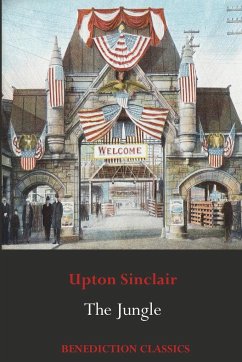
The Jungle is Upton Sinclair's scathing indictment of the meat packing industry in the early 1900s. This novel, which follows the Lithuanian immigrant Jurgis Rudkus and his family in their doomed struggle for survival in the brutal world of the Chicago stock yards, became a bestseller and changed history. The exposure of the appalling labor conditions and the unsanitary practices led to a public outcry, and eventually reforms, including the Meat Packing Act. At the time, fellow writer Jack London called The Jungle "the Uncle Tom's Cabin of wage slavery." Eric Schlosser's more recent assessment…mehr
The Jungle is Upton Sinclair's scathing indictment of the meat packing industry in the early 1900s. This novel, which follows the Lithuanian immigrant Jurgis Rudkus and his family in their doomed struggle for survival in the brutal world of the Chicago stock yards, became a bestseller and changed history. The exposure of the appalling labor conditions and the unsanitary practices led to a public outcry, and eventually reforms, including the Meat Packing Act. At the time, fellow writer Jack London called The Jungle "the Uncle Tom's Cabin of wage slavery." Eric Schlosser's more recent assessment is ''The Jungle . . . captures something essential about the American immigrant experience and the workings of a brutal industrial system. It transcends the specifics of one historical era and sadly remains relevant to our own.'' Sinclair's novel is now read both as literature and as history. Upton Sinclair, journalist, novelist, political activist and gubernatorial candidate, has featured on the cover of Time magazine and is remembered for The Jungle and the wry saying "It is difficult to get a man to understand something, when his salary depends upon his not understanding it."
Upton Sinclair (1878-1968) was a prolific American author and social reformer best known for his muckraking novel "The Jungle" (1906), which exposed the harsh conditions and unsanitary practices in the U.S. meatpacking industry. This groundbreaking work led to significant public outcry and contributed to the passage of the Pure Food and Drug Act and the Meat Inspection Act in 1906. Throughout his career, Sinclair wrote over 90 books, covering a wide range of genres including novels, plays, essays, and non-fiction works. Many of his writings addressed social issues such as labor rights, poverty, political corruption, and the need for reform. He was associated with the Progressive Movement and ran for political office several times, including a notable campaign for Governor of California in 1934 under the platform of the End Poverty in California (EPIC) movement. Sinclair's other notable works include "Oil!" (1927), which inspired the film "There Will Be Blood" (2007), and "The Brass Check" (1919), which critiqued the American press and led to the establishment of the first code of ethics for journalists. Upton Sinclair's commitment to social justice and reform left a lasting impact on American literature and society.
Es gelten unsere Allgemeinen Geschäftsbedingungen: www.buecher.de/agb
Impressum
www.buecher.de ist ein Internetauftritt der buecher.de internetstores GmbH
Geschäftsführung: Monica Sawhney | Roland Kölbl | Günter Hilger
Sitz der Gesellschaft: Batheyer Straße 115 - 117, 58099 Hagen
Postanschrift: Bürgermeister-Wegele-Str. 12, 86167 Augsburg
Amtsgericht Hagen HRB 13257
Steuernummer: 321/5800/1497
USt-IdNr: DE450055826