
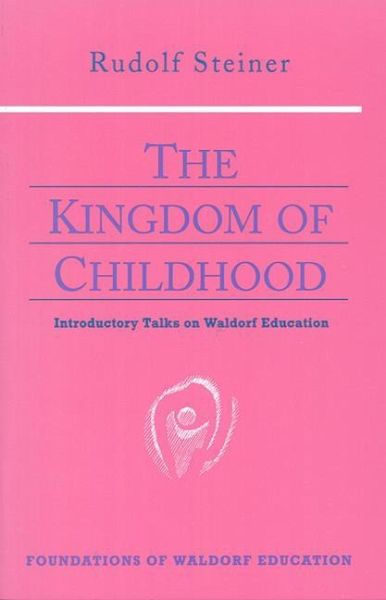
These seven talks, considered one of the best introductions to the Waldorf approach to education, were given by Rudolf Steiner to a small group on his last visit to England in 1924. Steiner shows how essential it is for teachers to work upon themselves -- to transform their natural gifts -- and to use humor to keep their teaching lively and imaginative. Above all, he stresses the grave importance of doing everything in the light of knowledge of the child as a citizen of the spiritual as well as the earthly world. Throughout, he returns to the practical value of Waldorf education. From the Foundations of Waldorf Education series.
7 lectures, Torquay, UK, August 12-20, 1924 (CW 311) These seven intimate, aphoristic talks were presented to a small group on Steiner's final visit to England. Because they were given to "pioneers" dedicated to opening a new Waldorf school, these talks are often considered one of the best introductions to Waldorf education. Steiner shows the necessity for teachers to work on themselves first, in order to transform their own inherent gifts. He explains the need to use humor to keep their teaching lively and imaginative. Above all, he stresses the tremendous importance of doing everything in the knowledge that children are citizens of both the spiritual and the earthly worlds. And, throughout these lectures, he continually returns to the practical value of Waldorf education. These talks are filled with practical illustrations and revolve around certain themes--the need for observation in teachers; the dangers of stressing the intellect too early; children's need for teaching that is concrete and pictorial; the education of children's souls through wonder and reverence; the importance of first presenting the "whole," then the parts, to the children's imagination. Here is one of the best introductions to Waldorf education, straight from the man who started it all. This volume is a translation of Die Kunst des Erziehens aus dem Erfassen der Menschenwesenheit, volume 311 of the Complete Centenary Edition of the works of Rudolf Steiner, published by Rudolf Steiner Verlag, Dornach, Switzerland.
7 lectures, Torquay, UK, August 12-20, 1924 (CW 311) These seven intimate, aphoristic talks were presented to a small group on Steiner's final visit to England. Because they were given to "pioneers" dedicated to opening a new Waldorf school, these talks are often considered one of the best introductions to Waldorf education. Steiner shows the necessity for teachers to work on themselves first, in order to transform their own inherent gifts. He explains the need to use humor to keep their teaching lively and imaginative. Above all, he stresses the tremendous importance of doing everything in the knowledge that children are citizens of both the spiritual and the earthly worlds. And, throughout these lectures, he continually returns to the practical value of Waldorf education. These talks are filled with practical illustrations and revolve around certain themes--the need for observation in teachers; the dangers of stressing the intellect too early; children's need for teaching that is concrete and pictorial; the education of children's souls through wonder and reverence; the importance of first presenting the "whole," then the parts, to the children's imagination. Here is one of the best introductions to Waldorf education, straight from the man who started it all. This volume is a translation of Die Kunst des Erziehens aus dem Erfassen der Menschenwesenheit, volume 311 of the Complete Centenary Edition of the works of Rudolf Steiner, published by Rudolf Steiner Verlag, Dornach, Switzerland.