Gregory K Dow
The Labor-Managed Firm
Gregory K Dow
The Labor-Managed Firm
- Broschiertes Buch
- Merkliste
- Auf die Merkliste
- Bewerten Bewerten
- Teilen
- Produkt teilen
- Produkterinnerung
- Produkterinnerung
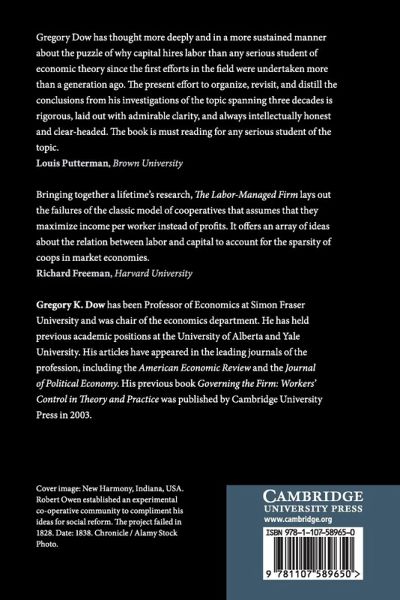
This book uses economic theory to argue that labor-managed firms are rare due to market failures rather than any inherent organizational defects.
Andere Kunden interessierten sich auch für
Alfred D. Chandler / Peter Hagstrom / Örjan Sölvell (eds.)The Dynamic Firm118,99 €
Julian Birkinshaw / Peter Hagström (eds.)The Flexible Firm63,99 €
Birger WernerfeltAdaptation, Specialization, and the Theory of the Firm39,99 €
Inagami TThe New Community Firm48,99 €
Christina WodtkeThe Team That Managed Itself22,99 €
Sundring Pantja DjatiThe Secret to enhance Organisational Innovativeness through Empowering Knowledge-based Interaction: Digital Leadership in Digital Firm30,99 €
Charles Heckscher / Paul Adler (eds.)The Firm as a Collaborative Community78,99 €-
-
-
This book uses economic theory to argue that labor-managed firms are rare due to market failures rather than any inherent organizational defects.
Produktdetails
- Produktdetails
- Verlag: Cambridge University Press
- Seitenzahl: 430
- Erscheinungstermin: 16. Mai 2019
- Englisch
- Abmessung: 224mm x 152mm x 22mm
- Gewicht: 578g
- ISBN-13: 9781107589650
- ISBN-10: 1107589657
- Artikelnr.: 56714285
- Herstellerkennzeichnung
- Libri GmbH
- Europaallee 1
- 36244 Bad Hersfeld
- gpsr@libri.de
- Verlag: Cambridge University Press
- Seitenzahl: 430
- Erscheinungstermin: 16. Mai 2019
- Englisch
- Abmessung: 224mm x 152mm x 22mm
- Gewicht: 578g
- ISBN-13: 9781107589650
- ISBN-10: 1107589657
- Artikelnr.: 56714285
- Herstellerkennzeichnung
- Libri GmbH
- Europaallee 1
- 36244 Bad Hersfeld
- gpsr@libri.de
Gregory K. Dow has been Professor of Economics at Simon Fraser University, British Columbia since 1995 and chaired the economics department during 2001-6. He has held previous academic positions at the University of Alberta and Yale University, Connecticut. His articles have appeared in the leading journals of the profession, including the American Economic Review and the Journal of Political Economy. His previous book Governing the Firm: Workers' Control in Theory and Practice was published by Cambridge in 2003.
Part I. Setting the Stage: 1. The puzzling asymmetry
Part II. Perfection and Symmetry: 2. Profit maximization and control rights
3. The labor-managed firm in the short run
4. The labor-managed firm in the long run
5. The labor-managed firm in general equilibrium
Part III. Imperfection and Asymmetry: 6. Empirical asymmetries (I)
7. Empirical asymmetries (II)
8. The rarity of labor-managed firms
Part IV. Appropriation Problems: 9. Imperfect appropriation
10. Firm formation with adverse selection
11. Partnership markets with adverse selection
Part V. Public Good Problems: 12. Collective choice and investor takeovers
13. Free riding and employee buyouts
Part VI. Opportunism Problems (I): 14. Transaction cost economics
15. Firm-specific investments
Part VII. Opportunism Problems (II): 16. Asset ownership and work incentives
17. Capital stocks and labor flows
18. Honest and dishonest controllers
Part VIII. Synthesis and Agenda: 19. Breaking the symmetry
20. Policy directions.
Part II. Perfection and Symmetry: 2. Profit maximization and control rights
3. The labor-managed firm in the short run
4. The labor-managed firm in the long run
5. The labor-managed firm in general equilibrium
Part III. Imperfection and Asymmetry: 6. Empirical asymmetries (I)
7. Empirical asymmetries (II)
8. The rarity of labor-managed firms
Part IV. Appropriation Problems: 9. Imperfect appropriation
10. Firm formation with adverse selection
11. Partnership markets with adverse selection
Part V. Public Good Problems: 12. Collective choice and investor takeovers
13. Free riding and employee buyouts
Part VI. Opportunism Problems (I): 14. Transaction cost economics
15. Firm-specific investments
Part VII. Opportunism Problems (II): 16. Asset ownership and work incentives
17. Capital stocks and labor flows
18. Honest and dishonest controllers
Part VIII. Synthesis and Agenda: 19. Breaking the symmetry
20. Policy directions.
Part I. Setting the Stage: 1. The puzzling asymmetry
Part II. Perfection and Symmetry: 2. Profit maximization and control rights
3. The labor-managed firm in the short run
4. The labor-managed firm in the long run
5. The labor-managed firm in general equilibrium
Part III. Imperfection and Asymmetry: 6. Empirical asymmetries (I)
7. Empirical asymmetries (II)
8. The rarity of labor-managed firms
Part IV. Appropriation Problems: 9. Imperfect appropriation
10. Firm formation with adverse selection
11. Partnership markets with adverse selection
Part V. Public Good Problems: 12. Collective choice and investor takeovers
13. Free riding and employee buyouts
Part VI. Opportunism Problems (I): 14. Transaction cost economics
15. Firm-specific investments
Part VII. Opportunism Problems (II): 16. Asset ownership and work incentives
17. Capital stocks and labor flows
18. Honest and dishonest controllers
Part VIII. Synthesis and Agenda: 19. Breaking the symmetry
20. Policy directions.
Part II. Perfection and Symmetry: 2. Profit maximization and control rights
3. The labor-managed firm in the short run
4. The labor-managed firm in the long run
5. The labor-managed firm in general equilibrium
Part III. Imperfection and Asymmetry: 6. Empirical asymmetries (I)
7. Empirical asymmetries (II)
8. The rarity of labor-managed firms
Part IV. Appropriation Problems: 9. Imperfect appropriation
10. Firm formation with adverse selection
11. Partnership markets with adverse selection
Part V. Public Good Problems: 12. Collective choice and investor takeovers
13. Free riding and employee buyouts
Part VI. Opportunism Problems (I): 14. Transaction cost economics
15. Firm-specific investments
Part VII. Opportunism Problems (II): 16. Asset ownership and work incentives
17. Capital stocks and labor flows
18. Honest and dishonest controllers
Part VIII. Synthesis and Agenda: 19. Breaking the symmetry
20. Policy directions.