One of the most widely studied texts of ancient philosophy and politics, Plato's Laws is his last and most substantial dialogue, debating crucial questions on the subject of law-giving and education. This two-volume edition of 1921 was prepared by the classicist Edwin Bourdieu England (1847-1936), who describes the dialogue as 'the treasury of pregnant truths which Plato in extreme old age left ... as his last legacy to humanity'. Generally held to have been written after Plato's failed attempt to influence Syracusan politics, it concerns the just city and its constitution, including…mehr
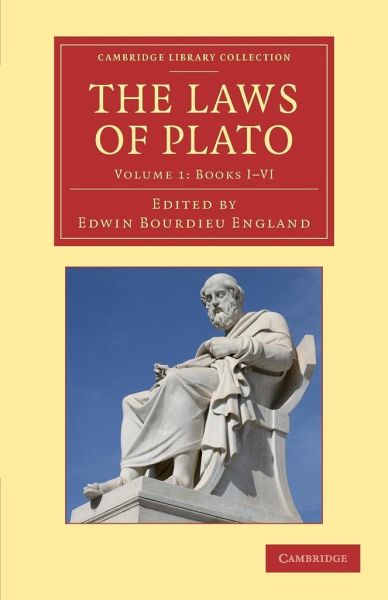
One of the most widely studied texts of ancient philosophy and politics, Plato's Laws is his last and most substantial dialogue, debating crucial questions on the subject of law-giving and education. This two-volume edition of 1921 was prepared by the classicist Edwin Bourdieu England (1847-1936), who describes the dialogue as 'the treasury of pregnant truths which Plato in extreme old age left ... as his last legacy to humanity'. Generally held to have been written after Plato's failed attempt to influence Syracusan politics, it concerns the just city and its constitution, including discussions of divine revelation, the role of intelligence in the creation of laws, and natural law itself. This edition comprises a short introduction, England's helpful analyses, the Greek text of the dialogue, and extensive notes. Volume 1 is devoted to Books 1-6.
Plato (428/427 or 424/423 - 348/347 BC) was an Athenian philosopher during the Classical period in Ancient Greece, founder of the Platonist school of thought, and the Academy, the first institution of higher learning in the Western world. He is widely considered the pivotal figure in the history of Ancient Greek and Western philosophy, along with his teacher, Socrates, and his most famous student, Aristotle.[a] Plato has also often been cited as one of the founders of Western religion and spirituality.[4] The so-called Neoplatonism of philosophers like Plotinus and Porphyry influenced Saint Augustine and thus Christianity. Alfred North Whitehead once noted: "the safest general characterization of the European philosophical tradition is that it consists of a series of footnotes to Plato."[5] Plato was the innovator of the written dialogue and dialectic forms in philosophy. Plato is also considered the founder of Western political philosophy. His most famous contribution is the theory of Forms known by pure reason, in which Plato presents a solution to the problem of universals known as Platonism (also ambiguously called either Platonic realism or Platonic idealism). He is also the namesake of Platonic love and the Platonic solids. His own most decisive philosophical influences are usually thought to have been along with Socrates, the pre-Socratics Pythagoras, Heraclitus and Parmenides, although few of his predecessors' works remain extant and much of what we know about these figures today derives from Plato himself.[b] Unlike the work of nearly all of his contemporaries, Plato's entire body of work is believed to have survived intact for over 2,400 years.[7] Although their popularity has fluctuated over the years, the works of Plato have never been without readers since the time they were written
Inhaltsangabe
Preface Introduction Analyses of Books I-VI Text of Books I-VI Notes.