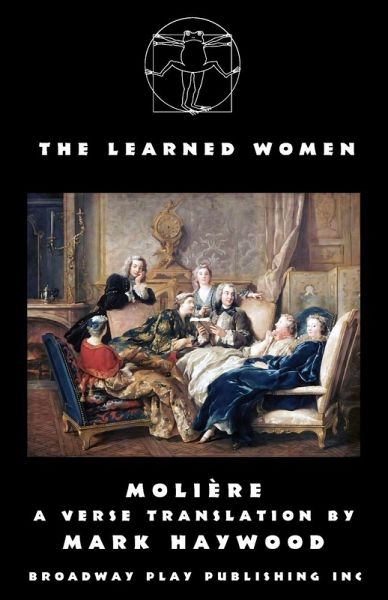
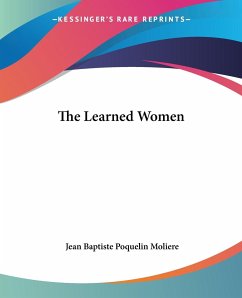
Henriette and Clitandre are in love and want to get married. But Henriette's mother, aunt, and sister have other ideas - they are pseudo-intellectual snobs who think that Henriette should follow their example by rejecting earthly pleasures and devoting her life to highbrow pursuits like philosophy and learning. Not to worry - Henriette's father will stick up for the amorous couple. Well, he would, if he weren't so dominated by his wife. Enter Trissotin, a self-acclaimed poet and wit who is actually neither, but who has managed to convince the "learned women" that he is a genius. What's he up…mehr
Henriette and Clitandre are in love and want to get married. But Henriette's mother, aunt, and sister have other ideas - they are pseudo-intellectual snobs who think that Henriette should follow their example by rejecting earthly pleasures and devoting her life to highbrow pursuits like philosophy and learning. Not to worry - Henriette's father will stick up for the amorous couple. Well, he would, if he weren't so dominated by his wife. Enter Trissotin, a self-acclaimed poet and wit who is actually neither, but who has managed to convince the "learned women" that he is a genius. What's he up to? And will Henriette and Clitandre ever manage to find happiness together?
Jean-Baptiste Poquelin, known by his stage name Molière (1622-1673), stands as one of the greatest masters of comedy in Western literature. Born to a prosperous upholstery family, Molière found his passion in the theatre. In 1643, he became the leader of the theatrical company called Illustre-Théâtre which eventually went bankrupt, leading him to spend several years touring the provinces to evade debtors. His experiences with provincial audiences honed his skills as an actor, director, and playwright. It was in 1658 that Molière's troupe returned to Paris and began to gain favor with King Louis XIV, enjoying royal patronage. His oeuvre consists of comedies that satirize the pretensions and hypocrisies of his society. 'The Learned Women' (Les Femmes savantes, 1672) is one such play that critiques the pedantic and pretentious nature of the intellectual pretensions that were apparent in the salons of his time. Molière's literary style blends farce and satire, employing comedic devices such as irony, and wit to lampoon his subjects in a manner that was both entertaining and thought-provoking. His works have been extensively adapted and translated, and his profound influence on the French language has led to its occasional designation as 'the language of Molière'. His contributions to theatre are celebrated in the annual Molière Awards, France's national theatre awards.
Es gelten unsere Allgemeinen Geschäftsbedingungen: www.buecher.de/agb
Impressum
www.buecher.de ist ein Internetauftritt der buecher.de internetstores GmbH
Geschäftsführung: Monica Sawhney | Roland Kölbl | Günter Hilger
Sitz der Gesellschaft: Batheyer Straße 115 - 117, 58099 Hagen
Postanschrift: Bürgermeister-Wegele-Str. 12, 86167 Augsburg
Amtsgericht Hagen HRB 13257
Steuernummer: 321/5800/1497
USt-IdNr: DE450055826