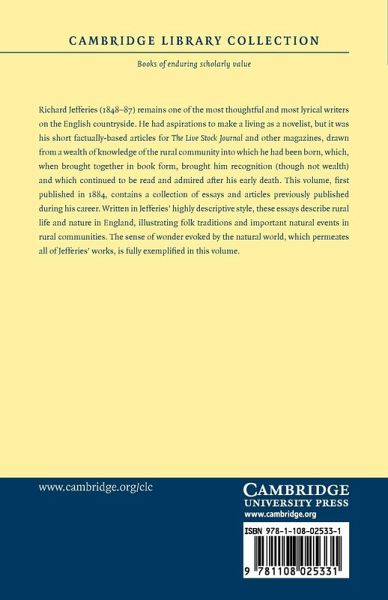
Richard Jefferies (1848-1887) remains one of the most thoughtful and most lyrical writers on the English countryside. He had aspirations to make a living as a novelist, but it was his short, factually based articles for The Live Stock Journal and other magazines, drawn from a wealth of knowledge of the rural community into which he had been born, which, when brought together in book form, brought him recognition (though not wealth) and which continued to be read and admired after his early death. This volume, first published in 1884, contains a collection of essays and articles previously…mehr
Richard Jefferies (1848-1887) remains one of the most thoughtful and most lyrical writers on the English countryside. He had aspirations to make a living as a novelist, but it was his short, factually based articles for The Live Stock Journal and other magazines, drawn from a wealth of knowledge of the rural community into which he had been born, which, when brought together in book form, brought him recognition (though not wealth) and which continued to be read and admired after his early death. This volume, first published in 1884, contains a collection of essays and articles previously published during his career. Written in Jefferies' highly descriptive style, these essays describe rural life and nature in England, illustrating folk traditions and important natural events in rural communities. The mysticism and wonder of the natural world which exemplifies Jefferies' works is fully illustrated in these essays.
John Richard Jefferies was an English nature writer who lived from November 6, 1848, to August 14, 1887. He was famous for writing stories, essays, and books about natural history that showed how people lived in the English countryside. His childhood on a small farm in Wiltshire shaped him a lot and is the setting for all of his big works of fiction. Jefferies wrote a lot of different types of books and about a lot of different subjects. Some of his most famous works are the classic children's book Bevis (1882) and the science fiction novel After London (1885). For most of his adult life, he had tuberculosis. His struggles with the disease and with being poor also show up in his work. Jefferies valued and worked on having strong feelings about the things going on around him. In The Story of My Heart (1883), he goes into more depth about this work. People at the time thought of him as a nature mystic because of this work, which was an introspective look at his thoughts and feelings about the world. But what most people admire about him is how well he writes about nature and people in it, both in his fiction and in collections of essays like The Amateur Poacher (1879) and Round About a Great Estate (1880).
Inhaltsangabe
1. The field-play 2. Bits of oak bark 3. The pageant of summer 4. Meadow thoughts 5. Clematis lane 6. Nature near Brighton 7. Sea, sky and down 8. January in the Sussex woods 9. By the Exe 10. The water-colley 11. Notes on landscape painting 12. Village miners 13. Mind under water 14. Sport and science 15. Nature and the gamekeeper 16. The sacrifice to trout 17. The hovering of the kestrel 18. Birds climbing the air 19. Country literature 20. Sunlight in a London square 21. Venice in the east end 22. The pigeons at the British Museum 23. The plainest city in Europe.
Es gelten unsere Allgemeinen Geschäftsbedingungen: www.buecher.de/agb
Impressum
www.buecher.de ist ein Internetauftritt der buecher.de internetstores GmbH
Geschäftsführung: Monica Sawhney | Roland Kölbl | Günter Hilger
Sitz der Gesellschaft: Batheyer Straße 115 - 117, 58099 Hagen
Postanschrift: Bürgermeister-Wegele-Str. 12, 86167 Augsburg
Amtsgericht Hagen HRB 13257
Steuernummer: 321/5800/1497
USt-IdNr: DE450055826