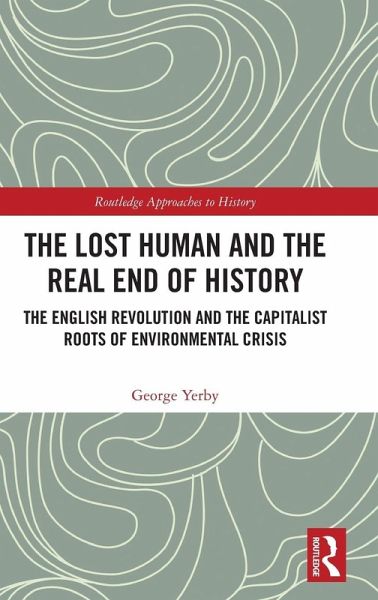
This book analyses the transformation in 16th- and 17th-century English economic life that overturned the traditional restraints of the medieval economy for the commercial ethos that governs the modern world, and the resulting imbalance which opened the way to the environmental breakdown of today.
This book analyses the transformation in 16th- and 17th-century English economic life that overturned the traditional restraints of the medieval economy for the commercial ethos that governs the modern world, and the resulting imbalance which opened the way to the environmental breakdown of today.
George Yerby is a historical researcher currently associated with the Raphael Samuel History Centre. His publications include The English Revolution and The Roots of Environmental Change (2016) and The Economic Causes of the English Civil War: Freedom of Trade and the English Revolution (2020).
Inhaltsangabe
Introduction: The Cycle of Destruction: As the Present Denies the Past, So the Past Deconstructs the Future 1. The Balance of Natural Forces in the Past: The Equitable Relationships Between People, and Between Human Economics and Nature in the Universalist Context of the Medieval Period 2. The Breach in the Universalist Continuum: The Rise of the Yeoman Farmer and the Force of the Profit Motive, with the Decline of the Communal Smallholders 3. The Structures That Split Up the Common Lands and Broke the Communal Spirit: The Shape of Consolidated Individualist Farming 4. The Timing of Enclosure, the Force of Consolidation Without Enclosure, and the General Polarisation of Landholding 5. Those Who Had to Move On, and Those Who Stayed, with Nothing: The Depth of Deprivation; and the Subjectivist Heart of Capitalist Accumulation 6. "The End of All Good Nurture", and the Breach of Relationship with the Land 7. The Environment Undermined: Early Industrialisation and the Invasion of the Commons 8. From Saints to Scientists: The Subjugation of Nature, the Agriculturalist Drive Behind the Scientific Revolution, and the Birth of Subjectivist Theory 9. The Rise of Freedom of Trade and Absolute Property: The Emergence of a Capitalist Ethos 10. The Emergent Nation-State, and the Enshrinement of the Subjectivist Mindset 11. Conclusion: The Lost Human, Who or Where?
Introduction: The Cycle of Destruction: As the Present Denies the Past, So the Past Deconstructs the Future 1. The Balance of Natural Forces in the Past: The Equitable Relationships Between People, and Between Human Economics and Nature in the Universalist Context of the Medieval Period 2. The Breach in the Universalist Continuum: The Rise of the Yeoman Farmer and the Force of the Profit Motive, with the Decline of the Communal Smallholders 3. The Structures That Split Up the Common Lands and Broke the Communal Spirit: The Shape of Consolidated Individualist Farming 4. The Timing of Enclosure, the Force of Consolidation Without Enclosure, and the General Polarisation of Landholding 5. Those Who Had to Move On, and Those Who Stayed, with Nothing: The Depth of Deprivation; and the Subjectivist Heart of Capitalist Accumulation 6. "The End of All Good Nurture", and the Breach of Relationship with the Land 7. The Environment Undermined: Early Industrialisation and the Invasion of the Commons 8. From Saints to Scientists: The Subjugation of Nature, the Agriculturalist Drive Behind the Scientific Revolution, and the Birth of Subjectivist Theory 9. The Rise of Freedom of Trade and Absolute Property: The Emergence of a Capitalist Ethos 10. The Emergent Nation-State, and the Enshrinement of the Subjectivist Mindset 11. Conclusion: The Lost Human, Who or Where?
Es gelten unsere Allgemeinen Geschäftsbedingungen: www.buecher.de/agb
Impressum
www.buecher.de ist ein Internetauftritt der buecher.de internetstores GmbH
Geschäftsführung: Monica Sawhney | Roland Kölbl | Günter Hilger
Sitz der Gesellschaft: Batheyer Straße 115 - 117, 58099 Hagen
Postanschrift: Bürgermeister-Wegele-Str. 12, 86167 Augsburg
Amtsgericht Hagen HRB 13257
Steuernummer: 321/5800/1497
USt-IdNr: DE450055826