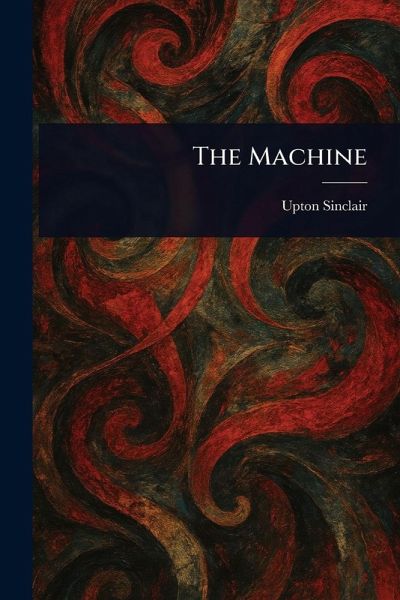
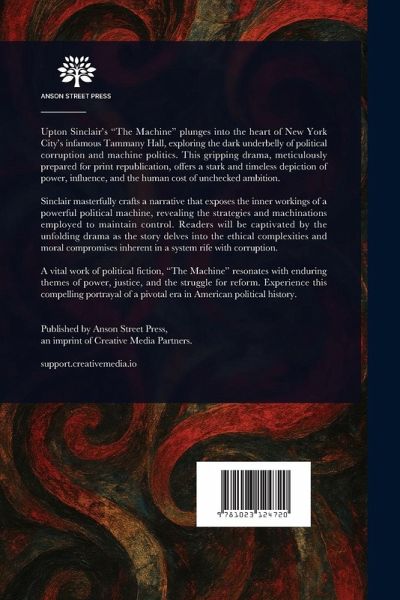
Upton Sinclair's "The Machine" plunges into the heart of New York City's infamous Tammany Hall, exploring the dark underbelly of political corruption and machine politics. This gripping drama, meticulously prepared for print republication, offers a stark and timeless depiction of power, influence, and the human cost of unchecked ambition. Sinclair masterfully crafts a narrative that exposes the inner workings of a powerful political machine, revealing the strategies and machinations employed to maintain control. Readers will be captivated by the unfolding drama as the story delves into the…mehr
Upton Sinclair's "The Machine" plunges into the heart of New York City's infamous Tammany Hall, exploring the dark underbelly of political corruption and machine politics. This gripping drama, meticulously prepared for print republication, offers a stark and timeless depiction of power, influence, and the human cost of unchecked ambition. Sinclair masterfully crafts a narrative that exposes the inner workings of a powerful political machine, revealing the strategies and machinations employed to maintain control. Readers will be captivated by the unfolding drama as the story delves into the ethical complexities and moral compromises inherent in a system rife with corruption. A vital work of political fiction, "The Machine" resonates with enduring themes of power, justice, and the struggle for reform. Experience this compelling portrayal of a pivotal era in American political history. This work has been selected by scholars as being culturally important, and is part of the knowledge base of civilization as we know it. This work is in the public domain in the United States of America, and possibly other nations. Within the United States, you may freely copy and distribute this work, as no entity (individual or corporate) has a copyright on the body of the work. Scholars believe, and we concur, that this work is important enough to be preserved, reproduced, and made generally available to the public. We appreciate your support of the preservation process, and thank you for being an important part of keeping this knowledge alive and relevant.
Upton Beall Sinclair Jr. was an American author, sleuth, political organizer, and writer who was born September 20, 1878, and died November 25, 1968. He was the Democratic Party's candidate for governor of California in 1934. He put together almost 100 books and other types of writing. In the first half of the 20th century, Sinclair's writing was well-known and liked. In 1943, he won the Pulitzer Prize for Fiction. Sinclair became famous in 1906 for his classic muck-raking novel, The Jungle. This book showed how dirty and unsafe the U.S. meatpacking industry was, which caused a public uproar that helped pass the Pure Food and Drug Act and the Meat Inspection Act a few months later. He wrote a dirty book about American journalism called "The Brass Check" in 1919. It brought attention to the problem of "yellow journalism" and the limits of the "free press" in the US. Henry Ford's rise to power, including his "wage reform" and the Sociological Department at his company, is told in The Flivver King. It also talks about Ford's fall into antisemitism as editor of The Dearborn Independent. In the coal fields of Colorado, King Coal talks to John D. Rockefeller Jr. about his part in the Ludlow Massacre the year before.
Es gelten unsere Allgemeinen Geschäftsbedingungen: www.buecher.de/agb
Impressum
www.buecher.de ist ein Internetauftritt der buecher.de internetstores GmbH
Geschäftsführung: Monica Sawhney | Roland Kölbl | Günter Hilger
Sitz der Gesellschaft: Batheyer Straße 115 - 117, 58099 Hagen
Postanschrift: Bürgermeister-Wegele-Str. 12, 86167 Augsburg
Amtsgericht Hagen HRB 13257
Steuernummer: 321/5800/1497
USt-IdNr: DE450055826