
Andere Kunden interessierten sich auch für
") Seleukos Nikator (Routledge Revivals)214,99 €
Seleukos Nikator (Routledge Revivals)214,99 € Sparta and Lakonia168,99 €
") Roman Spain (Routledge Revivals)214,99 €
Roman Spain (Routledge Revivals)214,99 € Oxford Handbook of the Valley of the Kings188,99 €
 Animal Sacrifice in the Ancient Greek World109,99 €
 The Court and Court Society in Ancient Monarchies123,99 €
 The History Written on the Classical Greek Body109,99 €



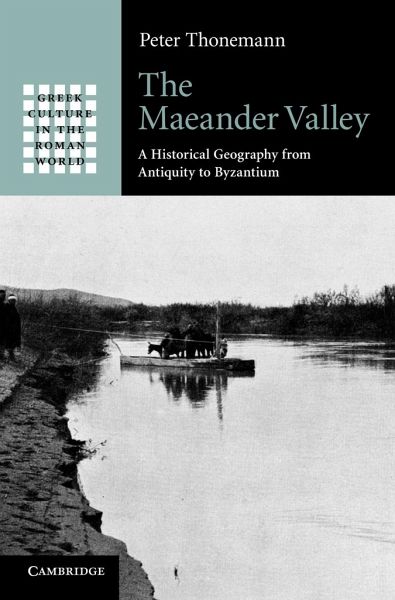
Covering a wide sweep, from Graeco-Roman antiquity to the end of the Middle Ages, Peter Thonemann shows how the landscape of the Maeander valley affected the economic relationships, social structures, cultural identities and ritual behaviour of its inhabitants.
This book is a study of the long-term historical geography of Asia Minor, from the fourth century BC to the thirteenth century AD. Using an astonishing breadth of sources, ranging from Byzantine monastic archives to Latin poetic texts, ancient land records to hagiographic biographies, Peter Thonemann reveals the complex and fascinating interplay between the natural environment and human activities in the Maeander valley. Both a large-scale regional history and a profound meditation on the role played by geography in human history, this book is an essential contribution to the history of the Eastern Mediterranean in Graeco-Roman antiquity and the Byzantine Middle Ages.
This book is a study of the long-term historical geography of Asia Minor, from the fourth century BC to the thirteenth century AD. Using an astonishing breadth of sources, ranging from Byzantine monastic archives to Latin poetic texts, ancient land records to hagiographic biographies, Peter Thonemann reveals the complex and fascinating interplay between the natural environment and human activities in the Maeander valley. Both a large-scale regional history and a profound meditation on the role played by geography in human history, this book is an essential contribution to the history of the Eastern Mediterranean in Graeco-Roman antiquity and the Byzantine Middle Ages.