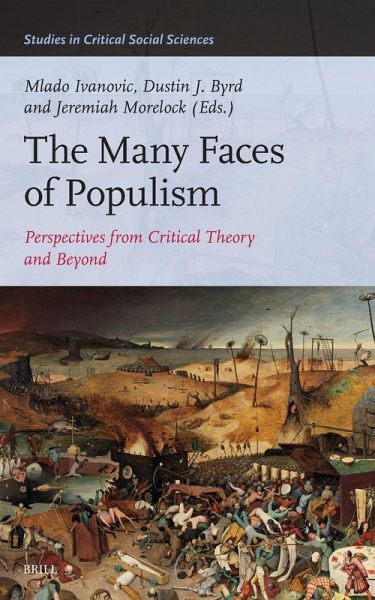
Today, more than ever, it is easy to understand how populism has become such a contested word in contemporary politics. Despite its relatively short history, the term follows a rather volatile trajectory in terms of its historical development and presence as a political practice. When we look at its political and moral impact, one can see that despite its often strict national commitments and narratives, populism is rather a global political phenomenon. As embodiment of anti-establishment narratives, polarizing attitudes, and emancipatory appeal, we can follow its occurrence from Central and…mehr
Today, more than ever, it is easy to understand how populism has become such a contested word in contemporary politics. Despite its relatively short history, the term follows a rather volatile trajectory in terms of its historical development and presence as a political practice. When we look at its political and moral impact, one can see that despite its often strict national commitments and narratives, populism is rather a global political phenomenon. As embodiment of anti-establishment narratives, polarizing attitudes, and emancipatory appeal, we can follow its occurrence from Central and Eastern Europe, Latin America, the USA and UK, the Middle East, all the way to China and India. This edited volume helps fill a gap in the existing literature on Critical Theory (broadly construed) and populism, focusing on the multiple dimensions of historical and contemporary contexts for today's rising populist movements and their often - but not necessarily - hostile relations towards cosmopolitanism, globalization, environmentalism, and general notions of inclusion and justice. Contributors are: Emília Barna, Ronald Beiner, Dustin J. Byrd, Samir Gandesha, Carlos Antonio Giovinazzo Júnior, Mlado Ivanovic, Yonathan Listik, Grigoris Markou, Jeremiah Morelock, Felipe Ziotti Narita, Ágnes Patakfalvi- Czirják, Maria Cristina Dancham Simões and Hassan Zaheer.
Mlado Ivanovic, Ph.D. (2016), Michigan State University, is an Associate Professor in the Department of Philosophy at Northern Michigan University. His research interests are situated within the intellectual tradition of the Frankfurt School and Poststructuralism, primarily the works of Theodor W. Adorno, Walter Benjamin, and Michel Foucault. His academic focus is currently on moral, political, and environmental challenges tied with the forceful displacement and migration of people. He is one of the directors of the Michigan-based NGO, Refugee Outreach Collective. Dustin J. Byrd, Ph.D. (2017), Michigan State University, is Professor of Philosophy and Religion at The University of Olivet. He is the Founder and Co-Director of the Institute for Critical Social Theory, and the Editor-in-Chief of Ekpyrosis Press. He has published numerous monographs, edited volumes, and articles on Islam, Critical Theory, psychoanalysis, and political philosophy. His most recent book is Syed Hussein Alatas and Critical Social Theory: Decolonizing the Captive Mind (Brill, 2022). Jeremiah Morelock is an instructor of Sociology at Woods College of Advancing Studies, Boston College, and a psychotherapist in private practice. His most recent co-edited volume is Feminism and the Early Frankfurt School (Brill, 2024), and he authored Pandemics, Authoritarian Populism, and Science Fiction: Medicine, Military, and Morality in American Film (Routledge, 2021), and The Society of the Selfie: Social Media and the Crisis of Liberal Democracy (UWP, 2021).
Es gelten unsere Allgemeinen Geschäftsbedingungen: www.buecher.de/agb
Impressum
www.buecher.de ist ein Internetauftritt der buecher.de internetstores GmbH
Geschäftsführung: Monica Sawhney | Roland Kölbl | Günter Hilger
Sitz der Gesellschaft: Batheyer Straße 115 - 117, 58099 Hagen
Postanschrift: Bürgermeister-Wegele-Str. 12, 86167 Augsburg
Amtsgericht Hagen HRB 13257
Steuernummer: 321/5800/1497
USt-IdNr: DE450055826