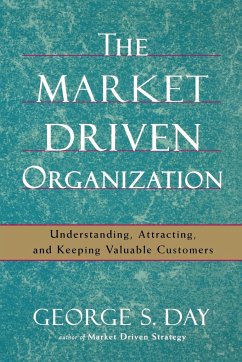
For forty years managers have been exhorted to "stay close to the customer and ahead of the competition." And with good reason Research now shows that market driven organizations outperform their rivals. Given the obvious benefits, why do so many companies fail to become market driven? Because their internal processes, structures, incentives, and controls get in the way, says George Day, one of the world's leading authorities on mar keting Strategy. Building on his pathbreaking book Market Driven Strategy and a decade of experience in coaching firms to deliver superior customer value, Day…mehr
For forty years managers have been exhorted to "stay close to the customer and ahead of the competition." And with good reason Research now shows that market driven organizations outperform their rivals. Given the obvious benefits, why do so many companies fail to become market driven? Because their internal processes, structures, incentives, and controls get in the way, says George Day, one of the world's leading authorities on mar keting Strategy. Building on his pathbreaking book Market Driven Strategy and a decade of experience in coaching firms to deliver superior customer value, Day presents for the first time a battle tested hame work for creating the market-driven organization. In eminently readable prose, Day argues that in successful market driven organizations, three key elements -- capabilities, culture, and configuration -- are aligned to the market. Day explores the distinctive market sensing and market relating capabilities that are at the heart of the market-driven companies. He draws on examples of such market-driven firms as Intuit, Wal-Mart, Virgin Airlines, Disney, and Gillette to illustrate how intimate knowledge of their customers and markets gives these firms a powerful advantage over rivals. By contrast, Day shows how failure to align the organization to the market can result in such mishaps as IBM's loss of leadership of the computer market or Motorola's stumble in shifting from analog to digital cellular phone systems. Using case studies of Owens Corning, Sears, and the Eurotunnel, Day provides a concise roadmap to managers who want to strengthen the orientation of their organizations to the market. He concludes with a detailed diagnostic questionnaire to help managers assess their own progress Here at last are all the insights and tools necessary to construct a company with superior skills for understanding, attracting, and keeping valuable customers.
George S. Day is the Geoffrey T. Boisi Emeritus Professor and Emeritus Faculty in Residence at the Mack Center for Technological Innovation at the Wharton School, University of Pennsylvania. He was previously the Executive Director of the Marketing Science Institute and is a past chairman of the American Marketing Association (AMA). Day has authored 20 books in the areas of marketing, innovation and strategic management and has published over 135 articles. He has won one best book award and 10 best article awards, and two of these articles were among the top 25 most influential articles in marketing science in the past 25 years. He was honored with the Charles Coolidge Parlin Award in 1994, the Paul D. Converse Award in 1996, the Sheth Foundation award in 2003, the Mahajan Award for career contributions to strategy in 2001, and the AMA/Irwin/McGraw-Hill Distinguished Marketing Educator Award in 2003. In 2011, he was selected to be one of 11 Legends in Marketing.
Inhaltsangabe
Contents Introduction: Move to the Market Part I Understanding Market Orientation 1. What It Means to Be Market Driven Understanding the Orientation to the Market Advantages of a Market Orientation Is Being Market Driven for Everyone? Staying Ahead in Turbulent Markets Market Driven Winners 2. Misconceptions About Market Orientation Why Don't More Firms Become Market Driven? Superior to the Market Avoiding the Pitfalls 3. Market Driven Cultures Market Driven Cultures Understanding the Culture Summary: The Defining Role of Culture 4. Configuring Around Capabilities Culture, Capabilities and Processes Identifying Capabilities Managing Capabilities Integrating Culture and Capabilities: How Virgin Atlantic Flies on All Engines Toward a New Concept of the Organization Part II Building the Capabilities 5. Market Sensing Sensing the Market Sense Making Improving Market Sensing The Collective Memory 6. The Shared Knowledge Base Synergistic Information Distribution Converting Information Into Strategic Knowledge Retaining Knowledge 7. Market Relating Relating for Advantage Building Relationships with the Market The Spectrum of Relationships Summary: Rethinking Market Relationships 8. Competing for Customer Relationships Customer Responsive Strategies Exploiting Interactivity Summary 9. Collaborative Partnering Partnering with Customers Channel Bonding Summary: The Advantages of Collaborative Partnering Part III Aligning the Organization to the Market 10. Reshaping the Organization Trade-offs and the Search for Optimal Design The Emergence of Hybrid Organizations What Role for Marketing? Achieving Closer Alignment to the Market 11. Setting the Direction Market Driven Strategic Thinking The Capability for Thinking Strategically 12. Guiding the Change Three Stories of Transformation Designing the Change Process The Six Conditions Conclusion: Answering the Call to the Market Appendix: Is Your Organization Market Driven? Acknowledgments Notes Index
Contents Introduction: Move to the Market Part I Understanding Market Orientation 1. What It Means to Be Market Driven Understanding the Orientation to the Market Advantages of a Market Orientation Is Being Market Driven for Everyone? Staying Ahead in Turbulent Markets Market Driven Winners 2. Misconceptions About Market Orientation Why Don't More Firms Become Market Driven? Superior to the Market Avoiding the Pitfalls 3. Market Driven Cultures Market Driven Cultures Understanding the Culture Summary: The Defining Role of Culture 4. Configuring Around Capabilities Culture, Capabilities and Processes Identifying Capabilities Managing Capabilities Integrating Culture and Capabilities: How Virgin Atlantic Flies on All Engines Toward a New Concept of the Organization Part II Building the Capabilities 5. Market Sensing Sensing the Market Sense Making Improving Market Sensing The Collective Memory 6. The Shared Knowledge Base Synergistic Information Distribution Converting Information Into Strategic Knowledge Retaining Knowledge 7. Market Relating Relating for Advantage Building Relationships with the Market The Spectrum of Relationships Summary: Rethinking Market Relationships 8. Competing for Customer Relationships Customer Responsive Strategies Exploiting Interactivity Summary 9. Collaborative Partnering Partnering with Customers Channel Bonding Summary: The Advantages of Collaborative Partnering Part III Aligning the Organization to the Market 10. Reshaping the Organization Trade-offs and the Search for Optimal Design The Emergence of Hybrid Organizations What Role for Marketing? Achieving Closer Alignment to the Market 11. Setting the Direction Market Driven Strategic Thinking The Capability for Thinking Strategically 12. Guiding the Change Three Stories of Transformation Designing the Change Process The Six Conditions Conclusion: Answering the Call to the Market Appendix: Is Your Organization Market Driven? Acknowledgments Notes Index
Es gelten unsere Allgemeinen Geschäftsbedingungen: www.buecher.de/agb
Impressum
www.buecher.de ist ein Internetauftritt der buecher.de internetstores GmbH
Geschäftsführung: Monica Sawhney | Roland Kölbl | Günter Hilger
Sitz der Gesellschaft: Batheyer Straße 115 - 117, 58099 Hagen
Postanschrift: Bürgermeister-Wegele-Str. 12, 86167 Augsburg
Amtsgericht Hagen HRB 13257
Steuernummer: 321/5800/1497
USt-IdNr: DE450055826