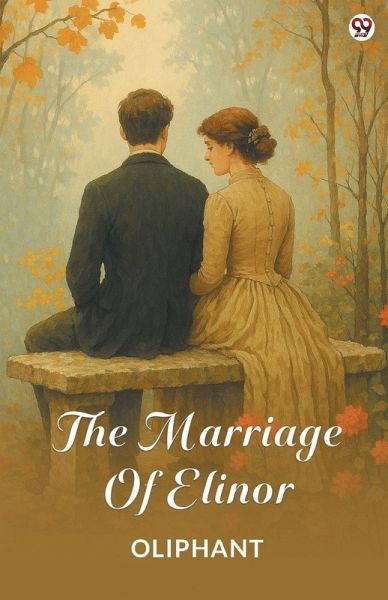
The marriage of Elinor examines the tension between personal desires and societal expectations as a young woman navigates love, duty, and the weight of family influence. Her deep affection for a man is met with skepticism from those closest to her, forcing her to confront conflicting emotions and external pressures. A trusted confidant struggles with his own feelings as he watches her make choices that may lead to heartache. The novel delves into the complexities of romantic relationships, where devotion clashes with the rigid structures of society. Gossip and judgment shape perceptions,…mehr
The marriage of Elinor examines the tension between personal desires and societal expectations as a young woman navigates love, duty, and the weight of family influence. Her deep affection for a man is met with skepticism from those closest to her, forcing her to confront conflicting emotions and external pressures. A trusted confidant struggles with his own feelings as he watches her make choices that may lead to heartache. The novel delves into the complexities of romantic relationships, where devotion clashes with the rigid structures of society. Gossip and judgment shape perceptions, creating obstacles that test loyalty and self-assurance. The consequences of defying convention unfold as emotions intertwine with duty, raising questions about personal fulfillment and the sacrifices required for happiness. The narrative explores how love can be both a source of strength and vulnerability, challenging characters to reconcile their aspirations with the expectations placed upon them. The marriage of Elinor presents an intricate portrayal of relationships, societal norms, and the inner conflicts that arise when love and obligation collide.
Margaret Oliphant was a Scottish author and historical writer who usually wrote under the name Mrs. Oliphant. She was born Margaret Oliphant Wilson on April 4, 1828, and died on June 20, 1897. She writes "domestic realism, the historical novel, and tales of the supernatural" as her short stories. Margaret Oliphant was born in Wallyford, near Musselburgh, East Lothian. She was the only daughter and youngest child still living of Margaret Oliphant (c. 1789 17 September 1854) and Francis W. Wilson, a clerk. We lived in Lasswade, Glasgow, and Liverpool when she was a child. In Wallyford, a street called Oliphant Gardens is named after her. As a girl, she was always trying new things with writing. Passages in the Life of Mrs. Margaret Maitland, her first book, came out in 1849. This was about the mostly successful Scottish Free Church movement, which was something her folks agreed with. Next came Caleb Field in 1851, the same year she met publisher William Blackwood in Edinburgh and was asked to write for Blackwood's Magazine. She did so for the rest of her life and wrote over 100 articles, including one that criticized Arthur Dimmesdale in Nathaniel Hawthorne's "The Scarlet Letter".
Es gelten unsere Allgemeinen Geschäftsbedingungen: www.buecher.de/agb
Impressum
www.buecher.de ist ein Internetauftritt der buecher.de internetstores GmbH
Geschäftsführung: Monica Sawhney | Roland Kölbl | Günter Hilger
Sitz der Gesellschaft: Batheyer Straße 115 - 117, 58099 Hagen
Postanschrift: Bürgermeister-Wegele-Str. 12, 86167 Augsburg
Amtsgericht Hagen HRB 13257
Steuernummer: 321/5800/1497
USt-IdNr: DE450055826