

Andere Kunden interessierten sich auch für
 Robur the Conqueror17,00 €
 Piper in the Woods9,00 €
 Journey to the Center of the Earth22,95 €
 The Little White Bird14,00 €
 The Defiant Agents18,95 €
 Stand by for Mars!18,95 €
 The Last Man24,90 €







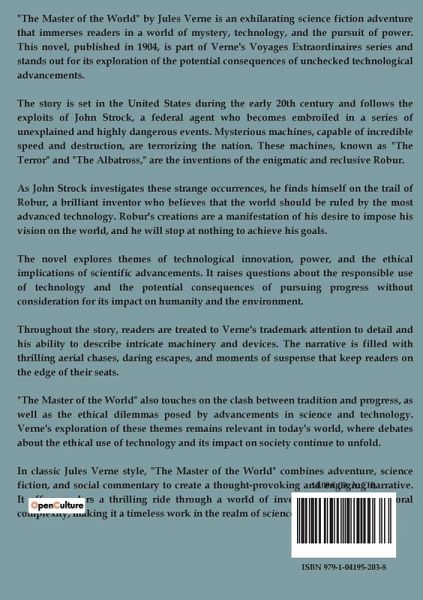
"The Master of the World" is a science fiction novel by Jules Verne, published in 1904. It serves as a sequel to "Robur the Conqueror" and explores themes of technological advancement and human evolution. The story is set in the United States, where mysterious occurrences in the mountains of North Carolina draw the attention of the protagonist, John Strock, a government agent. Strock is tasked with investigating these strange events, which are linked to a powerful and enigmatic machine known as "The Terror." This machine, capable of traversing land, sea, and air, is the creation of the elusive genius Robur, who seeks to assert his dominance over the world through his technological prowess. As Strock delves deeper into the mystery, he encounters various challenges and obstacles, including a secretive Automobile Club and the formidable natural landscape of the Great Eyrie. The narrative unfolds through a series of letters and reports, providing a detailed account of Strock's pursuit of Robur and his attempts to thwart the inventor's plans. The novel culminates in a dramatic confrontation at Niagara Falls, where the limits of human ingenuity and the consequences of unchecked change are starkly revealed. Verne's work is celebrated for its prescient depiction of advanced technology and its exploration of the ethical implications of scientific progress. "The Master of the World" reflects Verne's fascination with the potential of human progress, as well as his cautionary perspective on the responsibilities that accompany such power.