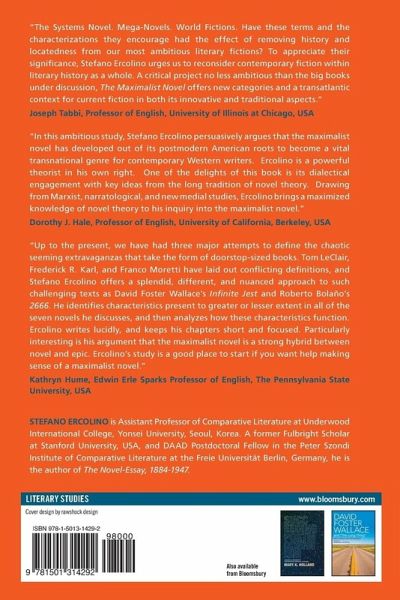
The Maximalist Novel sets out to define a new genre of contemporary fiction that developed in the United States from the early 1970s, and then gained popularity in Europe in the early twenty-first century. The maximalist novel has a very strong symbolic and morphological identity. Ercolino sets out ten particular elements which define and structure it as a complex literary form: length, an encyclopedic mode, dissonant chorality, diegetic exuberance, completeness, narrratorial omniscience, paranoid imagination, inter-semiocity, ethical commitment, and hybrid realism. These ten characteristics…mehr
The Maximalist Novel sets out to define a new genre of contemporary fiction that developed in the United States from the early 1970s, and then gained popularity in Europe in the early twenty-first century. The maximalist novel has a very strong symbolic and morphological identity. Ercolino sets out ten particular elements which define and structure it as a complex literary form: length, an encyclopedic mode, dissonant chorality, diegetic exuberance, completeness, narrratorial omniscience, paranoid imagination, inter-semiocity, ethical commitment, and hybrid realism. These ten characteristics are common to all of the seven works that centre his discussion: Gravity's Rainbow by Thomas Pynchon, Infinite Jest by David Foster Wallace, Underworld by Don DeLillo, White Teeth by Zadie Smith, The Corrections by Jonathan Franzen, 2666 by Roberto Bolaño, and 2005 dopo Cristo by the Babette Factory. Though the ten features are not all present in the same way or form in every single text, they are all decisive in defining the genre of the maximalist novel, insofar as they are systematically co-present. Taken singularly, they can be easily found both in modernist and postmodern novels, which are not maximalist. Nevertheless, it is precisely their co-presence, as well as their reciprocal articulation, which make them fundamental in demarcating the maximalist novel as a genre.
Stefano Ercolino is Assistant Professor of Comparative Literature at Ca' Foscari University of Venice, Italy. He taught at Yonsei University's Underwood International College, Korea, and has been a Visiting Professor at the University of Manchester, UK, DAAD Postdoctoral Fellow at Freie Universität Berlin, Germany, and Fulbright Scholar at Stanford University, USA. He is the author of The Maximalist Novel: From Thomas Pynchon's "Gravity's Rainbow" to Roberto Bolaño's "2666" (Bloomsbury, 2014) and The Novel-Essay, 1884-1947 (2014).
Inhaltsangabe
List of Figures Acknowledgements The Maximalist Novel Introduction. Maximalist Paradigms 1. "Art of Excess": The Systems Novel 2. "A Paradoxical Form": The Mega-Novel 3. "In the Eyes of the World": The Modern Epic Part One Chapter I. Length Chapter II. Encyclopedic Mode 1. An "Encyclopedic Novel"? 2. An Encyclopedic "Genre"? 3. The Encyclopedic Mode Chapter III. Dissonant Chorality 1. Chorality 2. Polyphony Minimalism/Maximalism Chapter IV. Diegetic Exuberance Chapter V. Completeness 1. Structural Practices of the Maximalist Novel 1.1 Circular Geometries 1.2 Temporal Architectures 1.3 Conceptual Structures 1.3.1 Leitmotiv 1.3.2 Myth 1.3.3 Intertextual Forms Chapter VI. Narratorial Omniscience Chapter VII. Paranoid Imagination Internal Dialectic. Chaos-Function/Cosmos-Function Part Two Chapter VIII. Intersemioticity Chapter IX. Ethical Commitment 1. "Chemically Troubled Times": Representing Addiction Chapter X. Hybrid Realism Bibliography Index
List of Figures Acknowledgements The Maximalist Novel Introduction. Maximalist Paradigms 1. "Art of Excess": The Systems Novel 2. "A Paradoxical Form": The Mega-Novel 3. "In the Eyes of the World": The Modern Epic Part One Chapter I. Length Chapter II. Encyclopedic Mode 1. An "Encyclopedic Novel"? 2. An Encyclopedic "Genre"? 3. The Encyclopedic Mode Chapter III. Dissonant Chorality 1. Chorality 2. Polyphony Minimalism/Maximalism Chapter IV. Diegetic Exuberance Chapter V. Completeness 1. Structural Practices of the Maximalist Novel 1.1 Circular Geometries 1.2 Temporal Architectures 1.3 Conceptual Structures 1.3.1 Leitmotiv 1.3.2 Myth 1.3.3 Intertextual Forms Chapter VI. Narratorial Omniscience Chapter VII. Paranoid Imagination Internal Dialectic. Chaos-Function/Cosmos-Function Part Two Chapter VIII. Intersemioticity Chapter IX. Ethical Commitment 1. "Chemically Troubled Times": Representing Addiction Chapter X. Hybrid Realism Bibliography Index
Es gelten unsere Allgemeinen Geschäftsbedingungen: www.buecher.de/agb
Impressum
www.buecher.de ist ein Internetauftritt der buecher.de internetstores GmbH
Geschäftsführung: Monica Sawhney | Roland Kölbl | Günter Hilger
Sitz der Gesellschaft: Batheyer Straße 115 - 117, 58099 Hagen
Postanschrift: Bürgermeister-Wegele-Str. 12, 86167 Augsburg
Amtsgericht Hagen HRB 13257
Steuernummer: 321/5800/1497
USt-IdNr: DE450055826