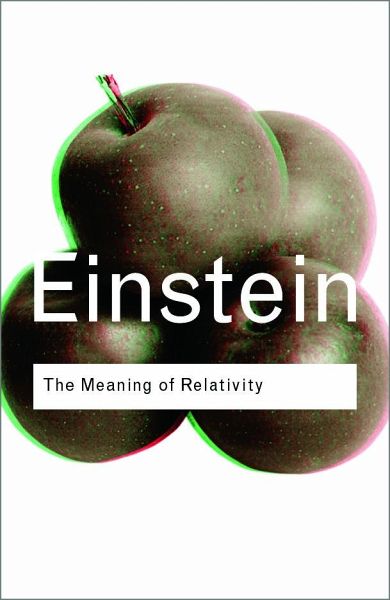
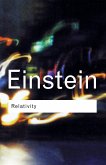
The world would be a very different place if it were not for Albert Einstein. Like Newton and Galileo before him, this remarkable scientist changed forever mankind's understanding of the universe. In 1921, five years after proclaiming his general theory of relativity, Einstein was awarded the Nobel Prize for Physics in recognition of his remarkable achievements. In the same year he travelled to the United States to give four lectures that consolidated his theory and sought to explain its meaning to a new audience. These lectures were published the following year as The Meaning of Relativity,…mehr
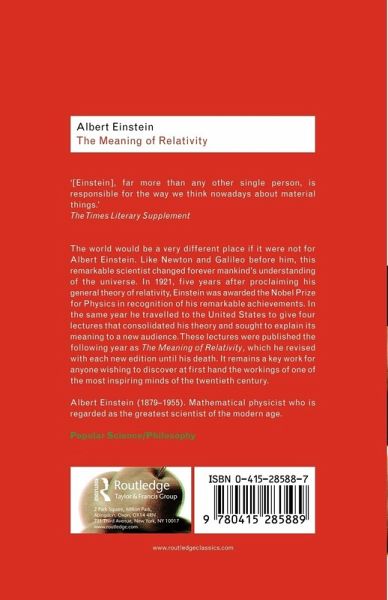
The world would be a very different place if it were not for Albert Einstein. Like Newton and Galileo before him, this remarkable scientist changed forever mankind's understanding of the universe. In 1921, five years after proclaiming his general theory of relativity, Einstein was awarded the Nobel Prize for Physics in recognition of his remarkable achievements. In the same year he travelled to the United States to give four lectures that consolidated his theory and sought to explain its meaning to a new audience. These lectures were published the following year as The Meaning of Relativity, which he revised with each new edition until his death. It remains a key work for anyone wishing to discover at first hand the workings of one of the most inspiring minds of the twentieth century.
Albert Einstein (1879-1955) Perhaps the most celebrated names in the field of physics, Albert Einstein is synonymous with everything Science and genius. Born in Germany in 1879 to Jewish parents, Einstein moved to Switzerland in 1895. In 1900, he graduated from Zurich's Federal Polytechnic School, and received his PhD from the University of Zurich in 1905. By the time the Nazis came to power in his home country, Germany in 1940, Einstein had regained his German citizenship because of his earlier work in the Prussian Academy of Sciences and the Humboldt University of Berlin. He openly denounced the Nazi ideologies and moved to the United States of America, becoming an American citizen in 1940, and living there until his death in 1955. Albert Einstein became a renowned physicist and scientist who made massive contributions to the field of physics. He developed the theory of relativity, the photoelectric effect, and the formula for a mass-velocity relationship, which states that energy is mass multiplied with the speed of light squared, and is depicted by the most famous equation of all time: E = mc2. Einstein received the Nobel Prize for Physics in 1921 in recognition of his 'services to theoretical physics'. Einstein was a great lover of music and poetry, and maintained that if not a physicist, he would have been a musician. He worked right till the very end of his life, maintaining that he would prefer to go to his death on his own accord and wouldn't want to unnecessarily prolong life. Einstein died on 17 April, 1955 of an abdominal aneurysm.
Inhaltsangabe
Space and Time in Pre-Relativity Physics. The Theory of Special Relativity. The General Theory of Relativity. Appendix I On the 'Cosmologic Problem'. Appendix II Relativistic Theory of the Non-Symmetric Field. Index
Space and Time in Pre-Relativity Physics. The Theory of Special Relativity. The General Theory of Relativity. Appendix I On the 'Cosmologic Problem'. Appendix II Relativistic Theory of the Non-Symmetric Field. Index
Rezensionen
'Einstein's little book serves as an excellent tying together of loose ends and as a broad survey of the subject.' - Physics Today
'Einstein's little book serves as an excellent tying together of loose ends and as a broad survey of the subject.' -Physics Today
Es gelten unsere Allgemeinen Geschäftsbedingungen: www.buecher.de/agb
Impressum
www.buecher.de ist ein Internetauftritt der buecher.de internetstores GmbH
Geschäftsführung: Monica Sawhney | Roland Kölbl | Günter Hilger
Sitz der Gesellschaft: Batheyer Straße 115 - 117, 58099 Hagen
Postanschrift: Bürgermeister-Wegele-Str. 12, 86167 Augsburg
Amtsgericht Hagen HRB 13257
Steuernummer: 321/5800/1497
USt-IdNr: DE450055826