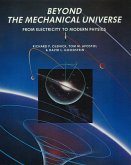
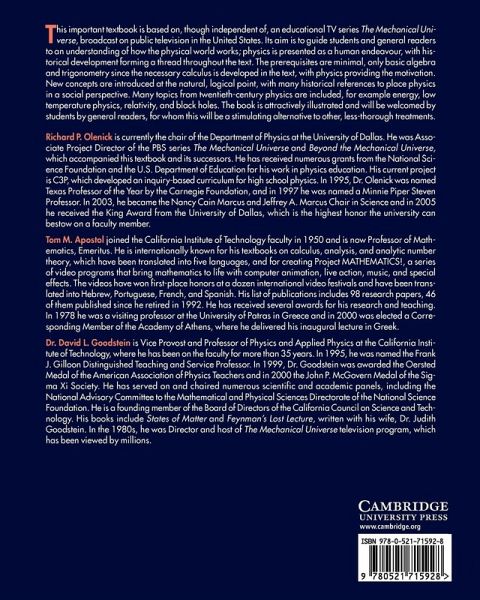
This important textbook is based on, though independent of, an educational TV series The Mechanical Universe broadcast on public television in the United States. Its aim is to guide students and general readers to an understanding of how the physical world works; physics is presented as a human endeavour, with historical development forming a thread throughout the text. The prerequisites are minimal, only basic algebra and trigonometry since the necessary calculus is developed in the text, with physics providing the motivation. New concepts are introduced at the natural, logical point with…mehr
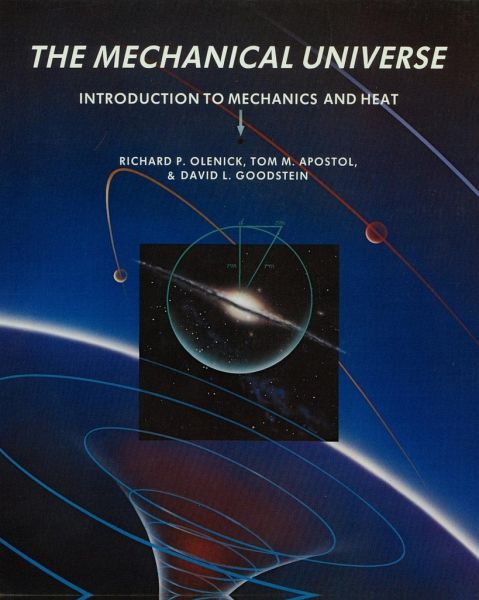
This important textbook is based on, though independent of, an educational TV series The Mechanical Universe broadcast on public television in the United States. Its aim is to guide students and general readers to an understanding of how the physical world works; physics is presented as a human endeavour, with historical development forming a thread throughout the text. The prerequisites are minimal, only basic algebra and trigonometry since the necessary calculus is developed in the text, with physics providing the motivation. New concepts are introduced at the natural, logical point with many historical references to place physics in a social perspective. Many topics from twentieth-century physics are included, for example energy, low temperature physics, relativity and black holes. The book is attractively and profusely illustrated and will be welcomed by students and also by general readers for whom this will be a stimulating alternative to other, less-thorough treatments.
Richard P. Olenick is currently the chair of Department of Physics at University of Dallas. He was Associate Project Director of the PBS Series The Mechanical Universe and Beyond the Mechanical Universe, which accompanied this textbook and its successors. He has received numerous grants from the National Science Foundation and the US Department of Education for his work in physics education. His current project is C3P, which developed an inquiry-based curriculum for high school physics. In 1995, Dr Olenick was named Texas Professor of the Year by the Carnegie Foundation and in 1997, he was named a Minnie Piper Steven Professor. In 2003, he became the Nancy Cain Marcus and Jeffrey A. Marcus Chair in Science and in 2005 he received the King Award from the University of Dallas, which is the highest honor the University can bestow on a faculty member.
Inhaltsangabe
Preface 1. Introduction to the mechanical universe 2. The law of falling bodies 3. Derivatives 4. Inertia 5. Vectors 6. Newton's law 7. Integration 8. The apple and the moon 9. Moving in circles 10. Forces 11. Gravity, electricity, and magnetism 12. The Milliken oil-drop experiment 13. The law of conservation of energy 14. Energy and stability 15. Temperature and the gas laws 16. The engine of nature 17. Entropy 18. The quest for low temperatures 19. The conservation of momentum 20. Harmonic motion 21. Resonance 22. Coupled oscillators and waves 23. Angular momentum 24. Gyroscopes 25. Kepler's laws and the conic sections 26. Solving the Kepler problem 27. Energy and eccentricity 28. Navigating in space 29. Loose ends and black holes 30. The harmony of the spheres: an overview of the mechanical universe Appendix A. The international system of units Appendix B. Conversion factors Appendix C. Formulas from algebra, geometry, and trigonometry Appendix D. Astronomical data Appendix E. Physical constants Selected bibliography Index.
Es gelten unsere Allgemeinen Geschäftsbedingungen: www.buecher.de/agb
Impressum
www.buecher.de ist ein Internetauftritt der buecher.de internetstores GmbH
Geschäftsführung: Monica Sawhney | Roland Kölbl | Günter Hilger
Sitz der Gesellschaft: Batheyer Straße 115 - 117, 58099 Hagen
Postanschrift: Bürgermeister-Wegele-Str. 12, 86167 Augsburg
Amtsgericht Hagen HRB 13257
Steuernummer: 321/5800/1497
USt-IdNr: DE450055826