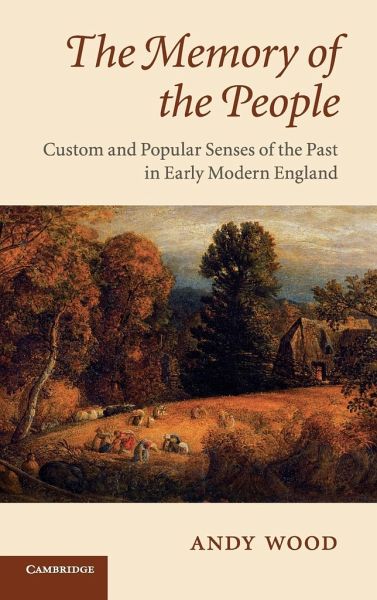
Did ordinary people in early modern England have any coherent sense of the past? Andy Wood's pioneering new book charts how popular memory generated a kind of usable past that legitimated claims to rights, space and resources. He explores the genesis of customary law in the medieval period; the politics of popular memory; local identities and traditions; gender and custom; literacy, orality and memory; landscape, space and memory; and the legacy of this cultural world for later generations. Drawing from a wealth of sources ranging from legal proceedings and parochial writings to proverbs and…mehr
Did ordinary people in early modern England have any coherent sense of the past? Andy Wood's pioneering new book charts how popular memory generated a kind of usable past that legitimated claims to rights, space and resources. He explores the genesis of customary law in the medieval period; the politics of popular memory; local identities and traditions; gender and custom; literacy, orality and memory; landscape, space and memory; and the legacy of this cultural world for later generations. Drawing from a wealth of sources ranging from legal proceedings and parochial writings to proverbs and estate papers, he shows how custom formed a body of ideas built up generation after generation from localized patterns of cooperation and conflict. This is a unique account of the intimate connection between landscape, place and identity and of how the poorer and middling sort felt about the world around them.
Andy Wood is Professor of Social History at the University of Durham. He writes about the poorer and middling people of Tudor, Stuart and Georgian England, and has published on a wide range of issues, including popular politics, class relations, rebellion, the mid-Tudor crisis, the English Revolution, local communities, literacy, oral culture, memory and customary law. His last book was The 1549 Rebellions and the Making of Early Modern England (Cambridge, 2007), which the American Historical Review described as 'social history at its best ... passionate and committed while at the same time judicious and balanced ... an extraordinary book, imaginative in its conceptualization and wide ranging in its implications'. Professor Wood is also the author of The Politics of Social Conflict: The Peak Country, 1520-1770 (Cambridge, 1999) and Riot, Rebellion and Popular Politics in Early Modern England (2002). He has held Research Fellowships with the British Academy, the Leverhulme Trust and the Institute of Advanced Studies at Durham University. The Memory of the People: Custom and Popular Senses of the Past in Early Modern England is based on twenty years' research and thought.
Inhaltsangabe
1. Reformation, custom and the end of medieval England 2. Custom and popular memory 3. Rights, resources and social alignments 4. Topographies of remembrance 5. Textual and verbal ways of remembering 6. The politics of popular memory.
1. Reformation, custom and the end of medieval England 2. Custom and popular memory 3. Rights, resources and social alignments 4. Topographies of remembrance 5. Textual and verbal ways of remembering 6. The politics of popular memory.
Es gelten unsere Allgemeinen Geschäftsbedingungen: www.buecher.de/agb
Impressum
www.buecher.de ist ein Internetauftritt der buecher.de internetstores GmbH
Geschäftsführung: Monica Sawhney | Roland Kölbl | Günter Hilger
Sitz der Gesellschaft: Batheyer Straße 115 - 117, 58099 Hagen
Postanschrift: Bürgermeister-Wegele-Str. 12, 86167 Augsburg
Amtsgericht Hagen HRB 13257
Steuernummer: 321/5800/1497
USt-IdNr: DE450055826