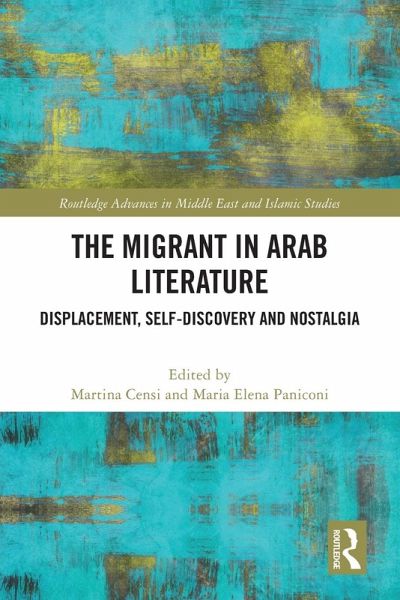
This edited book offers a collection of fresh and critical essays that explore the representation of the migrant subject in modern and contemporary Arabic literature and discuss its role in shaping new forms of transcultural and transnational identities. The selection of essays in this volume offers a set of new insights on a cluster of tropes: self-discovery, alienation, nostalgia, transmission and translation of knowledge, sense of exile, reconfiguration of the relationship with the past and the identity, and the building of transnational identity. A coherent yet multi-faceted narrative of…mehr
This edited book offers a collection of fresh and critical essays that explore the representation of the migrant subject in modern and contemporary Arabic literature and discuss its role in shaping new forms of transcultural and transnational identities. The selection of essays in this volume offers a set of new insights on a cluster of tropes: self-discovery, alienation, nostalgia, transmission and translation of knowledge, sense of exile, reconfiguration of the relationship with the past and the identity, and the building of transnational identity. A coherent yet multi-faceted narrative of micro-stories and of transcultural and transnational Arab identities will emerge from the essays: the volume aims at reversing the traditional perspective according to which a migrant subject is a non-political actor.
In contrast to many books about migration and literature, this one explores how the migrant subject becomes a specific literary trope, a catalyst of modern alienation, displacement, and uncertain identity, suggesting new forms of subjectification. Multiple representations of the migrant subject inform and perform the possibility of new post- national and transcultural individual and group identities and actively contribute to rewriting and decolonizing history.
Produktdetails
Produktdetails
Routledge Advances in Middle East and Islamic Studies
Martina Censi is Assistant Professor of Arabic Language and Literature at the University of Bergamo (Italy). She is a member of the Équipe de Recherche Interlangue (ERIMIT) at the University of Rennes 2 (France). In her research, she deals with literary representations of the body, processes of the construction of masculinity and femininity, and migration with a special focus on contemporary Arabic novel. She has published the book Le Corps dans le roman des écrivaines syriennes contemporaines: Dire, écrire, inscrire la différence (2016) and other articles about modern and contemporary Arabic literature. Maria Elena Paniconi is Associate Professor of Arabic Literature at the University of Macerata. She is interested in the rise of the Arab novel and in the dialectics among literary genres during the Arab Nah¿a. She has written articles and essays in the Journal of Arabic Literature and Oriente Moderno on nah¿aw¿ authors and co-edited with Jolanda Guardi the special issue of Oriente Moderno, "Nah¿a Narratives". She wrote the entries on ¿¿h¿ ¿usayn and Müammad ¿usayn Haykal for the third edition of the Encyclopedia of Islam. Her book Bildungsroman and the Arab Novel: Egyptian Intersections (Routledge 2023) explores a corpus of Egyptian canonical novels featuring young protagonists in their path toward adulthood, through the lens of international Bildungsroman.
Inhaltsangabe
Introduction (Martina Censi) 1. Migrating to and in Europe beyond the Nah aw and Modernist Paradigm: Mudun bi-l nakh l by riq al- ayyib and Taytanik t Ifriqiyya by Ab Bakr Kh l as Novels of Forced Migration (Maria Elena Paniconi) 2. Transcultural Identities in two Novels by an n al-Shaykh (Martina Censi) 3. The Body and the Migrating Subject in the Gulf: Daqq al- ab l by Mu ammad al-Bis (Cristina Dozio) 4. Writing Arabic in the Land of Migration: Waciny Laredj from risat al- il l: D n K sh t f al- az 'ir to Shuraf t bär al-sham l: Am r Amstird m (Jolanda Guardi) 5. Resistant Assimilation and Hometactics as Decolonial Practices: The Stories of Leilah and Ibrahim in The Orange Trees of Baghdad (Shima Shahbazi) 6. The Negotiation of Identity in Laila Halaby's Once in a Promised Land and West of Jordan (Sara Arami) 7. "Smotherland" Speaks: Syrian Refugee Identity in the Spaces between Media and Literature (Roula Salam) 8. The Global Migration Context and the Contemporary Iraqi Novel (Ikram Masmoudi) 9. Epilogue (Maria Elena Paniconi)
Introduction (Martina Censi) 1. Migrating to and in Europe beyond the Nah aw and Modernist Paradigm: Mudun bi-l nakh l by riq al- ayyib and Taytanik t Ifriqiyya by Ab Bakr Kh l as Novels of Forced Migration (Maria Elena Paniconi) 2. Transcultural Identities in two Novels by an n al-Shaykh (Martina Censi) 3. The Body and the Migrating Subject in the Gulf: Daqq al- ab l by Mu ammad al-Bis (Cristina Dozio) 4. Writing Arabic in the Land of Migration: Waciny Laredj from risat al- il l: D n K sh t f al- az 'ir to Shuraf t bär al-sham l: Am r Amstird m (Jolanda Guardi) 5. Resistant Assimilation and Hometactics as Decolonial Practices: The Stories of Leilah and Ibrahim in The Orange Trees of Baghdad (Shima Shahbazi) 6. The Negotiation of Identity in Laila Halaby's Once in a Promised Land and West of Jordan (Sara Arami) 7. "Smotherland" Speaks: Syrian Refugee Identity in the Spaces between Media and Literature (Roula Salam) 8. The Global Migration Context and the Contemporary Iraqi Novel (Ikram Masmoudi) 9. Epilogue (Maria Elena Paniconi)
Es gelten unsere Allgemeinen Geschäftsbedingungen: www.buecher.de/agb
Impressum
www.buecher.de ist ein Internetauftritt der buecher.de internetstores GmbH
Geschäftsführung: Monica Sawhney | Roland Kölbl | Günter Hilger
Sitz der Gesellschaft: Batheyer Straße 115 - 117, 58099 Hagen
Postanschrift: Bürgermeister-Wegele-Str. 12, 86167 Augsburg
Amtsgericht Hagen HRB 13257
Steuernummer: 321/5800/1497
USt-IdNr: DE450055826