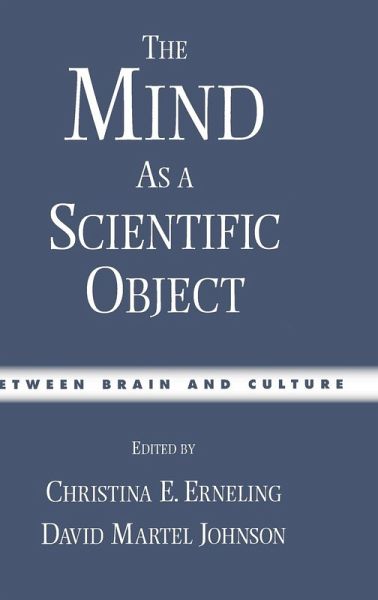
Are all cognitive sciences equal? The contributors of this book argue that the answer is no, because only neurophysiology and cultural psychology are suited to account for the mind's ontology. The papers collected here have been chosen to clarify these alternatives. In particular, because other books have emphasized the neuroscience alternative, this book highlights the cultural solution.
Are all cognitive sciences equal? The contributors of this book argue that the answer is no, because only neurophysiology and cultural psychology are suited to account for the mind's ontology. The papers collected here have been chosen to clarify these alternatives. In particular, because other books have emphasized the neuroscience alternative, this book highlights the cultural solution.
Erneling, Christina E. (Senior Lecturer in Psychology, University of Umea, USA) / Johnson, David Martel (Associate Professor of Philosophy, York University, USA)
Inhaltsangabe
* Introduction: can cognitive science locate and provide a correct account of the mind's center? Progress toward the literal * Where are we at present, and how did we get there? * 1: Rom Harre: The relevance of the philosophy of psychology to a science of psychology * 2: Thomas Leahey: Mind as scientific object: an historical, philosophical exploration * 3: Jagdish Hattiangadi: The emergence of minds in space and time * 4: Otniel E. Dror: Is the mind a scientific object of study?: lessons from history * Is the study of mind continuous with the rest of science? * 5: Thomas Leahey: Psychology as engineering * 6: Gunther Stent: Epistemic dualism * 7: David Olson: Mind, brain, and culture * 8: Don Ross: Chalmers' naturalistic dualism: the irrelevance of the mind-body problem to the scientific study of consciousness * 9: William Seager: Emergence and efficacy * Eliminative materialism: sound or mistaken? * 10: William Lycan: A particularly compelling refutation of eliminative materialism * 11: Ausonio Marras: Common-sense refutations of eliminativism * 12: David Henderson and Terrance Horgan: What does it take to be a true believer?: against the opulent ideology of eliminative materialism * 13: Barbara Von Eckhardt: Connectionism and the propositional attitudes * Is "mind" just another name for the brain and what the brain does? * 14: Martin Ingvar: All in the interest of time-on the problem of speed and cognition * 15: Vinod Goel: Can there be a cognitive neuroscience of central cognitive systems? * 16: Itiel Dror and Robin Thomas: The cognitive neuroscience laboratory: a framework for the science of mind * 17: Tadeusz Zadwidski and William Bechtel: Gall's legacy revisited: decomposition and localization in cognitive neuroscience * Does evolution provide a key to the scientific study of mind? * 18: Peter Gardenfors: The detachment of thought * 19: Jagdish Hattiangadi: The mind as an object of scientific study * 20: Stuart Shanker and Talbot J. Taylor: The significance of ape language research * 21: Charles Lumsden: I object: mind and brain as Darwinian things * Is the mind a cultural entity? * 22: Jerome Bruner: Ignace Meyerson and cultural psychology * 23: David Bakhurst: Strong culturalism * 24: Jens Brockmeier: The text of the mind * Rationality: cultural or natural? * 25: Timothy van Gelder: Beyond the mind-body problem * 26: Ian Jarvie: Workshop rationality, dogmatism and models of the mind * 27: Christina E. Erneling: Is cognitive development equivalent to scientific development? * 28: David Martel Johnson: Mind, brain, and the upper paleolithic * Afterword: between brain and culture - the diversity of mind
* Introduction: can cognitive science locate and provide a correct account of the mind's center? Progress toward the literal * Where are we at present, and how did we get there? * 1: Rom Harre: The relevance of the philosophy of psychology to a science of psychology * 2: Thomas Leahey: Mind as scientific object: an historical, philosophical exploration * 3: Jagdish Hattiangadi: The emergence of minds in space and time * 4: Otniel E. Dror: Is the mind a scientific object of study?: lessons from history * Is the study of mind continuous with the rest of science? * 5: Thomas Leahey: Psychology as engineering * 6: Gunther Stent: Epistemic dualism * 7: David Olson: Mind, brain, and culture * 8: Don Ross: Chalmers' naturalistic dualism: the irrelevance of the mind-body problem to the scientific study of consciousness * 9: William Seager: Emergence and efficacy * Eliminative materialism: sound or mistaken? * 10: William Lycan: A particularly compelling refutation of eliminative materialism * 11: Ausonio Marras: Common-sense refutations of eliminativism * 12: David Henderson and Terrance Horgan: What does it take to be a true believer?: against the opulent ideology of eliminative materialism * 13: Barbara Von Eckhardt: Connectionism and the propositional attitudes * Is "mind" just another name for the brain and what the brain does? * 14: Martin Ingvar: All in the interest of time-on the problem of speed and cognition * 15: Vinod Goel: Can there be a cognitive neuroscience of central cognitive systems? * 16: Itiel Dror and Robin Thomas: The cognitive neuroscience laboratory: a framework for the science of mind * 17: Tadeusz Zadwidski and William Bechtel: Gall's legacy revisited: decomposition and localization in cognitive neuroscience * Does evolution provide a key to the scientific study of mind? * 18: Peter Gardenfors: The detachment of thought * 19: Jagdish Hattiangadi: The mind as an object of scientific study * 20: Stuart Shanker and Talbot J. Taylor: The significance of ape language research * 21: Charles Lumsden: I object: mind and brain as Darwinian things * Is the mind a cultural entity? * 22: Jerome Bruner: Ignace Meyerson and cultural psychology * 23: David Bakhurst: Strong culturalism * 24: Jens Brockmeier: The text of the mind * Rationality: cultural or natural? * 25: Timothy van Gelder: Beyond the mind-body problem * 26: Ian Jarvie: Workshop rationality, dogmatism and models of the mind * 27: Christina E. Erneling: Is cognitive development equivalent to scientific development? * 28: David Martel Johnson: Mind, brain, and the upper paleolithic * Afterword: between brain and culture - the diversity of mind
Es gelten unsere Allgemeinen Geschäftsbedingungen: www.buecher.de/agb
Impressum
www.buecher.de ist ein Internetauftritt der buecher.de internetstores GmbH
Geschäftsführung: Monica Sawhney | Roland Kölbl | Günter Hilger
Sitz der Gesellschaft: Batheyer Straße 115 - 117, 58099 Hagen
Postanschrift: Bürgermeister-Wegele-Str. 12, 86167 Augsburg
Amtsgericht Hagen HRB 13257
Steuernummer: 321/5800/1497
USt-IdNr: DE450055826