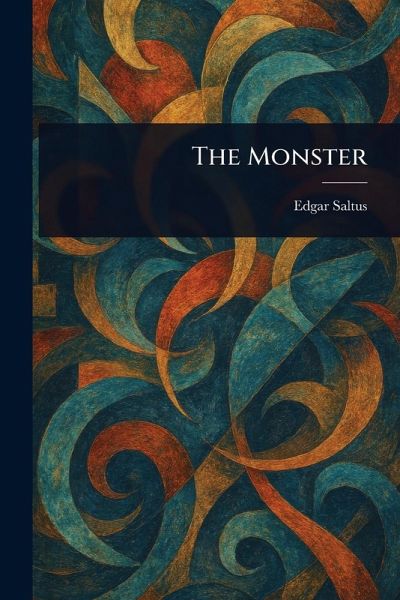
Edgar Saltus's "The Monster" delves into the complex and often turbulent landscape of man-woman relationships in this classic work of 19th-century American literature. A compelling exploration of the human psyche, this literary fiction examines the psychological depths of romance and its potential for both profound connection and destructive obsession. Rooted in the traditions of psychological fiction, "The Monster" offers a timeless perspective on the intricate dynamics between individuals, exploring themes that continue to resonate with readers today. Saltus masterfully crafts a narrative…mehr
Edgar Saltus's "The Monster" delves into the complex and often turbulent landscape of man-woman relationships in this classic work of 19th-century American literature. A compelling exploration of the human psyche, this literary fiction examines the psychological depths of romance and its potential for both profound connection and destructive obsession. Rooted in the traditions of psychological fiction, "The Monster" offers a timeless perspective on the intricate dynamics between individuals, exploring themes that continue to resonate with readers today. Saltus masterfully crafts a narrative that lays bare the emotional vulnerabilities and hidden desires that shape our interactions. A meticulously prepared print republication of this historical text, "The Monster" promises to captivate those drawn to the rich tapestry of 19th-century romance and the enduring power of literary fiction. This work has been selected by scholars as being culturally important, and is part of the knowledge base of civilization as we know it. This work is in the public domain in the United States of America, and possibly other nations. Within the United States, you may freely copy and distribute this work, as no entity (individual or corporate) has a copyright on the body of the work. Scholars believe, and we concur, that this work is important enough to be preserved, reproduced, and made generally available to the public. We appreciate your support of the preservation process, and thank you for being an important part of keeping this knowledge alive and relevant.
Edgar Evertson Saltus was born on October 8, 1855, in New York City to parents Francis Henry Saltus and Julia Ida Evertson Saltus. Known for his elaborate and elegant prose, he became a distinctive voice in American literature during the late 19th and early 20th centuries. His writing style was often compared to that of European decadent authors such as Joris-Karl Huysmans, Gabriele D'Annunzio, and Oscar Wilde, with whom he shared a fascination for aestheticism, moral ambiguity, and philosophical pessimism. Saltus began his career in law but turned to literature, where his refined diction and interest in metaphysical questions garnered both attention and controversy. His work spanned fiction, essays, and philosophical treatises, often exploring the limits of morality, beauty, and human desire. Among his notable writings are The Philosophy of Disenchantment and The Anatomy of Negation, which reflect his engagement with skepticism and nihilism. He lived much of his life in New York, where he was a known figure in intellectual and literary circles. He married Marie Saltus in 1911 and remained with her until his death on July 31, 1921, in Manhattan, at the age of 65.
Es gelten unsere Allgemeinen Geschäftsbedingungen: www.buecher.de/agb
Impressum
www.buecher.de ist ein Internetauftritt der buecher.de internetstores GmbH
Geschäftsführung: Monica Sawhney | Roland Kölbl | Günter Hilger
Sitz der Gesellschaft: Batheyer Straße 115 - 117, 58099 Hagen
Postanschrift: Bürgermeister-Wegele-Str. 12, 86167 Augsburg
Amtsgericht Hagen HRB 13257
Steuernummer: 321/5800/1497
USt-IdNr: DE450055826