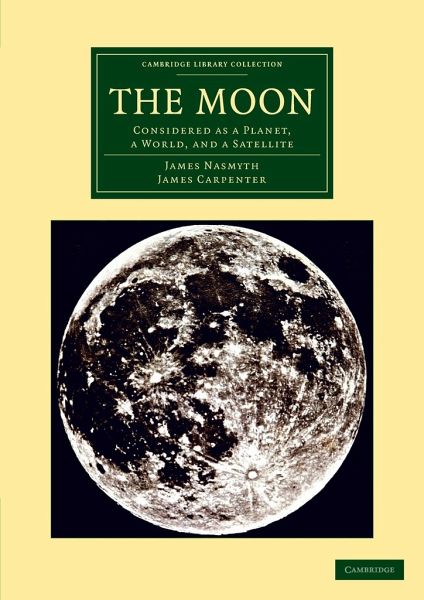
The movement of the moon in space had been well documented by the second half of the nineteenth century. In this monograph, which first appeared in 1874, James Nasmyth (1808-90) and James Carpenter (1840-99) pay closer attention to the lunar surface, notably illustrating their work with photographs of accurate plaster models. At this time, many questions about the moon's properties were still open. Could the moon support life? Did it have an atmosphere? How had its craters been formed? Marshalling the latest available evidence, Nasmyth and Carpenter provide their answers in a text accompanied…mehr
The movement of the moon in space had been well documented by the second half of the nineteenth century. In this monograph, which first appeared in 1874, James Nasmyth (1808-90) and James Carpenter (1840-99) pay closer attention to the lunar surface, notably illustrating their work with photographs of accurate plaster models. At this time, many questions about the moon's properties were still open. Could the moon support life? Did it have an atmosphere? How had its craters been formed? Marshalling the latest available evidence, Nasmyth and Carpenter provide their answers in a text accompanied by explanatory diagrams. Also included are theories on planetary formation, a discussion of lunar volcanism, and a vivid imagining of a day on the moon's surface, describing everything from low lunar gravity to the sudden, monthly sunrise. The work remains an instructive resource, reflecting the state of contemporary astronomical knowledge.
James Hall Nasmyth was a Scottish engineer, philosopher, artist, and inventor who is best known for developing the steam hammer. He was a co-founder of Nasmyth, Gaskell and Company, which manufactured machine tools. He retired at the age of 48 and relocated to Penshurst, Kent, where he pursued his passions of astronomy and photography. Nasmyth was born at 47 York Place in Edinburgh, where his father, Alexander Nasmyth, painted landscapes and portraits. Alexander's hobby was mechanics, and he spent almost all of his free time in his workshop, where he encouraged his youngest son to work alongside him on various materials. From 1821 until 1826, Nasmyth attended the Edinburgh School of Arts (now Heriot-Watt University), making him one of the institution's inaugural students. In 1828, he created a complete steam carriage capable of traveling a mile with eight passengers. This feat fueled his desire to be a mechanical engineer. He had heard about Henry Maudslay's business and resolved to work there; but, his father could not afford to hire him as an apprentice. Nasmyth intended to demonstrate his abilities to Maudslay by building a complete functional model of a high-pressure steam engine, with the working plans and components.
Inhaltsangabe
Preface 1. On the cosmical origin of the planets of the solar system 2. The generation of cosmical heat 3. The subsequent cooling of the igneous body 4. The form, magnitude, weight, and density of the lunar globe 5. On the existence or non-existence of a lunar atmosphere 6. The general aspect of the lunar surface 7. Topography of the moon 8. On lunar craters 9. On the great ring-formations not manifestly volcanic 10. Peaks and mountain ranges 11. Cracks and radiating streaks 12. Colour and brightness of lunar details: chronology of formations, and finality of existing features 13. The moon as a world: day and night upon its surface 14. The moon as a satellite: its relation to the earth and man 15 Concluding summary.
Preface 1. On the cosmical origin of the planets of the solar system 2. The generation of cosmical heat 3. The subsequent cooling of the igneous body 4. The form, magnitude, weight, and density of the lunar globe 5. On the existence or non-existence of a lunar atmosphere 6. The general aspect of the lunar surface 7. Topography of the moon 8. On lunar craters 9. On the great ring-formations not manifestly volcanic 10. Peaks and mountain ranges 11. Cracks and radiating streaks 12. Colour and brightness of lunar details: chronology of formations, and finality of existing features 13. The moon as a world: day and night upon its surface 14. The moon as a satellite: its relation to the earth and man 15 Concluding summary.
Es gelten unsere Allgemeinen Geschäftsbedingungen: www.buecher.de/agb
Impressum
www.buecher.de ist ein Internetauftritt der buecher.de internetstores GmbH
Geschäftsführung: Monica Sawhney | Roland Kölbl | Günter Hilger
Sitz der Gesellschaft: Batheyer Straße 115 - 117, 58099 Hagen
Postanschrift: Bürgermeister-Wegele-Str. 12, 86167 Augsburg
Amtsgericht Hagen HRB 13257
Steuernummer: 321/5800/1497
USt-IdNr: DE450055826