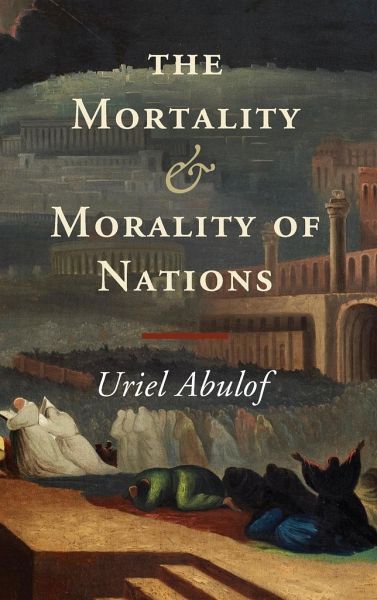
Standing at the edge of life's abyss, we seek meaningful order. We commonly find this 'symbolic immortality' in religion, civilization, state and nation. What happens, however, when the nation itself appears mortal? The Mortality and Morality of Nations seeks to answer this question, theoretically and empirically. It argues that mortality makes morality, and right makes might; the nation's sense of a looming abyss informs its quest for a higher moral ground, which, if reached, can bolster its vitality. The book investigates nationalism's promise of moral immortality and its limitations via…mehr
Standing at the edge of life's abyss, we seek meaningful order. We commonly find this 'symbolic immortality' in religion, civilization, state and nation. What happens, however, when the nation itself appears mortal? The Mortality and Morality of Nations seeks to answer this question, theoretically and empirically. It argues that mortality makes morality, and right makes might; the nation's sense of a looming abyss informs its quest for a higher moral ground, which, if reached, can bolster its vitality. The book investigates nationalism's promise of moral immortality and its limitations via three case studies: French Canadians, Israeli Jews, and Afrikaners. All three have been insecure about the validity of their identity or the viability of their polity, or both. They have sought partial redress in existential self-legitimation: by the nation, of the nation and for the nation's very existence.
Uriel Abulof is an Assistant Professor of Politics at Tel-Aviv University and a senior research fellow at Princeton University's Woodrow Wilson School of Public and International Affairs/Liechtenstein Institute on Self-Determination (LISD). He is the author of Living on the Edge: The Existential Uncertainty of Zionism, which won the Bahat Prize, Israel's most prestigious academic book award. Abulof studies political legitimation, nationalism and ethnic conflicts. His articles have appeared in journals such as International Studies Quarterly, International Political Sociology, Nations and Nationalism, The British Journal of Sociology, Ethnic and Racial Studies and International Politics.
Inhaltsangabe
Part I. Preface Part II. Introduction: 1. Theory 2. Case studies Part III. Theory: 3. Meaning 4. Mortality 5. Morality 6. Liberty 7. Language Part IV. The French Canadians: 8. The Canadiens: the emergence of an endangered ethnie 9. The French Canadians: the rise and demise of ethno-religionism 10. The Québécois: the rise and demise of ethnonationalism Part V. Jews and Zionists: 11. Ontological insecurity: Jewish identity in modernity 12. Epistemic insecurity: Jewish and Zionist survival in question 13. Existential threats: Zionism's 'holes in the net' 14. Existential threads: the lifelines of Zionism Part VI. The Afrikaners: 15. Ontological insecurity: the birth of the Afrikaner ethnie 16. Epistemic insecurity: Afrikaner survival in question 17. Existential threats: Afrikanerdom's 'holes in the net' 18. Existential threads: the lifelines of Afrikanerdom 19. The twilight of apartheid and its aftermath.
Es gelten unsere Allgemeinen Geschäftsbedingungen: www.buecher.de/agb
Impressum
www.buecher.de ist ein Internetauftritt der buecher.de internetstores GmbH
Geschäftsführung: Monica Sawhney | Roland Kölbl | Günter Hilger
Sitz der Gesellschaft: Batheyer Straße 115 - 117, 58099 Hagen
Postanschrift: Bürgermeister-Wegele-Str. 12, 86167 Augsburg
Amtsgericht Hagen HRB 13257
Steuernummer: 321/5800/1497
USt-IdNr: DE450055826