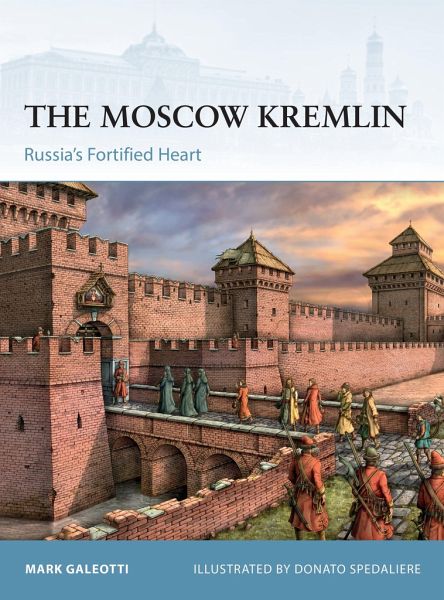
A detailed study of the tumultuous history of the Moscow Kremlin, a metaphor for Russia, a symbol for its government and an enduring icon of the country.
A detailed study of the tumultuous history of the Moscow Kremlin, a metaphor for Russia, a symbol for its government and an enduring icon of the country.
Dr Mark Galeotti is a world-class expert on Russian history, politics and security. He has taught in the UK, USA, Russia and Czech Republic, advised governments and corporations, and talked to everyone from Russian gangsters to Chinese marines. Donato Spedaliere was born in Switzerland and moved to Italy. He studied at Belle Arti in Florence and he is both a 2D and 3D artist, working with publishers, museums, archaeologists, architects and military institutions.
Inhaltsangabe
Introduction Chronology The Moscow Gorod - The early wooden incarnations, including detail on design and construction, culminating in the razing of the later fort by the Mongols in the 13th century. A White-Stone Fortress - The construction of the first stone Kremlin by Dmitry Donskoi in the 14th century, again with information on the design and construction. Red Brick Kremlin - The expansion and development of the Kremlin over the years, including the building of new walls and towers and evolution to keep pace with military technologies. Times of Troubles - The 17th century: A summary of the actual combat experiences of the stone Kremlin, especially looking the 1680 siege of the city by the Polish-Lithuanian Commonwealth. Napoleon and Nicholases - The fate of the Kremlin when Napoleon took it in 1812. Red Fortress - The Kremlin in the 20th century, including a description of the defences added as the Germans approached and attacked Moscow in 194-42. Twenty Towers - Analysis of the 20 towers around the Kremlin walls. Today's Kremlin - An overview of its current roles, including detail about its defences, from the Presidential Regiment barracked in the old Arsenal Building (known as Block 14) to the systems jamming drones and GPS in the area and the helipad built for a rapid evacuation of the president. Bibliography - including a few of the best Russian-language sources. Glossary Index
Introduction Chronology The Moscow Gorod - The early wooden incarnations, including detail on design and construction, culminating in the razing of the later fort by the Mongols in the 13th century. A White-Stone Fortress - The construction of the first stone Kremlin by Dmitry Donskoi in the 14th century, again with information on the design and construction. Red Brick Kremlin - The expansion and development of the Kremlin over the years, including the building of new walls and towers and evolution to keep pace with military technologies. Times of Troubles - The 17th century: A summary of the actual combat experiences of the stone Kremlin, especially looking the 1680 siege of the city by the Polish-Lithuanian Commonwealth. Napoleon and Nicholases - The fate of the Kremlin when Napoleon took it in 1812. Red Fortress - The Kremlin in the 20th century, including a description of the defences added as the Germans approached and attacked Moscow in 194-42. Twenty Towers - Analysis of the 20 towers around the Kremlin walls. Today's Kremlin - An overview of its current roles, including detail about its defences, from the Presidential Regiment barracked in the old Arsenal Building (known as Block 14) to the systems jamming drones and GPS in the area and the helipad built for a rapid evacuation of the president. Bibliography - including a few of the best Russian-language sources. Glossary Index
Es gelten unsere Allgemeinen Geschäftsbedingungen: www.buecher.de/agb
Impressum
www.buecher.de ist ein Internetauftritt der buecher.de internetstores GmbH
Geschäftsführung: Monica Sawhney | Roland Kölbl | Günter Hilger
Sitz der Gesellschaft: Batheyer Straße 115 - 117, 58099 Hagen
Postanschrift: Bürgermeister-Wegele-Str. 12, 86167 Augsburg
Amtsgericht Hagen HRB 13257
Steuernummer: 321/5800/1497
USt-IdNr: DE450055826