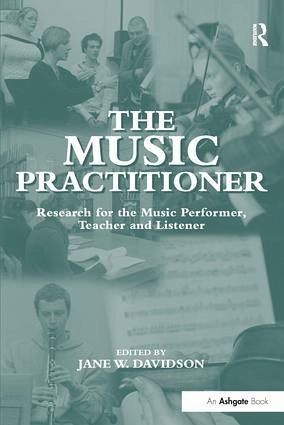
This is the first book to provide a wide assessment of what ptactical benefits this research can bring to the music practitioner. With 25 chapters be writers representing a broad range of perspectives, this volume is able to highlight many of the potential links between music reserach and practice.
This is the first book to provide a wide assessment of what ptactical benefits this research can bring to the music practitioner. With 25 chapters be writers representing a broad range of perspectives, this volume is able to highlight many of the potential links between music reserach and practice.
Contents: Foreword; Introduction, Jane W. Davidson; Part 1 The Practitioner and Research: Psychology and the music practitioner, Aaron Williamon and Sam Thompson; What and why do we need to know about music psychology research to improve music instrument teaching?, Kacper Miklaszewski; The state of play in performance studies, John Rink; A case study of a practical research environment: Sibelius Academy, Helsinki, Kari Kurkela. Part 2 Theory and Experimentation: Understanding Pitches, Tuning and Rhythms: From acoustics to psychology: pitch strength of sounds, Andrzej Rakowski; 'Expressive intonation' in string performance: problems of analysis and interpretation, Peter Johnson; Do compositions reveal information about historical tuning?, Bernhard Billeter; Enrichment of music theory pedagogy by computer-based repertoire analysis and perceptual-cognitive theory, Richard Parncutt; The perceptual space between and within musical rhythm categories, George Papadelis and George Papanikolaou. Part 3 Practitioners Investigating their Daily Work: Making a reflexive turn: practical music-making becomes conventional research, Jane W. Davidson; Singing by heart: memorization strategies for the words and music of songs, Jane Ginsborg; Formal and non-formal music learning amongst rock musicians, Anna-Karin Gullberg and Sture Brÿndström; Priorities in voice training: carrying power or tone quality, Allan Vurma and Jaan Ross. Part 4 Researching Musician Identity and Perception: Rethinking voice evaluation in singing, António G. Salgado; Assessing vocal performance, Daniela Coimbra and Jane W. Davidson; Starting a music degree at university, Stephanie E. Pitts; Tracing a musical life transition, Karen Burland and Jane W. Davidson; Flawed expertise: exploring the need to overcome the discrepancy between instrumental training and orchestral work - the case of string players, Daina Langner. Part 5 Adopting Innovative Research Approaches: A new method for analysing and representing singing, Stefanie Sadler Elmer and Franz-Josef Elmer; The fears and joys of new forms of investigation into teaching: student evaluation of instrumental teaching, Ingrid Maria Hanken; A role for action research projects in developing new pedagogical approaches to aural and musicianship education, Nicholas Bannan; A new approach to pursuing the professional development of recent graduates from German music academies: the alumni project, Heiner Gembris; What music psychology is telling us about emotions and why it can't yet tell us more: a need for empirical and theoretical innovation, Matthew M. Lavy. Part 6 A Final Note: Musical chills and other delights of music, Jerrold Levinson. Index.
Contents: Foreword; Introduction, Jane W. Davidson; Part 1 The Practitioner and Research: Psychology and the music practitioner, Aaron Williamon and Sam Thompson; What and why do we need to know about music psychology research to improve music instrument teaching?, Kacper Miklaszewski; The state of play in performance studies, John Rink; A case study of a practical research environment: Sibelius Academy, Helsinki, Kari Kurkela. Part 2 Theory and Experimentation: Understanding Pitches, Tuning and Rhythms: From acoustics to psychology: pitch strength of sounds, Andrzej Rakowski; 'Expressive intonation' in string performance: problems of analysis and interpretation, Peter Johnson; Do compositions reveal information about historical tuning?, Bernhard Billeter; Enrichment of music theory pedagogy by computer-based repertoire analysis and perceptual-cognitive theory, Richard Parncutt; The perceptual space between and within musical rhythm categories, George Papadelis and George Papanikolaou. Part 3 Practitioners Investigating their Daily Work: Making a reflexive turn: practical music-making becomes conventional research, Jane W. Davidson; Singing by heart: memorization strategies for the words and music of songs, Jane Ginsborg; Formal and non-formal music learning amongst rock musicians, Anna-Karin Gullberg and Sture Brÿndström; Priorities in voice training: carrying power or tone quality, Allan Vurma and Jaan Ross. Part 4 Researching Musician Identity and Perception: Rethinking voice evaluation in singing, António G. Salgado; Assessing vocal performance, Daniela Coimbra and Jane W. Davidson; Starting a music degree at university, Stephanie E. Pitts; Tracing a musical life transition, Karen Burland and Jane W. Davidson; Flawed expertise: exploring the need to overcome the discrepancy between instrumental training and orchestral work - the case of string players, Daina Langner. Part 5 Adopting Innovative Research Approaches: A new method for analysing and representing singing, Stefanie Sadler Elmer and Franz-Josef Elmer; The fears and joys of new forms of investigation into teaching: student evaluation of instrumental teaching, Ingrid Maria Hanken; A role for action research projects in developing new pedagogical approaches to aural and musicianship education, Nicholas Bannan; A new approach to pursuing the professional development of recent graduates from German music academies: the alumni project, Heiner Gembris; What music psychology is telling us about emotions and why it can't yet tell us more: a need for empirical and theoretical innovation, Matthew M. Lavy. Part 6 A Final Note: Musical chills and other delights of music, Jerrold Levinson. Index.
Es gelten unsere Allgemeinen Geschäftsbedingungen: www.buecher.de/agb
Impressum
www.buecher.de ist ein Internetauftritt der buecher.de internetstores GmbH
Geschäftsführung: Monica Sawhney | Roland Kölbl | Günter Hilger
Sitz der Gesellschaft: Batheyer Straße 115 - 117, 58099 Hagen
Postanschrift: Bürgermeister-Wegele-Str. 12, 86167 Augsburg
Amtsgericht Hagen HRB 13257
Steuernummer: 321/5800/1497
USt-IdNr: DE450055826