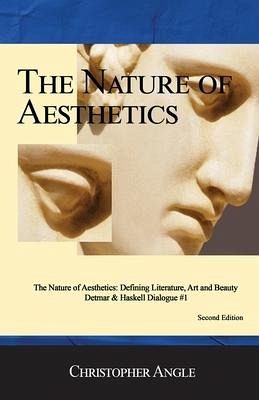
The Nature of Aesthetics: Defining Literature, Art & Beauty Philosophy Christopher Angle has written an engaging and readable inquiry into aesthetics. In the style of Socratic dialogues, Angle raises the right questions and defends his own original answers. -- John Greco, Dept. of Philosophy, Fordham University ¿¿¿or artist sees his world and distinguishes this from other types of expression such as a newspaper article, lab report, etc. Chapter Three defines and defends aesthetics and beauty as the evolutionary, positive extreme the basis of which is steeped in survival. It concludes that…mehr
The Nature of Aesthetics: Defining Literature, Art & Beauty Philosophy Christopher Angle has written an engaging and readable inquiry into aesthetics. In the style of Socratic dialogues, Angle raises the right questions and defends his own original answers. -- John Greco, Dept. of Philosophy, Fordham University ¿¿¿or artist sees his world and distinguishes this from other types of expression such as a newspaper article, lab report, etc. Chapter Three defines and defends aesthetics and beauty as the evolutionary, positive extreme the basis of which is steeped in survival. It concludes that beauty is not in the eye of the beholder, and that the aesthetic sense has an evolutionary purpose to enable man to recognize and appreciate that which is positive for his survival. The works are done in a non-academic, explanatory style that lends itself to easy and enjoyable reading. Although philosophical and academic in content, The Nature of Aesthetics: Defining Literature, Art & Beauty is fun to read. The Nature of Aesthetics - Chapters One and Two define literature and art as the expression of how an author The work succinctly defines literature, art, and beauty in a manner that is engaging and readable.
The author, Chris Angle, took an interest in philosophy starting at the University of Michigan where the courses introduced him to the many famous works among which were the dialogues of Plato and the character of Socrates which intrigued and influenced him forever afterwards.At the U of M, Angle decided that he would write philosophical works of his own. But preparatory to that, he realized that in order to begin this endeavor, he should have to be able to define philosophical concepts.Angle found that to understand these concepts, learning about the biological history and evolution of man would be insightful. And, indeed it was. Angle's explications of many philosophical concepts often involve reference to biological anthropology.
Es gelten unsere Allgemeinen Geschäftsbedingungen: www.buecher.de/agb
Impressum
www.buecher.de ist ein Internetauftritt der buecher.de internetstores GmbH
Geschäftsführung: Monica Sawhney | Roland Kölbl | Günter Hilger
Sitz der Gesellschaft: Batheyer Straße 115 - 117, 58099 Hagen
Postanschrift: Bürgermeister-Wegele-Str. 12, 86167 Augsburg
Amtsgericht Hagen HRB 13257
Steuernummer: 321/5800/1497
USt-IdNr: DE450055826