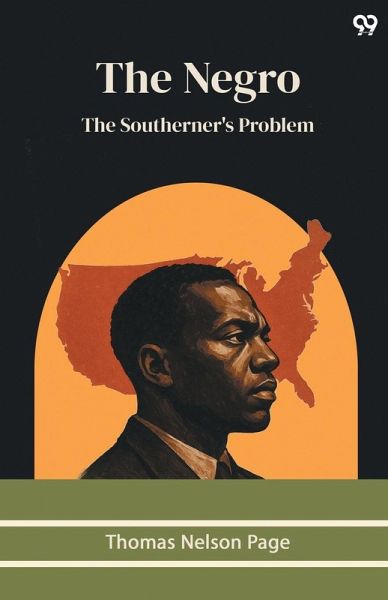
The Negro: The southerner's problem is a collection of essays written that addresses the extensive and complex issues surrounding race relations in the post-Civil War American South. Through the writings, the text attempts to explore the historical context of the racial divide, focusing particularly on the consequences of emancipation and the ongoing challenges faced by both black and white communities in the South. The essays reflect views on the inherent complexities and sensitivities involving the narrative of race in America, drawing from experiences and observations. At the start of the…mehr
The Negro: The southerner's problem is a collection of essays written that addresses the extensive and complex issues surrounding race relations in the post-Civil War American South. Through the writings, the text attempts to explore the historical context of the racial divide, focusing particularly on the consequences of emancipation and the ongoing challenges faced by both black and white communities in the South. The essays reflect views on the inherent complexities and sensitivities involving the narrative of race in America, drawing from experiences and observations. At the start of the text, the groundwork is laid for a thorough examination of the negro question, identified as a crucial and long-standing dilemma most notably affecting Southern society. It is noted that this topic has been a source of contention and misunderstanding, particularly between Southern whites who live daily with its implications and Northern whites who hold often radical views shaped by sentimental narratives. The work aims to approach this subject with candor, highlighting the historical relationships between races, the impact of slavery, and the failures and successes in attempts at integration and education for freedmen. Through this introduction, it expresses the hope that the writings might contribute to a more informed and open dialogue about these pressing issues.
Thomas Nelson Page was an American attorney, politician, and writer. During World War I, he was the United States' ambassador to Italy from 1913 to 1919, serving under President Woodrow Wilson. Page's writing popularized Plantation tradition literature, which was utilized to spread the Lost Cause idea throughout the New South. Page originally captured the public's notice with his story Marse Chan, which appeared in the Century Illustrated Monthly magazine. Page's most notable pieces are The Burial of the Guns and In Ole Virginia. Page was born on one of the Nelson family's properties in Oakland, near the community of Beaverdam, Hanover County, Virginia. He was the son of John Page (a lawyer and plantation owner) and Elizabeth Burwell (Nelson). He descended from the well-known Nelson and Page families, both of whom were First Families of Virginia. Although he came from an affluent family, during the American Civil War, which began when he was eight years old, his parents and relatives were largely poor during Reconstruction and his adolescence. In 1869, he enrolled in Washington College, now known as Washington and Lee University, in Lexington, Virginia, where Robert E. Lee was president.
Es gelten unsere Allgemeinen Geschäftsbedingungen: www.buecher.de/agb
Impressum
www.buecher.de ist ein Internetauftritt der buecher.de internetstores GmbH
Geschäftsführung: Monica Sawhney | Roland Kölbl | Günter Hilger
Sitz der Gesellschaft: Batheyer Straße 115 - 117, 58099 Hagen
Postanschrift: Bürgermeister-Wegele-Str. 12, 86167 Augsburg
Amtsgericht Hagen HRB 13257
Steuernummer: 321/5800/1497
USt-IdNr: DE450055826