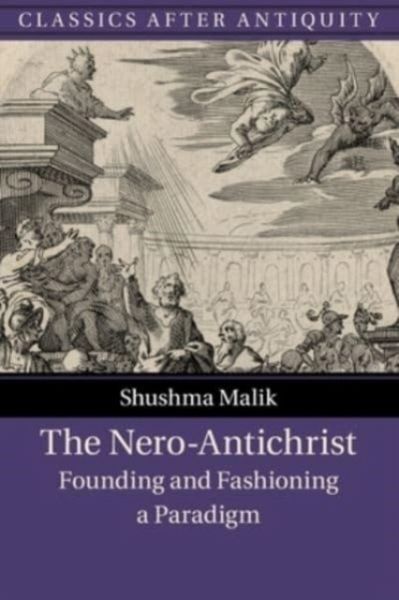
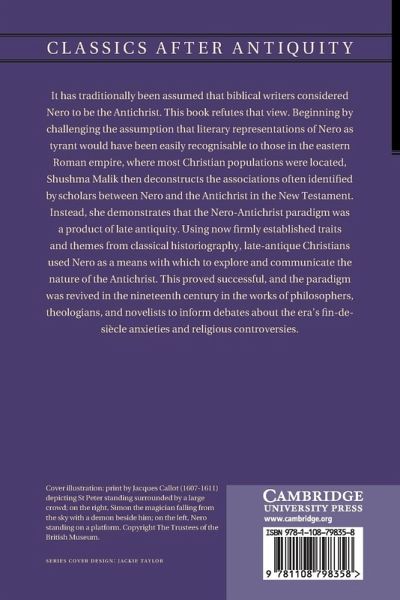
Refutes the commonly-held perception that Nero should be understood as the Antichrist figure in the Bible, and argues instead that this paradigm was a product of late antiquity. The paradigm's success facilitated its revival in the nineteenth century against the backdrop of the era's fin-de-sià cle anxieties and religious controversies.
Shushma Malik is a Lecturer in Classics at the University of Roehampton. She has published book chapters and articles in international journals such as Classical Quarterly. Shushma has also featured as a guest on BBC Radio 3's The Sunday Feature: The Deluxe Edition and BBC Radio 4's In Our Time: Nero.
Inhaltsangabe
1. Introduction: Neronian Myths 2. Nero and the Bible 3. The Invention of the Nero-Antichrist 4. Reviving the Nero-Antichrist 5. Epilogue: The Legacy of Revival Appendix A. List of Early-Christian References to the Nero-Antichrist Bibliography Index.
Es gelten unsere Allgemeinen Geschäftsbedingungen: www.buecher.de/agb
Impressum
www.buecher.de ist ein Internetauftritt der buecher.de internetstores GmbH
Geschäftsführung: Monica Sawhney | Roland Kölbl | Günter Hilger
Sitz der Gesellschaft: Batheyer Straße 115 - 117, 58099 Hagen
Postanschrift: Bürgermeister-Wegele-Str. 12, 86167 Augsburg
Amtsgericht Hagen HRB 13257
Steuernummer: 321/5800/1497
USt-IdNr: DE450055826