
Andere Kunden interessierten sich auch für
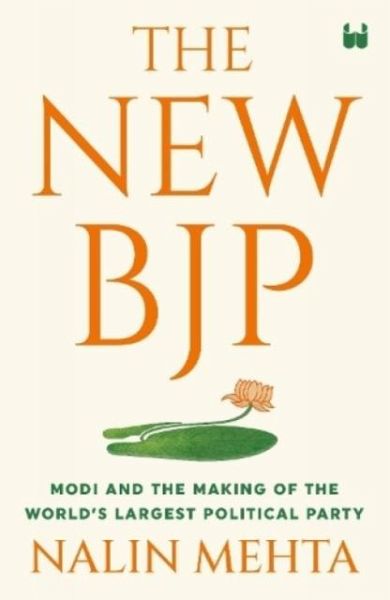
 The New BJP140,99 €
 In the Shadow of the Swastika46,99 €
 INDIA WAY14,99 €
 Empowering Marginalised Women in Remote Indian Villages67,99 €
 Agrarian Reform and Farmer Resistance in Punjab43,99 €
 The Rise of the Bjp24,99 €
 The Indian Farmers' Protest of 2020-2021160,99 €




In election after election since 2014, both at the Union and state levels, the BJP has won more often than it has lost-a clear indication of growth beyond its core Hindu base. The question is, why do so many people across divisions of caste, religion and gender vote for a party with unapologetically aggressive Hindutva politics? Are its much-publicised development schemes, whatever their flaws, the big pull factor? Or the active mobilisation of the RSS cadre to its cause? In this fascinating revisionist history, political scientist and journalist Nalin Mehta examines how the BJP became the world's largest political party. He goes beyond the usual narrative of the party's Hindutva politics to explain how, under Narendra Modi, it reshaped the Indian polity using its own brand of social engineering.
'The transformation of the BJP from a small player in the political scene to the premier, possibly new dominant formation in India has led to much comment but not as much quality scholarship as one might have expected. Dr Mehta brings to this subject the keen energy of a journalist and observer with the patience of an archivist. His analysis has much that will excite, surprise, and provoke critical thought even as it informs and gives a sense of perspective. It is especially notable how work on the growth of the Sangh and the party in the last two decades are matched by careful examination of key moments in the early years of the Bharatiya Jan Sangh. A book that will be indispensable for the study of contemporary India.'
-Professor Mahesh Rangarajan, Vice Chancellor, Krea University
'I've had the pleasure of reading drafts of all the chapters of Nalin Mehta's manuscript on the Bharatiya Janata Party. In my opinion, it is going to be a classic, a book that will be read widely and for a long time. Its readership will include scholars, political activists and anyone whose job or interest lies in understanding contemporary India and the processes that have shaped it.'
-Professor Robin Jeffrey, Visiting Research Professor, National University of Singapore; Emeritus Professor, Australian National University, Canberra & La Trobe University, Melbourne
'Mehta's masterful account of the evolution and rise of the BJP deftly weaves an enormous amount of material into an expansive and authoritative account of modern India. This brilliantly revealing portrait of the inner workings of the party-its ideological bedrock, organisational structure and economic outlook-is brimming with insights about India's cultural contradictions, political alliances and searing religious tensions. Mehta's benchmark study deftly brings together the freshness and vigour of on-the-ground reporting with scholarly precision and vivid descriptions of India's political, economic and social systems. An urgent investigation of Indian democracy, its electoral system and voting patterns; written with anthropological attentiveness to local idioms, gender structure, caste conflict and class relations: a major achievement.'
-Professor Assa Doron, Professor of Anthropology and South Asia, Founding Director, South Asia Centre, Australian National University, Canberra
-Professor Mahesh Rangarajan, Vice Chancellor, Krea University
'I've had the pleasure of reading drafts of all the chapters of Nalin Mehta's manuscript on the Bharatiya Janata Party. In my opinion, it is going to be a classic, a book that will be read widely and for a long time. Its readership will include scholars, political activists and anyone whose job or interest lies in understanding contemporary India and the processes that have shaped it.'
-Professor Robin Jeffrey, Visiting Research Professor, National University of Singapore; Emeritus Professor, Australian National University, Canberra & La Trobe University, Melbourne
'Mehta's masterful account of the evolution and rise of the BJP deftly weaves an enormous amount of material into an expansive and authoritative account of modern India. This brilliantly revealing portrait of the inner workings of the party-its ideological bedrock, organisational structure and economic outlook-is brimming with insights about India's cultural contradictions, political alliances and searing religious tensions. Mehta's benchmark study deftly brings together the freshness and vigour of on-the-ground reporting with scholarly precision and vivid descriptions of India's political, economic and social systems. An urgent investigation of Indian democracy, its electoral system and voting patterns; written with anthropological attentiveness to local idioms, gender structure, caste conflict and class relations: a major achievement.'
-Professor Assa Doron, Professor of Anthropology and South Asia, Founding Director, South Asia Centre, Australian National University, Canberra