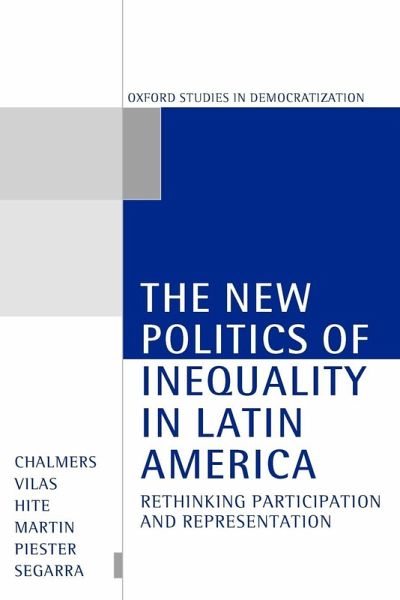
Against a broader backdrop of globalization and worldwide moves toward political democracy, The New Politics of Inequality in Latin America examines the unfolding relationships among social change, equity, and the democratic representation of the poor in Latin America. Recent Latin American governments have turned away from redistributive policies; at the same time, popular political and social organizations have been generally weakened, inequality has increased, and the gap between rich and poor has grown. Hanging in the balance is the consolidation and the quality of new or would-be…mehr
Against a broader backdrop of globalization and worldwide moves toward political democracy, The New Politics of Inequality in Latin America examines the unfolding relationships among social change, equity, and the democratic representation of the poor in Latin America. Recent Latin American governments have turned away from redistributive policies; at the same time, popular political and social organizations have been generally weakened, inequality has increased, and the gap between rich and poor has grown. Hanging in the balance is the consolidation and the quality of new or would-be democracies; this volume suggests that governments must find not just short-term programmes to alleviate poverty, but long-term means to ensure the effective integration of the poor into political life. The New Politics of Inequality in Latin America bridges the intellectual chasm between, on the one hand, studies of grassroots politics, and on the other, explorations of elite politics and formal institution-building. It will be of interest to students and scholars of contemporary Latin American politics and society and, more generally, in the vicissitudes of democracy and citizenship in the late twentieth-century global system.
Douglas A. Chalmers is Professor of Political Science at Columbia University and Acting Dean of its School of International and Public Affairs. Chalmers has written several articles on political institutions and the state in Latin America, and he is co-editor (with Maria do Campello de Souza and Atilio Borón) of The Right and Democracy in Latin America (1992). He received his Ph.D. from Yale University. Chalmers's recent research has focused on transnational linkages and on Mexico, where he taught at El Colegio de Mexico and where he led a team of researchers investigating the role of non-governmental organizations in that country. Carlos M. Vilas is Research Professor at Universidad Nacional Autónoma de Mexico. He is the author of numerous articles and books, including State, Class and Ethnicity in Nicaragua (1989) and Between Earthquakes and Volcanoes: Market, States and the Central American Revolutions His current research focuses on the on-going restructuring of state/market/civil society relations in Latin America and its impact on processes of democratization.
Inhaltsangabe
* Introduction * 1: Carlos M. Vilas: Participation, Inequality, and the Whereabouts of Democracy * Section I: Traditional Actors, New Settings * 2: Scott B. Martin: Beyond Corporatism: New Patterns of Representation in the Brazilian Auto Industry * 3: M. Victoria Murillo: Union Politics, Market-Orientated Reforms and the Reshaping of Argentine Corporatism * 4: Anthony W. Pereira: The Crisis of Developmentalism and the Rural Labor Movement in Northeast Brazil * Section II: Searching for New Forms of Participation * 5: Margarita Lopez-Maya: The Rise of Causa R in Venezuela * 6: Kathleen Bruhn: The Seven-Month Itch?: Neoliberal Politics, Popular Movements, and the Left in Mexico * 7: Melina Selverston: The Politics of Identity Reconstruction: Indians and Democracy in Ecuador * 8: Kathryn Hochstetler: The Evolution of the Brazilian Environmental Movement and Its Political Roles * 9: Aldo Panfichi: The Authoritarian Alternative: Anti-Politics Among the Popular Sectors of Lima * Section III: The Stubbornness of Violence * 10: Deborah J. Yashar: The Quetzal is Red: Military States, Popular Movements, and Political Violence in Guatemala * 11: Paulo Sergio Pinheiro: Popular Responses to State-Sponsored Violence in Brazil * 12: Jo-Marie Burt: Political Violence and the Grassroots in Lima, Peru * Section IV: Dilemmas of a Social Democratic Project * 13: Kenneth M. Roberts: Rethinking Economic Alternatives: Left Parties and the Articulation of Popular Demands in Chile and Peru * 14: Eric Hershberg: Market-Orientated Development Strategies and State-Society Relations in New Democracies: Lessons from Contemporary Chile and Spain * 15: Fernando Fildueira and Jorge Papadopulos: Putting Conservatism to Good Use?: Long Crisis and Vetoed Alternatives in Uruguay * Section V: Reconstructing Representation * 16: Jonathan Fox: The Difficult Transition from Clientelism to Citizenship: Lessons from Mexico * 17: William R. Nylen: Reconstructing the Workers Party (PT): Lessons from Northeastern Brazil * 18: Peter Winn and Lilia Ferro-Clerico: Can a Leftist Government Make a Difference?: The Frente Amplio Administration of Montevideo, 1990-1994 * 19: Kerianne Piester: Targeting the Poor: The Politics of Social Policy Reforms in Mexico * 20: Monique Segarra: Redefining the Public/Private Mix: NGOs and the Emergency Social Investment Fund in Ecuador * 21: Maria Lorena Cook: Regional Integration and Transnational Politics: Popular Sector Strategies in the NAFTA Era * Conclusion * 22: Douglas A. Chalmers: Associative Networks: New Structures of Representation for the Popular Sectors? * Contributors List * Bibliography
* Introduction * 1: Carlos M. Vilas: Participation, Inequality, and the Whereabouts of Democracy * Section I: Traditional Actors, New Settings * 2: Scott B. Martin: Beyond Corporatism: New Patterns of Representation in the Brazilian Auto Industry * 3: M. Victoria Murillo: Union Politics, Market-Orientated Reforms and the Reshaping of Argentine Corporatism * 4: Anthony W. Pereira: The Crisis of Developmentalism and the Rural Labor Movement in Northeast Brazil * Section II: Searching for New Forms of Participation * 5: Margarita Lopez-Maya: The Rise of Causa R in Venezuela * 6: Kathleen Bruhn: The Seven-Month Itch?: Neoliberal Politics, Popular Movements, and the Left in Mexico * 7: Melina Selverston: The Politics of Identity Reconstruction: Indians and Democracy in Ecuador * 8: Kathryn Hochstetler: The Evolution of the Brazilian Environmental Movement and Its Political Roles * 9: Aldo Panfichi: The Authoritarian Alternative: Anti-Politics Among the Popular Sectors of Lima * Section III: The Stubbornness of Violence * 10: Deborah J. Yashar: The Quetzal is Red: Military States, Popular Movements, and Political Violence in Guatemala * 11: Paulo Sergio Pinheiro: Popular Responses to State-Sponsored Violence in Brazil * 12: Jo-Marie Burt: Political Violence and the Grassroots in Lima, Peru * Section IV: Dilemmas of a Social Democratic Project * 13: Kenneth M. Roberts: Rethinking Economic Alternatives: Left Parties and the Articulation of Popular Demands in Chile and Peru * 14: Eric Hershberg: Market-Orientated Development Strategies and State-Society Relations in New Democracies: Lessons from Contemporary Chile and Spain * 15: Fernando Fildueira and Jorge Papadopulos: Putting Conservatism to Good Use?: Long Crisis and Vetoed Alternatives in Uruguay * Section V: Reconstructing Representation * 16: Jonathan Fox: The Difficult Transition from Clientelism to Citizenship: Lessons from Mexico * 17: William R. Nylen: Reconstructing the Workers Party (PT): Lessons from Northeastern Brazil * 18: Peter Winn and Lilia Ferro-Clerico: Can a Leftist Government Make a Difference?: The Frente Amplio Administration of Montevideo, 1990-1994 * 19: Kerianne Piester: Targeting the Poor: The Politics of Social Policy Reforms in Mexico * 20: Monique Segarra: Redefining the Public/Private Mix: NGOs and the Emergency Social Investment Fund in Ecuador * 21: Maria Lorena Cook: Regional Integration and Transnational Politics: Popular Sector Strategies in the NAFTA Era * Conclusion * 22: Douglas A. Chalmers: Associative Networks: New Structures of Representation for the Popular Sectors? * Contributors List * Bibliography
Es gelten unsere Allgemeinen Geschäftsbedingungen: www.buecher.de/agb
Impressum
www.buecher.de ist ein Internetauftritt der buecher.de internetstores GmbH
Geschäftsführung: Monica Sawhney | Roland Kölbl | Günter Hilger
Sitz der Gesellschaft: Batheyer Straße 115 - 117, 58099 Hagen
Postanschrift: Bürgermeister-Wegele-Str. 12, 86167 Augsburg
Amtsgericht Hagen HRB 13257
Steuernummer: 321/5800/1497
USt-IdNr: DE450055826