
Andere Kunden interessierten sich auch für
 Ontology, or the Theory of Being An Introduction to General Metaphysics42,99 €
 The Real Starting-Point for Our World15,99 €
 In the Beginning There Was Freedom16,99 €
 The Three Category Ontology24,99 €
 Metaphysics121,99 €
 Ontology or the Theory of Being30,99 €
 INSTANCOLOGY42,99 €
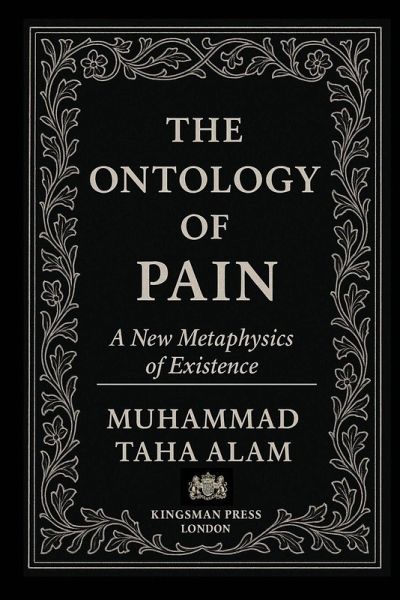
The Ontology of Pain: A New Metaphysics of Existence by Muhammad Taha Alam redefines pain as the foundation of Being, challenging traditional metaphysical views that equate existence with harmony or perfection. ¿ Pain is presented as the first vibration of existence-the strain that makes difference, relation, and awareness possible. ¿ It is the medium through which Being learns itself, transforming resistance into reflexivity and reflexivity into meaning. ¿ The book explores pain as the primal mode of contact through which existence becomes aware of its limits. ¿ Pain is not merely a biological signal or emotional state but the first sensation that enables awareness. ¿ This perspective redefines freedom, not as the absence of constraint, but as the conscious participation in the limits that sustain existence. ¿ Reflexivity-the capacity to feel and respond to resistance-is identified as the structural principle of reality, linking pain to the evolution of consciousness, freedom, and agency. ¿ Ethically, the book argues that compassion is the highest expression of Being's reflexivity. ¿ Compassion is not just a moral sentiment but a metaphysical act-a recognition of shared endurance. ¿ To act compassionately is to transform suffering into meaning and relation, participating in the reflexive labor of existence. ¿ This ethical framework challenges the modern pursuit of comfort and control, offering instead a vision of life as mutual endurance and shared understanding. ¿ The social critique examines how modern systems-capitalism, technology, and governance-externalize pain, concealing the endurance that sustains them. ¿ This externalization has led to alienation, inequality, and ecological crisis. ¿ Yet these crises are interpreted as moments of revelation, opportunities to rediscover the interdependence that underlies existence. ¿ The book envisions a transparent civilization where institutions distribute endurance equitably and knowledge serves relation rather than domination. ¿ Philosophical spirituality is central to the book's vision, offering transparency as the ultimate goal of reflexivity. ¿ Transparency is described as the state in which awareness understands the necessity of resistance without mistaking it for hostility. ¿ It is the equilibrium where pain and pleasure are reconciled, and consciousness perceives the world as mutual endurance. ¿ The sacred is reinterpreted as the reflexive structure of reality itself, dissolving the boundary between cognition and devotion. ¿ The book emphasizes the ethical and spiritual dimensions of transparency, arguing that the good is whatever increases mutual awareness among beings. ¿ Justice is framed as the equitable distribution of endurance, and compassion is presented as the practical expression of the sacred. ¿ The transparent civilization envisioned in the book integrates ethics, science, and spirituality, transforming institutions into organs of shared reflexivity. Modernity's crises-ecological collapse, social inequality, and spiritual alienation-are framed as the return of the repressed real, moments when Being remembers itself through suffering. ¿ The book argues that the exhaustion of the modern project-its denial of dependence and externalization of pain-prepares the ground for a new mode of realism. ¿ This realism acknowledges that knowledge is participation, not mastery, and that freedom lies in the conscious acceptance of limits. ¿ Ultimately, The Ontology of Pain offers a profound rethinking of existence, freedom, and meaning. ¿ It challenges readers to confront their assumptions about suffering and to see pain not as an obstacle but as a teacher.