
Andere Kunden interessierten sich auch für
 The Origins of Asset Management from 1700 to 196098,99 €
 The Origins of Globalization185,99 €
 The Origins of Neoliberalism194,99 €
 The Origins and Evolution of the Single Market in Europe130,99 €
 The Origins of Liberty46,99 €
 The Origins of Business17,99 €
 The Origins of Economic Democracy131,99 €






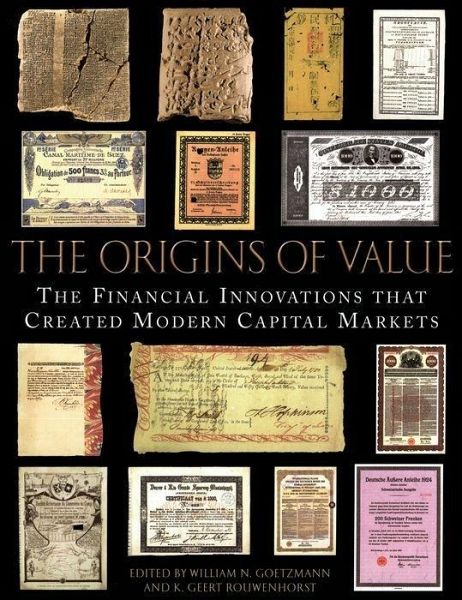
The essays in this volume are written by a distinguished and adventurous set of historians and economists who have been willing, in many cases, to step beyond their typical field of inquiry and explore the historical foundations of financial innovation. The essays are motivated by the need to place our current age of finanical revolution in historical perspective. The continuing process of financial innovation, as sophisticated as it may seem to most of the modern
world, is in fact built on surprisingly few basic principles: the inter-temporal transfer of value through time, the ability to contract on future outcomes, and the negotiability of claims. This book traces the evolution of these basic principles of finance through 3,000 years of history - to the dawn
of writing. The methodology that is used can be thought of as financial archaeology in the sense that the authors focus on primary survived financial documents to draw their conclusions such as clay tablets, notched sticks, sealed parchment and printed paper. The analysis of original documents is a means for economists to focus on the primary text, to analyze and interpret the object and to move interpretation and understanding of its relationship to modern financial
instruments and markets. The result is a collection of interdisciplinary studies of the key innovations in finance from the Old Babylonion loan tablets, to the 1953 London Debt Agreement that span regions in Asia, Africa, North America and Europe.
world, is in fact built on surprisingly few basic principles: the inter-temporal transfer of value through time, the ability to contract on future outcomes, and the negotiability of claims. This book traces the evolution of these basic principles of finance through 3,000 years of history - to the dawn
of writing. The methodology that is used can be thought of as financial archaeology in the sense that the authors focus on primary survived financial documents to draw their conclusions such as clay tablets, notched sticks, sealed parchment and printed paper. The analysis of original documents is a means for economists to focus on the primary text, to analyze and interpret the object and to move interpretation and understanding of its relationship to modern financial
instruments and markets. The result is a collection of interdisciplinary studies of the key innovations in finance from the Old Babylonion loan tablets, to the 1953 London Debt Agreement that span regions in Asia, Africa, North America and Europe.