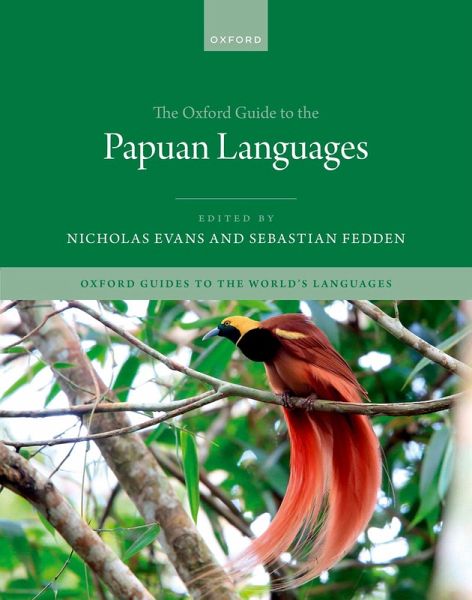
This volume presents a wide-ranging survey of the Papuan languages, spoken on the island of New Guinea and its surroundings. They make up around 12% of the world's languages, with a level of linguistic diversity comparable to the vast Eurasian zone concentrated into just 1% of the world's land area. This is true whether we count individual languages (around 890), families and isolates (around 95), or elements of structural diversity: many linguistic phenomena were first reported or are still only attested in this region. Following a detailed introduction by the editors, The Oxford Guide to the…mehr
This volume presents a wide-ranging survey of the Papuan languages, spoken on the island of New Guinea and its surroundings. They make up around 12% of the world's languages, with a level of linguistic diversity comparable to the vast Eurasian zone concentrated into just 1% of the world's land area. This is true whether we count individual languages (around 890), families and isolates (around 95), or elements of structural diversity: many linguistic phenomena were first reported or are still only attested in this region. Following a detailed introduction by the editors, The Oxford Guide to the Papuan Languages is divided into four parts. The first provides structural descriptions of 23 languages from across the region, many of which have never previously been described. Part II includes typological surveys of features that are of particular interest in Papuan languages, from tone to valency change, and from information structure to kinship terminology. Chapters in Part III explore language in its cultural context, with topics including multilingualism, sign languages, and language shift, while Part IV focuses on historical and contact studies. The volume will be a crucial reference not only for scholars of Papuan languages but also for anyone interested in the human history of this fascinating and little-known part of the world.
Nicholas Evans is Distinguished Professor of Linguistics at the Australian National University. He investigates linguistic diversity and what this tells us about the nature of language, culture, deep history, and human creativity. He has carried out extensive fieldwork in Northern Australia (Kayardild, Bininj Kunwok, Dalabon, Iwaidja) and Papua New Guinea (Nen, Idi); his interests range from questions of grammar-writing, linguistic typology, and translation to historical linguistics. A member of the Australian Academy of the Humanities, the Australian Social Sciences Academy and the British Academy, he has been awarded an inaugural Anneliese Maier Forschungspreis, and a Ken Hale Award from the Linguistics Society of America. Sebastian Fedden is Professor of Linguistics at the Université Sorbonne Nouvelle in Paris and is affiliated with the Ludwig-Maximilians-Universität in Munich and the University of Surrey. He is a typologist with a specialization in morphology and Papuan languages and linguistics. His interests span linguistic diversity, the relationship between language, mind and culture, and grammar writing. He has carried out fieldwork in Papua New Guinea (on Mian) and Indonesia (on languages of Alor and Pantar). His grammar of Mian, published in 2011, won the von der Gabelentz Award of the Association for Linguistic Typology (ALT) for the best published grammar from 2009 to 2012.
Inhaltsangabe
* 1: Nicholas Evans and Sebastian Fedden: Papuan languages: A general introduction * Part I. Language descriptions * 2: Ger Reesink and Cecilia Odé: Mpur (Isolate, Birds Head) * 3: Brendon Yoder: Abawiri (Lakes Plain) * 4: Marian Klamer: Sentani (Sentanic) * 5: Mark Donohue: Skou (Sko) * 6: Jose Antonio Jodár-Sánchez, Lea Brown, and Matthew S. Dryer: Srenge (Torricelli) * 7: Sylvain Loiseau: Tuwari (Walio) * 8: Bernard Comrie and John Davies: Haruai (Piawi) * 9: Gerd Jendraschek: Iatmul (Sepik, Ndu) * 10: Darja Hoenigman: Awiakay (Arafundi) * 11: Birgit Hellwig, Cindy Schneider, and Tonya Stebbins: Baining (New Britain) * 12: Angela Terrill and Michael Dunn: Touo (Isolate, Solomon Is.) * 13: Christian Döhler: Bine (Oriomo) * 14: Mae Carroll: Yei (Yam) * 15: Don Daniels: Soq (TNG, Madang) * 16: Carl R. Whitehead: Menya (TNG, Angan) * 17: Volker Heeschen: Eipo (TNG, Mek) * 18: Bernhard Wälchli and Erik Svärd: Nalca (TNG, Mek) * 19: Sebastian Fedden: Telefol (TNG, Ok Oksapmin) * 20: Bruno Olsson: Yaqay (TNG, Anim) * 21: Jason Brown: Urama (TNG, Kiwaian) * 22: Katherine Walker and Nikolaus P. Himmelmann: Iha (TNG, West Bomberai) * 23: Eline Visser: Kalamang (TNG, West Bomberai) * 24: Frantiek Kratochvíl, George Saad, and Benediktus Delpada: Abui (TNG, Alor Pantar) * Part II. The typology of Papuan languages * 25: John Hajek and Timothy C. Brickell: A typology of Papuan segmental phoneme inventories * 26: Sebastian Fedden: Tone in Papuan languages * 27: Birgit Hellwig: Semantic typology in Papuan languages * 28: Antoinette Schapper: Lexical typology in Papuan languages, with special reference to colexification * 29: Nicholas Evans, Wolfgang Barth, Simon J. Greenhill, Bruno Olsson, and Sam Passmore: Kinship terminology in Papuan languages * 30: Chris Healey, Janet Gagul, and Alfred Kik: Ethnobiological nomenclature in Papuan languages * 31: Volker Heeschen and Sonja Riesberg: Lexicography and lexicology of Papuan languages * 32: Bruno Olsson and Christian Döhler: Alignment in Papuan languages * 33: Bruno Olsson: Valency change in Papuan languages * 34: Nicholas Evans: Reciprocal constructions in Papuan languages * 35: Nicholas Evans and Sebastian Fedden: Tense, aspect, and mood systems in Papuan languages * 36: Lila San Roque: Evidentiality and epistemic marking in Papuan languages * 37: Alexandra Y. Aikhenvald: Serial verbs in Papuan languages * 38: Sonja Riesberg and Bruno Olsson: Coverb constructions in Papuan languages * 39: Frantiek Kratochvíl: Demonstratives in Papuan languages * 40: Bernard Comrie: Numeral systems in Papuan languages * 41: Sebastian Fedden: Nominal classification in Papuan languages * 42: Gary Holton and Henry Osborne: Possession in Papuan languages * 43: I Wayan Arka, Mary Dalrymple, and Keira Mullan: Grammatical number in Papuan languages * 44: Tina Gregor: Suppletion in Papuan languages * 45: Don Daniels: Switch reference in Papuan languages: Synchronic and diachronic * 46: Hannah S. Sarvasy: Clause chaining in Papuan languages * 47: Ger Reesink and Nicholas Evans: Reported speech in Papuan languages * 48: Don Daniels: Information structure in Papuan languages * 49: Nikolaus P. Himmelmann and Sonja Riesberg: Discourse patterns and emerging grammar in Papuan languages * Part III. Papuan languages in their cultural context * 50: Christian Döhler: Multilingualism in the Papuasphere * 51: Darja Hoenigman: Speech styles and registers in Papuan languages * 52: Alan Rumsey and Don Niles: Language, song, and sung tales in the Papuan region * 53: Alexandra Y. Aikhenvald: Names and naming in Papuan languages of New Guinea * 54: Kensy Cooperrider and Rafael E. Núñez: Gesture in New Guinea * 55: Lauren W. Reed: Sign languages of the Papuasphere * 56: James Slotta: Sociocultural processes of Papuan linguistic diversification * 57: Eri Kashima and Dineke Schokkin: Sociolinguistic variation in New Guinea * 58: Yusuf Sawaki and I Wayan Arka: The contemporary sociolinguistics of Tanah Papua * 59: Don Kulick and Lise M. Dobrin: Rampant language shift in Papua New Guinea * 60: Birgit Hellwig, Hannah S. Sarvasy, and Marisa Casillas: Acquisition of Papuan languages * 61: Lila San Roque and Bambi B. Schiefflin: Language socialization in Papuan languages * 62: Lourens de Vries, René van den Berg, and Bert Voorhoeve: An overview of the missionary linguistics of New Guinea * Part IV. Papuan historical and areal linguistics * 63: Simon J. Greenhill: Tentatively tracing Trans New Guinea * 64: Don Daniels: The Madang branch of Trans New Guinea * 65: Edgar Suter: Comparative grammar of the Huon peninsula languages * 66: Edgar Suter: Contact-induced morphological change in Dedua * 67: Nicholas Evans, Christian Döhler, and Mae Carroll: Historical linguistics of the Yam family * 68: Marian Klamer: Papuan-Austronesian contact in pre-modern eastern Indonesia * 69: Laura Arnold and Emily Gasser: Austronesian-Papuan contact in Northwestern New Guinea * 70: Sylvain Loiseau: Papuan-Papuan contact: Sepik * 71: Angela Kluge: Papuan Malay * 72: Chris Ballard: Papuan histories and linguistics
* 1: Nicholas Evans and Sebastian Fedden: Papuan languages: A general introduction * Part I. Language descriptions * 2: Ger Reesink and Cecilia Odé: Mpur (Isolate, Birds Head) * 3: Brendon Yoder: Abawiri (Lakes Plain) * 4: Marian Klamer: Sentani (Sentanic) * 5: Mark Donohue: Skou (Sko) * 6: Jose Antonio Jodár-Sánchez, Lea Brown, and Matthew S. Dryer: Srenge (Torricelli) * 7: Sylvain Loiseau: Tuwari (Walio) * 8: Bernard Comrie and John Davies: Haruai (Piawi) * 9: Gerd Jendraschek: Iatmul (Sepik, Ndu) * 10: Darja Hoenigman: Awiakay (Arafundi) * 11: Birgit Hellwig, Cindy Schneider, and Tonya Stebbins: Baining (New Britain) * 12: Angela Terrill and Michael Dunn: Touo (Isolate, Solomon Is.) * 13: Christian Döhler: Bine (Oriomo) * 14: Mae Carroll: Yei (Yam) * 15: Don Daniels: Soq (TNG, Madang) * 16: Carl R. Whitehead: Menya (TNG, Angan) * 17: Volker Heeschen: Eipo (TNG, Mek) * 18: Bernhard Wälchli and Erik Svärd: Nalca (TNG, Mek) * 19: Sebastian Fedden: Telefol (TNG, Ok Oksapmin) * 20: Bruno Olsson: Yaqay (TNG, Anim) * 21: Jason Brown: Urama (TNG, Kiwaian) * 22: Katherine Walker and Nikolaus P. Himmelmann: Iha (TNG, West Bomberai) * 23: Eline Visser: Kalamang (TNG, West Bomberai) * 24: Frantiek Kratochvíl, George Saad, and Benediktus Delpada: Abui (TNG, Alor Pantar) * Part II. The typology of Papuan languages * 25: John Hajek and Timothy C. Brickell: A typology of Papuan segmental phoneme inventories * 26: Sebastian Fedden: Tone in Papuan languages * 27: Birgit Hellwig: Semantic typology in Papuan languages * 28: Antoinette Schapper: Lexical typology in Papuan languages, with special reference to colexification * 29: Nicholas Evans, Wolfgang Barth, Simon J. Greenhill, Bruno Olsson, and Sam Passmore: Kinship terminology in Papuan languages * 30: Chris Healey, Janet Gagul, and Alfred Kik: Ethnobiological nomenclature in Papuan languages * 31: Volker Heeschen and Sonja Riesberg: Lexicography and lexicology of Papuan languages * 32: Bruno Olsson and Christian Döhler: Alignment in Papuan languages * 33: Bruno Olsson: Valency change in Papuan languages * 34: Nicholas Evans: Reciprocal constructions in Papuan languages * 35: Nicholas Evans and Sebastian Fedden: Tense, aspect, and mood systems in Papuan languages * 36: Lila San Roque: Evidentiality and epistemic marking in Papuan languages * 37: Alexandra Y. Aikhenvald: Serial verbs in Papuan languages * 38: Sonja Riesberg and Bruno Olsson: Coverb constructions in Papuan languages * 39: Frantiek Kratochvíl: Demonstratives in Papuan languages * 40: Bernard Comrie: Numeral systems in Papuan languages * 41: Sebastian Fedden: Nominal classification in Papuan languages * 42: Gary Holton and Henry Osborne: Possession in Papuan languages * 43: I Wayan Arka, Mary Dalrymple, and Keira Mullan: Grammatical number in Papuan languages * 44: Tina Gregor: Suppletion in Papuan languages * 45: Don Daniels: Switch reference in Papuan languages: Synchronic and diachronic * 46: Hannah S. Sarvasy: Clause chaining in Papuan languages * 47: Ger Reesink and Nicholas Evans: Reported speech in Papuan languages * 48: Don Daniels: Information structure in Papuan languages * 49: Nikolaus P. Himmelmann and Sonja Riesberg: Discourse patterns and emerging grammar in Papuan languages * Part III. Papuan languages in their cultural context * 50: Christian Döhler: Multilingualism in the Papuasphere * 51: Darja Hoenigman: Speech styles and registers in Papuan languages * 52: Alan Rumsey and Don Niles: Language, song, and sung tales in the Papuan region * 53: Alexandra Y. Aikhenvald: Names and naming in Papuan languages of New Guinea * 54: Kensy Cooperrider and Rafael E. Núñez: Gesture in New Guinea * 55: Lauren W. Reed: Sign languages of the Papuasphere * 56: James Slotta: Sociocultural processes of Papuan linguistic diversification * 57: Eri Kashima and Dineke Schokkin: Sociolinguistic variation in New Guinea * 58: Yusuf Sawaki and I Wayan Arka: The contemporary sociolinguistics of Tanah Papua * 59: Don Kulick and Lise M. Dobrin: Rampant language shift in Papua New Guinea * 60: Birgit Hellwig, Hannah S. Sarvasy, and Marisa Casillas: Acquisition of Papuan languages * 61: Lila San Roque and Bambi B. Schiefflin: Language socialization in Papuan languages * 62: Lourens de Vries, René van den Berg, and Bert Voorhoeve: An overview of the missionary linguistics of New Guinea * Part IV. Papuan historical and areal linguistics * 63: Simon J. Greenhill: Tentatively tracing Trans New Guinea * 64: Don Daniels: The Madang branch of Trans New Guinea * 65: Edgar Suter: Comparative grammar of the Huon peninsula languages * 66: Edgar Suter: Contact-induced morphological change in Dedua * 67: Nicholas Evans, Christian Döhler, and Mae Carroll: Historical linguistics of the Yam family * 68: Marian Klamer: Papuan-Austronesian contact in pre-modern eastern Indonesia * 69: Laura Arnold and Emily Gasser: Austronesian-Papuan contact in Northwestern New Guinea * 70: Sylvain Loiseau: Papuan-Papuan contact: Sepik * 71: Angela Kluge: Papuan Malay * 72: Chris Ballard: Papuan histories and linguistics
Es gelten unsere Allgemeinen Geschäftsbedingungen: www.buecher.de/agb
Impressum
www.buecher.de ist ein Internetauftritt der buecher.de internetstores GmbH
Geschäftsführung: Monica Sawhney | Roland Kölbl | Günter Hilger
Sitz der Gesellschaft: Batheyer Straße 115 - 117, 58099 Hagen
Postanschrift: Bürgermeister-Wegele-Str. 12, 86167 Augsburg
Amtsgericht Hagen HRB 13257
Steuernummer: 321/5800/1497
USt-IdNr: DE450055826