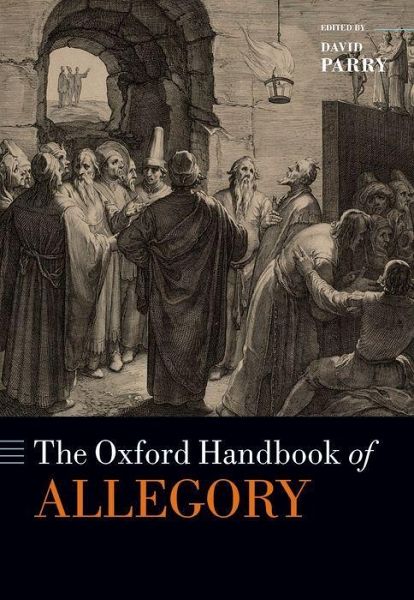
191,99 €
inkl. MwSt.
Versandkostenfrei*Erscheint vorauss. 6. Februar 2026
Melden Sie sich
hier
hier
für den Produktalarm an, um über die Verfügbarkeit des Produkts informiert zu werden.

96 °P sammeln
Andere Kunden interessierten sich auch für
 The Oxford Handbook of Lord Byron205,99 €
 The Oxford Handbook of Samuel Johnson192,99 €
 The Oxford Handbook of Slavic and East European Folklore257,99 €
 The Oxford Book of Modern Science Writing20,99 €
 The Oxford Critical Guide to Homer's Iliad137,99 €
 The Oxford History of the Novel in English191,99 €
 The Oxford History of Life Writing: Volume 2. Early Modern69,99 €
Allegory has been variously defined as a literary genre, a mode of interpretation, and a symbolic dimension to all language. Although 'allegory' historically escapes easy definition, it can be broadly defined as a mode of communicating that says one thing and means another. Allegory arguably functions by means of a distinction between the surface level of communication and a further level or levels of significance beyond the surface. The term 'allegory' has historically been used both of a mode of writing or representation and of a mode of reading and interpretation. Allegorical writing is found throughout history in a wide variety of literary forms and traditions. This Handbook reflects the diversity of literature in which allegory occurs, including genres such as medieval drama, Romantic poetry, and the postcolonial novel. It addresses both key texts typically thought of as allegories (such as Piers Plowman, The Pilgrim's Progress, and Animal Farm), and allegorical motifs and tendencies present in works not usually labelled as allegories, such as the novels of Dickens and the drama of Beckett. The Handbook also explores forms of allegorical representation beyond written texts, including visual art and film. In addition, the volume traces the history of allegorical reading and interpretation (often known as allegoresis), which has had immense cultural significance, especially in the case of sacred texts such as the Bible, but also, for instance, in the edifying readings of Greek myths and legends. This Handbook tackles a topic that is by its nature global, transhistorical, and interdisciplinary, and its coverage reflects that breadth of appeal, starting with Plato's myth of the cave and finishing with the 2015 Disney/Pixar film Inside Out. It draws upon, and makes contributions to, fields including literary studies, film studies, art history, mathematics, classics, theology, and cognitive science. It features both traditional topics of discussion in relation to allegory (such as rhetoric, personification, and typology) and innovative new approaches (such as ecocritical and phenomenological readings), offering a kaleidoscope of perspectives to illuminate the ongoing resonance of allegory's 'other-speaking' to the present.