Archaeological research on islands has made significant contributions to our understanding of human cultural development, with aquatic resources and maritime adaptations being increasingly recognized as having had profound effects on human evolution, worldwide dispersals, and the development of social complexity. Once thought to be marginal habitats for humans--lacking in many of the necessary dietary and raw material requirements for societies to thrive--recent research in island and coastal regions around the world has shown this to be false. In fact, the opposite appears to be true in many…mehr
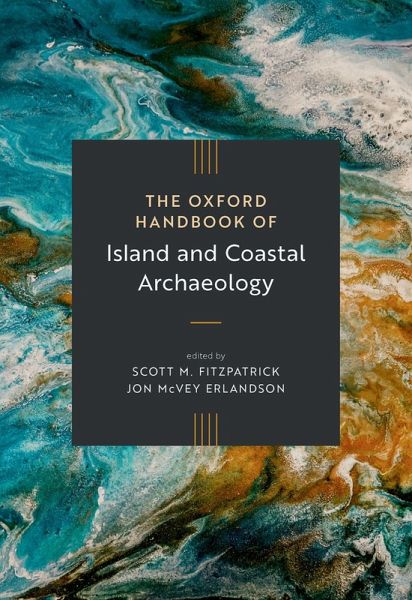
Archaeological research on islands has made significant contributions to our understanding of human cultural development, with aquatic resources and maritime adaptations being increasingly recognized as having had profound effects on human evolution, worldwide dispersals, and the development of social complexity. Once thought to be marginal habitats for humans--lacking in many of the necessary dietary and raw material requirements for societies to thrive--recent research in island and coastal regions around the world has shown this to be false. In fact, the opposite appears to be true in many cases, where aquatic resources were plentiful, highly nutritious, and relatively easy to harvest. The Oxford Handbook of Island & Coastal Archaeology is the first volume to synthesize major topics in the subfield of island and coastal archaeology on a truly global scale, including methodological and theoretical advances that have positioned the subfield as central to archaeology, history, and historical ecology. It includes up-to-date syntheses by leading scholars of the development of human societies in island and coastal environments around the world, including Oceania, the Americas, Europe, Asia, and Africa. This volume also highlights emerging contemporary issues such as Indigenous perspectives and rights, submerged landscapes, heritage conservation and management, and tourism. This volume explores an array of research topics, including: the origins and development of aquatic adaptations and the exploitation of marine resources; the colonization and settlement histories of island and coastal regions around the worlds; the movement and transfer of exotic goods, plants, and animals; the development of trade and exchange systems between different cultural groups; interaction spheres that evolved through time; reports or comparisons of seafaring technologies worldwide; how insular environments affected or influenced sociocultural complexity; how peoples compensated for restricted resources on some islands; historical ecologies, human impacts, and long-term human resilience in island settings; the transformation of Indigenous societies after European contact; and current multidisciplinary methods and research of archaeologists and other scientists.
Scott M. Fitzpatrick is a Professor in the Department of Anthropology and Curator of Indo-Pacific Collections at the Museum of Natural and Cultural History, University of Oregon. He is an archaeologist who specializes in the historical ecology of island and coastal regions, particularly the Pacific and Caribbean. Much of his research has focused on colonization events, seafaring strategies, adaptations to smaller islands, exchange systems, and human impacts on ancient environments. Dr. Fitzpatrick is the founding co-editor of the Journal of Island and Coastal Archaeology and has published several books and more than 150 journal articles and book chapters. Jon McVey Erlandson is an Archaeologist and retired Professor/Museum Director with the University of Oregon. His field research has focused on the Pacific Coast of North America and Viking Age Iceland. His broader research interests and expertise are in the deep history (archaeology and historical ecology) of human interaction with island and coastal ecosystems worldwide, including human evolution, dispersals, adaptations, ecological impacts, sustainability, and resilience. He is an elected member of the American Academy of Arts & Sciences, the American Association for the Advancement of Science, and Sigma Xi.
Inhaltsangabe
* Chapter 1: Island and Coastal Archaeology in the 21st Century, Jon M. Erlandson and Scott M. Fitzpatrick * Chapter 2: The Importance of Aquatic Foods and Environments for the Early Hominin Brain, Kathlyn M. Stewart and Stephen C. Cunnane * Chapter 3: The Origins of Prehistoric Sailing Technologies in the Pacific Ocean, Atholl Anderson * Chapter 4: The Sailing Performance of Ancient Pacific Canoes: Technological Innovations and Maritime Migrations, Geoffrey Irwin, Richard G. J. Flay, Loughlin Dudley, and Dilys Johns * Chapter 5: From Colonization to Increasing Social Complexity: The Importance of Prehistoric Interaction, Marshall I. Weisler and Glenn R. Summerhayes * Chapter 6: The Archaeology of Islands and Coasts in the Study of Colonialism and the Rise of the Early Modern World, Kent G. Lightfoot, Benjamin D. Siegel, and James M. Allan * Chapter 7: Archaeology and the Anthropocene in Island and Coastal Settings, Todd J. Braje * Chapter 8: The Origins and Significance of Coastal Resource Use in Human Evolution, Curtis W. Marean * Chapter 9: Underwater Archaeology and Submerged Landscapes, Amy Gusick * Chapter 10: Seafaring in Prehistory: Simulations and Experiments, Alvaro Montenegro * Chapter 11: Exchange Systems and Interaction in Ancient Island and Coastal Settings, Helen Dawson and Julian Jansen van Rensburg * Chapter 12: Animals in Insular Archaeological Settings: Key Themes for Contextualizing Island Zooarchaeological Research the 21st Century, Christina Giovas, Michelle LeFebvre, Tiina Manne, Kellie Pollard, Damià Ramis, and Melinda S. Allen * Chapter 13: The Importance of Geophytes and Other Plant Foods in Ancient Island and Coastal Societies, Kristina Gill and Jon M. Erlandson * Chapter 14: The Use of Seaweeds and Marine Plants by Island and Coastal Peoples in the Past, Amira F. Ainis, Jon M. Erlandson * Chapter 15: Contributions of Human Genetics to Island and Coastal Archaeology, Jessica H. Stone and Laura S. Weyrich * Chapter 16: Isotope Research in Island and Coastal Archaeology, Rebecca Kinaston, Jane Evans, Jason Laffoon, Domingo C. Salazar Garcia, and Eric J. Bartelink * Chapter 17: Commensal Models in Island Archeology: Animal and Plant Translocations, Catherine Collins, Anna L. Gosling, and Elizabeth Matisoo-Smith * Chapter 18: Historical Ecology and the Archaeology of Islands and Coastlines, Torben C. Rick, Courtney A. Hofman, and Alexis M. Mychajliw * Chapter 19: Pleistocene and Holocene Archaeology of Southern African Coastlines, Antonieta Jerardino * Chapter 20: Coastal Foraging and the Archaeofauna of Northern Africa, Teresa E. Steele, Esteban Álvarez-Fernández, and Emily Y. Hallett * Chapter 21: East African Islands: A Deep Archaeological History, Alison Crowther, Nicole Boivin, and Sinyati R. Mark * Chapter 22: The Archaeology of Madagascar: Current and Future Directions, Tanambelo Rasolondrainy and Kristina Douglass * Chapter 23: Coastal Archaeology of the Arabian Peninsula, Niklas Hausmann, Matthew Meredith-Williams, Robyn Inglis, and Abdullah Al-Sharekh * Chapter 24: Connectivity and Demography in the Insular and Coastal Mediterranean: Perspectives from Paleogenomics and Radiocarbon Probability Distributions, Thomas P. Leppard and John F. Cherry * Chapter 25: The Archaeology of the Iberian Atlantic façade, Nuno Bicho * Chapter 26: Submerged Landscapes in Northern Europe, Peter Moe Astrup and Björn Nilsson * Chapter 27: Across the Gray Waters: Diaspora, Biogeography, and Early Globalization in the North Atlantic, Megan Hicks, Rowan Jackson, George Hambrecht, and Andy Dugmore * Chapter 28: Pleistocene and Early Holocene Occupation on the Eastern Wallacean Islands, Ceri Shipton, Shimona Kealy, and Sue O'Connor * Chapter 29: A Moving Feast: Australia's Coastal and Island Archaeological Record, Ariana B. J. Lambrides, Kane Ditchfield, Sean Ulm, and Peter Veth * Chapter 30: Torres Strait: Seascape Archaeologies Reveal 9000 Years of Dynamic Maritime Cultural History, Ian J. McNiven * Chapter 31: New Guinea and Near Oceania, Mark Golitko * Chapter 32: The Archaeology and Historical Ecology of the Ryukyu Archipelago, Hiroto Takamiya and Mark Hudson * Chapter 33: Archaeology and Human Ecodynamics in the Kuril and Aleutian Island Chains, Katsunori Takase and Ben Fitzhugh * Chapter 34: Recent Advances in the Archaeology of the Arctic Coasts of Alaska, Canada, and Greenland, Christyann M. Darwent and John Darwent * Chapter 35: Placemaking on the Northwest Coast of North America, Dana Lepofsky, Bryn Letham, Morgan Ritchie, and Chelsey Geralda Armstrong * Chapter 36: California's Channel Islands: Ecology, Colonization, and Exchange, Jennifer E. Perry, Christopher S. Jazwa, and Hugh D. Radde * Chapter 37: Native American Archaeology of the Coastal American Southeast, Victor D. Thompson and Isabelle Holland-Lulewicz * Chapter 38: The Coastal Archaeology of South America: Northwest Pacific and Caribbean Rim to Tierra del Fuego, Tom D. Dillehay, Augusto Oyuela-Caycedo, Maria Dulce Gaspar, Mariano Bonomo, Luis Orquera, and Carlos Ocampo * Chapter 39: Highlights in the Pre-Contact Archaeology of the Island Caribbean, Scott M. Fitzpatrick, William J. Pestle, Maaike DeWaal, and Christina Giovas * Chapter 40: Lapita in the Southwest Pacific: Origins, Distribution, Chronology, Economy, and Transformation, Stuart Bedford, Matthew Spriggs, Geoffrey Clark * Chapter 41: Life after Lapita: The diversification of regional cultural identities in the western Pacific Islands, Ben Shaw and Sean P. Connaughton * Chapter 42: The Archaeology of East Polynesia, Patrick V. Kirch and Guillaume Molle * Chapter 43: The Influence and Efflorescence of Ancient Micronesia, Scott M. Fitzpatrick and Matthew F. Napolitano * Chapter 44: Conservation and Management of Coastal Sites, Leslie Reeder-Myers and Nathan Fulmer * Chapter 45: Indigenous Perspectives on Collaborative Archaeology: Two Case Studies from the Pacific Coast of North America, Gabriel M. Sanchez, Mike Grone, Anna Antoniou, and Earl Davis * Chapter 46: Island Tourism and Archaeology, Godfrey Baldacchino and Nicholas C. Vella * Chapter 47: Island and Coastal Archaeology: A Coming of Age, Scott M. Fitzpatrick and Jon M. Erlandson
* Chapter 1: Island and Coastal Archaeology in the 21st Century, Jon M. Erlandson and Scott M. Fitzpatrick * Chapter 2: The Importance of Aquatic Foods and Environments for the Early Hominin Brain, Kathlyn M. Stewart and Stephen C. Cunnane * Chapter 3: The Origins of Prehistoric Sailing Technologies in the Pacific Ocean, Atholl Anderson * Chapter 4: The Sailing Performance of Ancient Pacific Canoes: Technological Innovations and Maritime Migrations, Geoffrey Irwin, Richard G. J. Flay, Loughlin Dudley, and Dilys Johns * Chapter 5: From Colonization to Increasing Social Complexity: The Importance of Prehistoric Interaction, Marshall I. Weisler and Glenn R. Summerhayes * Chapter 6: The Archaeology of Islands and Coasts in the Study of Colonialism and the Rise of the Early Modern World, Kent G. Lightfoot, Benjamin D. Siegel, and James M. Allan * Chapter 7: Archaeology and the Anthropocene in Island and Coastal Settings, Todd J. Braje * Chapter 8: The Origins and Significance of Coastal Resource Use in Human Evolution, Curtis W. Marean * Chapter 9: Underwater Archaeology and Submerged Landscapes, Amy Gusick * Chapter 10: Seafaring in Prehistory: Simulations and Experiments, Alvaro Montenegro * Chapter 11: Exchange Systems and Interaction in Ancient Island and Coastal Settings, Helen Dawson and Julian Jansen van Rensburg * Chapter 12: Animals in Insular Archaeological Settings: Key Themes for Contextualizing Island Zooarchaeological Research the 21st Century, Christina Giovas, Michelle LeFebvre, Tiina Manne, Kellie Pollard, Damià Ramis, and Melinda S. Allen * Chapter 13: The Importance of Geophytes and Other Plant Foods in Ancient Island and Coastal Societies, Kristina Gill and Jon M. Erlandson * Chapter 14: The Use of Seaweeds and Marine Plants by Island and Coastal Peoples in the Past, Amira F. Ainis, Jon M. Erlandson * Chapter 15: Contributions of Human Genetics to Island and Coastal Archaeology, Jessica H. Stone and Laura S. Weyrich * Chapter 16: Isotope Research in Island and Coastal Archaeology, Rebecca Kinaston, Jane Evans, Jason Laffoon, Domingo C. Salazar Garcia, and Eric J. Bartelink * Chapter 17: Commensal Models in Island Archeology: Animal and Plant Translocations, Catherine Collins, Anna L. Gosling, and Elizabeth Matisoo-Smith * Chapter 18: Historical Ecology and the Archaeology of Islands and Coastlines, Torben C. Rick, Courtney A. Hofman, and Alexis M. Mychajliw * Chapter 19: Pleistocene and Holocene Archaeology of Southern African Coastlines, Antonieta Jerardino * Chapter 20: Coastal Foraging and the Archaeofauna of Northern Africa, Teresa E. Steele, Esteban Álvarez-Fernández, and Emily Y. Hallett * Chapter 21: East African Islands: A Deep Archaeological History, Alison Crowther, Nicole Boivin, and Sinyati R. Mark * Chapter 22: The Archaeology of Madagascar: Current and Future Directions, Tanambelo Rasolondrainy and Kristina Douglass * Chapter 23: Coastal Archaeology of the Arabian Peninsula, Niklas Hausmann, Matthew Meredith-Williams, Robyn Inglis, and Abdullah Al-Sharekh * Chapter 24: Connectivity and Demography in the Insular and Coastal Mediterranean: Perspectives from Paleogenomics and Radiocarbon Probability Distributions, Thomas P. Leppard and John F. Cherry * Chapter 25: The Archaeology of the Iberian Atlantic façade, Nuno Bicho * Chapter 26: Submerged Landscapes in Northern Europe, Peter Moe Astrup and Björn Nilsson * Chapter 27: Across the Gray Waters: Diaspora, Biogeography, and Early Globalization in the North Atlantic, Megan Hicks, Rowan Jackson, George Hambrecht, and Andy Dugmore * Chapter 28: Pleistocene and Early Holocene Occupation on the Eastern Wallacean Islands, Ceri Shipton, Shimona Kealy, and Sue O'Connor * Chapter 29: A Moving Feast: Australia's Coastal and Island Archaeological Record, Ariana B. J. Lambrides, Kane Ditchfield, Sean Ulm, and Peter Veth * Chapter 30: Torres Strait: Seascape Archaeologies Reveal 9000 Years of Dynamic Maritime Cultural History, Ian J. McNiven * Chapter 31: New Guinea and Near Oceania, Mark Golitko * Chapter 32: The Archaeology and Historical Ecology of the Ryukyu Archipelago, Hiroto Takamiya and Mark Hudson * Chapter 33: Archaeology and Human Ecodynamics in the Kuril and Aleutian Island Chains, Katsunori Takase and Ben Fitzhugh * Chapter 34: Recent Advances in the Archaeology of the Arctic Coasts of Alaska, Canada, and Greenland, Christyann M. Darwent and John Darwent * Chapter 35: Placemaking on the Northwest Coast of North America, Dana Lepofsky, Bryn Letham, Morgan Ritchie, and Chelsey Geralda Armstrong * Chapter 36: California's Channel Islands: Ecology, Colonization, and Exchange, Jennifer E. Perry, Christopher S. Jazwa, and Hugh D. Radde * Chapter 37: Native American Archaeology of the Coastal American Southeast, Victor D. Thompson and Isabelle Holland-Lulewicz * Chapter 38: The Coastal Archaeology of South America: Northwest Pacific and Caribbean Rim to Tierra del Fuego, Tom D. Dillehay, Augusto Oyuela-Caycedo, Maria Dulce Gaspar, Mariano Bonomo, Luis Orquera, and Carlos Ocampo * Chapter 39: Highlights in the Pre-Contact Archaeology of the Island Caribbean, Scott M. Fitzpatrick, William J. Pestle, Maaike DeWaal, and Christina Giovas * Chapter 40: Lapita in the Southwest Pacific: Origins, Distribution, Chronology, Economy, and Transformation, Stuart Bedford, Matthew Spriggs, Geoffrey Clark * Chapter 41: Life after Lapita: The diversification of regional cultural identities in the western Pacific Islands, Ben Shaw and Sean P. Connaughton * Chapter 42: The Archaeology of East Polynesia, Patrick V. Kirch and Guillaume Molle * Chapter 43: The Influence and Efflorescence of Ancient Micronesia, Scott M. Fitzpatrick and Matthew F. Napolitano * Chapter 44: Conservation and Management of Coastal Sites, Leslie Reeder-Myers and Nathan Fulmer * Chapter 45: Indigenous Perspectives on Collaborative Archaeology: Two Case Studies from the Pacific Coast of North America, Gabriel M. Sanchez, Mike Grone, Anna Antoniou, and Earl Davis * Chapter 46: Island Tourism and Archaeology, Godfrey Baldacchino and Nicholas C. Vella * Chapter 47: Island and Coastal Archaeology: A Coming of Age, Scott M. Fitzpatrick and Jon M. Erlandson
Es gelten unsere Allgemeinen Geschäftsbedingungen: www.buecher.de/agb
Impressum
www.buecher.de ist ein Internetauftritt der buecher.de internetstores GmbH
Geschäftsführung: Monica Sawhney | Roland Kölbl | Günter Hilger
Sitz der Gesellschaft: Batheyer Straße 115 - 117, 58099 Hagen
Postanschrift: Bürgermeister-Wegele-Str. 12, 86167 Augsburg
Amtsgericht Hagen HRB 13257
Steuernummer: 321/5800/1497
USt-IdNr: DE450055826