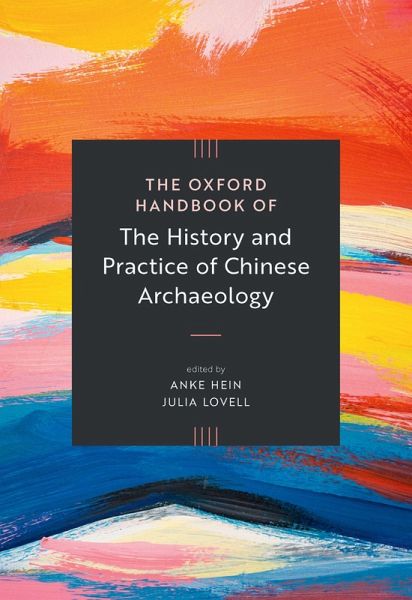
The Oxford Handbook of the History and Practice of Chinese Archaeology
Herausgeber: Oxford Handbooks
Versandkostenfrei innerhalb Deutschlands
254,99 €
inkl. MwSt.
Versandkostenfrei*
Erscheint vorauss. 8. Mai 2026
Melden Sie sich
hier
hier
für den Produktalarm an, um über die Verfügbarkeit des Produkts informiert zu werden.

127 °P sammeln
The Oxford Handbook of the History and Practice of Chinese Archaeology
Herausgeber: Oxford Handbooks
- Gebundenes Buch
Archaeology publications tend to focus on the history of archaeology through a lens of an account and summary of discoveries without considering the contexts (cultural, intellectual, political, economic) of knowledge production that have shaped the course of these discoveries, the research questions asked, and the practice of the discipline. Chinese archaeology in particular has been presented largely in short single-author accounts that often focus exclusively on the Central Plains and to a lesser extent northern China. New and varied perspectives on this topic are essential for a better…mehr
Andere Kunden interessierten sich auch für
 The Oxford Handbook of the History of Archaeology219,99 €
 The Oxford Handbook of the Archaeology and Anthropology of Hunter-Gatherers271,99 €
 The Oxford Handbook of Light in Archaeology223,99 €
 The Oxford Handbook of Islamic Archaeology223,99 €
 The Oxford Handbook of the Archaeology of Diet184,99 €
 The Oxford Handbook of Southwest Archaeology223,99 €
 Liv Nilsson StutzThe Oxford Handbook of Mesolithic Europe238,99 €
-
-
-
Archaeology publications tend to focus on the history of archaeology through a lens of an account and summary of discoveries without considering the contexts (cultural, intellectual, political, economic) of knowledge production that have shaped the course of these discoveries, the research questions asked, and the practice of the discipline. Chinese archaeology in particular has been presented largely in short single-author accounts that often focus exclusively on the Central Plains and to a lesser extent northern China. New and varied perspectives on this topic are essential for a better understanding of not just the practice of archaeology in China, but also a well-rounded understanding of modern and present-day China. Historians, anthropologists, and archaeologists alike would benefit from a comprehensive overview of the region and its notable relationship to the discipline of archaeology. The Oxford Handbook of the History and Practice of Chinese Archaeology is a multi-regional and multi-voiced account of the history of Chinese archaeology. It provides insights into the actors, structures, and motivations moving this history forward, from the beginnings of the discipline, up to the present day. This volume brings together 47 chapters contributed by a diverse community of scholars (archaeologists, historians, heritage specialists, and museum professionals) from Asia, Europe and North America to cover many of the most significant issues in Chinese archaeology: the discipline's origins in antiquarian practices at least a millennium old; its beginnings amid the cultural, intellectual and epistemological tumult of the early 20th century; the intersection of local and international scholarship in the formation of the discipline; the specificities of fieldwork practice and institutional organization; and the impact of scientific methods that have transformed knowledge production.
Produktdetails
- Produktdetails
- Verlag: Oxford University Press
- Seitenzahl: 1104
- Erscheinungstermin: 8. Mai 2026
- Englisch
- ISBN-13: 9780197800324
- ISBN-10: 0197800327
- Artikelnr.: 75914405
- Herstellerkennzeichnung
- Libri GmbH
- Europaallee 1
- 36244 Bad Hersfeld
- gpsr@libri.de
- Verlag: Oxford University Press
- Seitenzahl: 1104
- Erscheinungstermin: 8. Mai 2026
- Englisch
- ISBN-13: 9780197800324
- ISBN-10: 0197800327
- Artikelnr.: 75914405
- Herstellerkennzeichnung
- Libri GmbH
- Europaallee 1
- 36244 Bad Hersfeld
- gpsr@libri.de
Anke Hein is Associate Professor in Chinese Archaeology at the University of Oxford. She is an anthropological archaeologist focusing on issues of culture contact, human-environment interaction, ceramic technology, and the history and practice of archaeology as a discipline. She has extensive field research experience on the Chinese mainland, having worked on several international collaborative projects. She has published on the archaeology of western China in particular, mostly in leading peer-reviewed journals in English and Chinese. Book publications of hers include Graves as Composite Objects - The Burial Record of Prehistoric Liangshan, Southwest China and Understanding Authenticity in Chinese Cultural Heritage. Julia Lovell is Professor of Modern Chinese Literature and History at Birkbeck, University of London. She has published widely on modern Chinese intellectual and cultural history, specifically on the links between different cultural forms and identity construction since the late 19th century. She was the academic partner for the 2023 British Museum exhibition China's Hidden Century, which told the history of China's long 19th century through material culture. She has also translated many works of Chinese fiction into English, most recently Journey to the West (Penguin Classics, 2021).
* Introduction: The History and Practice of Chinese Archaeology, Anke
HEIN (University of Oxford) and Julia LOVELL (Birkbeck, University of
London)
* I. The Beginnings of Chinese Archaeology
* Chapter 1: Before Archaeology: Antiquarianism, Collecting, and
"Evidential Scholarship" in Late Imperial China, Phillip GRIMBERG
(University of Erlangen-Nuremberg)
* Chapter 2: Frederick McCormick and The China Monuments Society, ZHA
Xiaoying (Sichuan University) and Anke HEIN (University of Oxford)
* Chapter 3: The Influences of Geology and Palaeontology on the
Formation of Chinese Professional Archaeological Practices: the Case
of the Yangshao Culture Explorations in the early 1920s, Marie Louise
Stig SØRENSEN (University of Cambridge)
* Chapter 4: An Empire and an Archaeologist on the Edge: Liao Culture,
Torii Ryuzo (1870-1953), and Japanese Imperialism in Manchuria,
Lance PURSEY (Hebrew University of Jerusalem)
* II. Major Discoveries and their Influence on the Discipline
* Chapter 5: Tradition, Transition, and Transformation: Rethinking
Yinxu Studies at the Institute of History and Philology, Academia
Sinica, LEE Hsiu-ping and UCHIDA Junko (Academia Sinica)
*
* Chapter 6: The Beiping Academy and its Search for Ancient Capitals in
the Political Context of the Nanjing Decade (1927-1937), Maria
KHAYUTINA (University of Munich)
*
* Chapter 7: In Search of the First Dynasty: Xu Xusheng and the
Beginnings of Xia Archaeology, LI Min (University of California, Los
Angeles)
*
* Chapter 8: Now and Then: Fuhao's Tomb and its Discovery at Yinxu, Qin
CAO (Durham University)
*
* Chapter 9: The Mausoleum Complex of Emperor Qin Shihuang: A Major
Discovery and Its Impacts, LI Xiuzhen (Oxford) and Anke HEIN (Oxford)
*
* Chapter 10: The Sanxingdui Site: History of Its Fieldwork and
Interpretation in the Context of Archaeological Practice in China,
Anke HEIN (Oxford), Jay XU (Asian Art Museum, San Francisco), Jianjun
MEI (University of Cambridge), and Julia LOVELL (Birkbeck, University
of London)
* Chapter 11: Studying Unearthed Manuscript Texts in Modern China, GUO
Jue (Bowdoin College)
* Chapter 12: Shimao and Its Impact on Debates about the 'Origin of
Chinese Civilization,' Ying Tung FUNG (University of Hong Kong)
* III. Institutional Organization and Training
* Chapter 13: Bringing the Field to the Ivory Tower: Xu Xusheng, Huang
Wenbi and the Early Institutionalization of Chinese Archaeology,
Yajun MO (Boston College)
* Chapter 14: The Establishment and Working Practices of Chinese
Archaeological Institutions (from the 1920s to the Present),
Zhouyong SUN (Shaanxi Academy of Archaeology) and Anke HEIN
(University of Oxford)
* Chapter 15: Teaching 'Chinese' Archaeology in Taiwan (1947 to 2022):
Changing Agendas, Perspectives, and Identities, Yu-chun KAN (UCL)
* Chapter 16: Visualizing the Development of Archaeological Education
in Mainland China-A Statistical Review of Theses and Dissertations
from 1980-2019, Jeff SUN (Independent Researcher), YI Hailin (Xiamen
University and Durham University), and SHI Tao (Sichuan University)
* IV. Theories and Methods in Chinese Archaeology
* Chapter 17: Marxist Influence on Archaeology in China, 1949-1976,
ZHOU Danlei (University of Oxford) and Guo Peng CHEN (University of
Oxford)
* Chapter 18: The Concept of Archaeological Cultures in Chinese
Archaeology, Richard EHRICH (Xibei University, Xi'an)
* Chapter 19: Why Is Linear Evolutionary Theory Popular in Archaeology
in China?, Guo Peng CHEN (University of Oxford)
* Chapter 20: Gender Archaeology in China: Recent Developments, Min LIN
(University of Cambridge)
* Chapter 21: A Brief History of Chinese Field Archaeology, Hai ZHANG
(Peking University)
* Chapter 22: The Emergence of the Conventional Archaeological Site
Report Format in the People's Republic of China, ZHU Tianrui (New
York University)
* V. The Sciences in Chinese Archaeology
* Chapter 23: The Impact of Science on Chinese Archaeology, Kuei-chen
LIN (Academia Sinica) and Pochan CHEN (formerly National University
of Taiwan)
* Chapter 24: The Development of Archaeometallurgical Research in
Mainland China over the Past Fifty Years, Jianjun MEI (Needham
Research Institute) and Kunlong CHEN (University of Science and
Technology, Beijing)
* Chapter 25: The History of Archaeobotanical Practice in China, Rita
DAL MARTELLO (Universita Ca'Foscari Venezia), TANG Liya (Xibei
University), Marvin DEMICOLI (Museum of London Archaeology), and Jade
D'ALPOIM GUEDES (University of Washington)
* Chapter 26: Why do Zooarchaeologists Study Domestic Taxa? An
Exploration of Historical Trends in Chinese Zooarchaeology, Jada KO
(Brown University) and Katherine BRUNSON (Wesleyan University)
* Chapter 27: Geoarchaeology, Geomythology, and Origins of Chinese
Civilization, Michael STOROZUM (Newcastle University)
* Chapter 28: Publication Trends in Research on Human Environment
Interactions in Early China, Anke HEIN (University of Oxford), Andrew
WOMACK (Furman University), Siran LIU (University of Science and
Technology Beijing), and Yitzchak JAFFE (University of Haifa)
* Chapter 29: Salt Archaeology in China: Review and Perspectives, LI
Shuicheng (Sichuan University, Peking University)
* VI. Regional Archaeologies Across Asia
* Chapter 30: Maritime Archaeology in the Chinese Mainland, Hong Kong,
Macao, and Taiwan, Chi Yan (Jay) MOK (University of Oxford), Kam Wing
FUNG (University of Hong Kong), Cheng-Hwa TSANG (National Tsing Hua
University, Taiwan), Kong Fai CHEONG (American University), and
Xiaoxu GAO (Shanghai University)
* Chapter 31: Taiwan Archaeology: In and Out of Chinese Archaeology,
Frank MUYARD (Ecole française d'Extrême-Orient)
* Chapter 32: Bronze Drum Studies in China and Vietnam since the 1950s,
HAN Xiaorong (The Hong Kong Polytechnic University)
* Chapter 33: A Brief History of Archaeological Research on the Tibetan
Plateau, Mark ALDENDERFER (University of California, Merced)
* Chapter 34: Resurrecting the Sogdians: A Discourse Analysis focused
on the Tomb of Yu Hong, Kiraz PERINCEK KARAVIT (Bogaziçi University,
Researcher), Aybike Seyma TEZEL (Bogaziçi University), and Erdal
KÜÇÜKYALÇIN (Bogaziçi University)
* Chapter 35: Facets of the "Silkroadification" of Archaeological
Discoveries from the Han-era Hexi Corridor, Kathrin LEESE-MESSING
(University of Freiburg)
* VII. Chinese Archaeology Goes Global
* Chapter 36: Encountering Egypt: Chinese Studies of Ancient Egypt
during the Late Qing Period (1840-1912) and their Echoes in Chinese
Archaeology Abroad Today, Tian TIAN (Cambridge)
* Chapter 37: Cross-Border Archaeology: A New Opportunity for Fostering
Positive Changes in Chinese Archaeology, Yuqi LI (Nankai University)
* Chapter 38: Chinese Archaeology within the International Academic
Community: a View from Citation Networks in Archaeological Core
Journals, Xuan WEI (Wuhan University), Wentai LOU (Wuhan University),
Ting LI (Wuhan University), Ruxi YANG (Wuhan University), Xinlai LI
(Hubei University), Tengfei WANG (Wuhan University), Feng WANG (Wuhan
University), and Anke HEIN (University of Oxford), and Yinghua LI
(Wuhan University)
* VIII. Museums and Archaeological Tourism
* Chapter 39: Zeng Zhaoyu, Nanjing Museum, and the Politics of Museums
in Early Mao-Era China, LUO Lanzhou (Fudan University) and Julia
LOVELL (Birkbeck, University of London)
* Chapter 40: Peking Man's Place in Public Representations of
Palaeolithic Archaeology, Lena WESEMANN (FU Berlin)
* Chapter 41: From Soil to Glass Case: Archaeological Heritage in
Public Museums in Contemporary China, Sofia BOLLO (University of
Zurich)
* Chapter 42: A History of Chinese Archaeological Museums in Three
Case-Studies, Guohua YANG (University of Cambridge)
* Chapter 43: The Evolving Landscape of Archaeological Tourism in
China: History, Cultural Policy, and Complexities, Qian GAO (Durham
University)
* IX. Public Archaeology and the Media
* Chapter 44: Public Archaeology in China between the Late Qing and
Republican Periods, YUAN Fang (Nanjing University) and Julia LOVELL
(Birkbeck, University of London)
* Chapter 45: Converging Narratives on the Yangshao Culture: A
Comparative Study of Traditional and Social Media Perspectives,
Rouran ZHANG (University of Cambridge; Shenzhen University), Ying LYU
(Shenzhen University), and Weili ZHAN (Shenzhen University)
* Chapter 46: Sharing Authority and Participation: Archaeology and
Heritage Discourses on Social Media in the People's Republic of
China, Mitchell MA (University of Toronto) and Casey LUN (University
of Toronto)
* Chapter 47: Representing Archaeology: On the Interplay of
Nationalism, Colonialism, and Censorship in 'Tomb Robbing' Films and
Series, Rebecca O'SULLIVAN (University of Liverpool)
HEIN (University of Oxford) and Julia LOVELL (Birkbeck, University of
London)
* I. The Beginnings of Chinese Archaeology
* Chapter 1: Before Archaeology: Antiquarianism, Collecting, and
"Evidential Scholarship" in Late Imperial China, Phillip GRIMBERG
(University of Erlangen-Nuremberg)
* Chapter 2: Frederick McCormick and The China Monuments Society, ZHA
Xiaoying (Sichuan University) and Anke HEIN (University of Oxford)
* Chapter 3: The Influences of Geology and Palaeontology on the
Formation of Chinese Professional Archaeological Practices: the Case
of the Yangshao Culture Explorations in the early 1920s, Marie Louise
Stig SØRENSEN (University of Cambridge)
* Chapter 4: An Empire and an Archaeologist on the Edge: Liao Culture,
Torii Ryuzo (1870-1953), and Japanese Imperialism in Manchuria,
Lance PURSEY (Hebrew University of Jerusalem)
* II. Major Discoveries and their Influence on the Discipline
* Chapter 5: Tradition, Transition, and Transformation: Rethinking
Yinxu Studies at the Institute of History and Philology, Academia
Sinica, LEE Hsiu-ping and UCHIDA Junko (Academia Sinica)
*
* Chapter 6: The Beiping Academy and its Search for Ancient Capitals in
the Political Context of the Nanjing Decade (1927-1937), Maria
KHAYUTINA (University of Munich)
*
* Chapter 7: In Search of the First Dynasty: Xu Xusheng and the
Beginnings of Xia Archaeology, LI Min (University of California, Los
Angeles)
*
* Chapter 8: Now and Then: Fuhao's Tomb and its Discovery at Yinxu, Qin
CAO (Durham University)
*
* Chapter 9: The Mausoleum Complex of Emperor Qin Shihuang: A Major
Discovery and Its Impacts, LI Xiuzhen (Oxford) and Anke HEIN (Oxford)
*
* Chapter 10: The Sanxingdui Site: History of Its Fieldwork and
Interpretation in the Context of Archaeological Practice in China,
Anke HEIN (Oxford), Jay XU (Asian Art Museum, San Francisco), Jianjun
MEI (University of Cambridge), and Julia LOVELL (Birkbeck, University
of London)
* Chapter 11: Studying Unearthed Manuscript Texts in Modern China, GUO
Jue (Bowdoin College)
* Chapter 12: Shimao and Its Impact on Debates about the 'Origin of
Chinese Civilization,' Ying Tung FUNG (University of Hong Kong)
* III. Institutional Organization and Training
* Chapter 13: Bringing the Field to the Ivory Tower: Xu Xusheng, Huang
Wenbi and the Early Institutionalization of Chinese Archaeology,
Yajun MO (Boston College)
* Chapter 14: The Establishment and Working Practices of Chinese
Archaeological Institutions (from the 1920s to the Present),
Zhouyong SUN (Shaanxi Academy of Archaeology) and Anke HEIN
(University of Oxford)
* Chapter 15: Teaching 'Chinese' Archaeology in Taiwan (1947 to 2022):
Changing Agendas, Perspectives, and Identities, Yu-chun KAN (UCL)
* Chapter 16: Visualizing the Development of Archaeological Education
in Mainland China-A Statistical Review of Theses and Dissertations
from 1980-2019, Jeff SUN (Independent Researcher), YI Hailin (Xiamen
University and Durham University), and SHI Tao (Sichuan University)
* IV. Theories and Methods in Chinese Archaeology
* Chapter 17: Marxist Influence on Archaeology in China, 1949-1976,
ZHOU Danlei (University of Oxford) and Guo Peng CHEN (University of
Oxford)
* Chapter 18: The Concept of Archaeological Cultures in Chinese
Archaeology, Richard EHRICH (Xibei University, Xi'an)
* Chapter 19: Why Is Linear Evolutionary Theory Popular in Archaeology
in China?, Guo Peng CHEN (University of Oxford)
* Chapter 20: Gender Archaeology in China: Recent Developments, Min LIN
(University of Cambridge)
* Chapter 21: A Brief History of Chinese Field Archaeology, Hai ZHANG
(Peking University)
* Chapter 22: The Emergence of the Conventional Archaeological Site
Report Format in the People's Republic of China, ZHU Tianrui (New
York University)
* V. The Sciences in Chinese Archaeology
* Chapter 23: The Impact of Science on Chinese Archaeology, Kuei-chen
LIN (Academia Sinica) and Pochan CHEN (formerly National University
of Taiwan)
* Chapter 24: The Development of Archaeometallurgical Research in
Mainland China over the Past Fifty Years, Jianjun MEI (Needham
Research Institute) and Kunlong CHEN (University of Science and
Technology, Beijing)
* Chapter 25: The History of Archaeobotanical Practice in China, Rita
DAL MARTELLO (Universita Ca'Foscari Venezia), TANG Liya (Xibei
University), Marvin DEMICOLI (Museum of London Archaeology), and Jade
D'ALPOIM GUEDES (University of Washington)
* Chapter 26: Why do Zooarchaeologists Study Domestic Taxa? An
Exploration of Historical Trends in Chinese Zooarchaeology, Jada KO
(Brown University) and Katherine BRUNSON (Wesleyan University)
* Chapter 27: Geoarchaeology, Geomythology, and Origins of Chinese
Civilization, Michael STOROZUM (Newcastle University)
* Chapter 28: Publication Trends in Research on Human Environment
Interactions in Early China, Anke HEIN (University of Oxford), Andrew
WOMACK (Furman University), Siran LIU (University of Science and
Technology Beijing), and Yitzchak JAFFE (University of Haifa)
* Chapter 29: Salt Archaeology in China: Review and Perspectives, LI
Shuicheng (Sichuan University, Peking University)
* VI. Regional Archaeologies Across Asia
* Chapter 30: Maritime Archaeology in the Chinese Mainland, Hong Kong,
Macao, and Taiwan, Chi Yan (Jay) MOK (University of Oxford), Kam Wing
FUNG (University of Hong Kong), Cheng-Hwa TSANG (National Tsing Hua
University, Taiwan), Kong Fai CHEONG (American University), and
Xiaoxu GAO (Shanghai University)
* Chapter 31: Taiwan Archaeology: In and Out of Chinese Archaeology,
Frank MUYARD (Ecole française d'Extrême-Orient)
* Chapter 32: Bronze Drum Studies in China and Vietnam since the 1950s,
HAN Xiaorong (The Hong Kong Polytechnic University)
* Chapter 33: A Brief History of Archaeological Research on the Tibetan
Plateau, Mark ALDENDERFER (University of California, Merced)
* Chapter 34: Resurrecting the Sogdians: A Discourse Analysis focused
on the Tomb of Yu Hong, Kiraz PERINCEK KARAVIT (Bogaziçi University,
Researcher), Aybike Seyma TEZEL (Bogaziçi University), and Erdal
KÜÇÜKYALÇIN (Bogaziçi University)
* Chapter 35: Facets of the "Silkroadification" of Archaeological
Discoveries from the Han-era Hexi Corridor, Kathrin LEESE-MESSING
(University of Freiburg)
* VII. Chinese Archaeology Goes Global
* Chapter 36: Encountering Egypt: Chinese Studies of Ancient Egypt
during the Late Qing Period (1840-1912) and their Echoes in Chinese
Archaeology Abroad Today, Tian TIAN (Cambridge)
* Chapter 37: Cross-Border Archaeology: A New Opportunity for Fostering
Positive Changes in Chinese Archaeology, Yuqi LI (Nankai University)
* Chapter 38: Chinese Archaeology within the International Academic
Community: a View from Citation Networks in Archaeological Core
Journals, Xuan WEI (Wuhan University), Wentai LOU (Wuhan University),
Ting LI (Wuhan University), Ruxi YANG (Wuhan University), Xinlai LI
(Hubei University), Tengfei WANG (Wuhan University), Feng WANG (Wuhan
University), and Anke HEIN (University of Oxford), and Yinghua LI
(Wuhan University)
* VIII. Museums and Archaeological Tourism
* Chapter 39: Zeng Zhaoyu, Nanjing Museum, and the Politics of Museums
in Early Mao-Era China, LUO Lanzhou (Fudan University) and Julia
LOVELL (Birkbeck, University of London)
* Chapter 40: Peking Man's Place in Public Representations of
Palaeolithic Archaeology, Lena WESEMANN (FU Berlin)
* Chapter 41: From Soil to Glass Case: Archaeological Heritage in
Public Museums in Contemporary China, Sofia BOLLO (University of
Zurich)
* Chapter 42: A History of Chinese Archaeological Museums in Three
Case-Studies, Guohua YANG (University of Cambridge)
* Chapter 43: The Evolving Landscape of Archaeological Tourism in
China: History, Cultural Policy, and Complexities, Qian GAO (Durham
University)
* IX. Public Archaeology and the Media
* Chapter 44: Public Archaeology in China between the Late Qing and
Republican Periods, YUAN Fang (Nanjing University) and Julia LOVELL
(Birkbeck, University of London)
* Chapter 45: Converging Narratives on the Yangshao Culture: A
Comparative Study of Traditional and Social Media Perspectives,
Rouran ZHANG (University of Cambridge; Shenzhen University), Ying LYU
(Shenzhen University), and Weili ZHAN (Shenzhen University)
* Chapter 46: Sharing Authority and Participation: Archaeology and
Heritage Discourses on Social Media in the People's Republic of
China, Mitchell MA (University of Toronto) and Casey LUN (University
of Toronto)
* Chapter 47: Representing Archaeology: On the Interplay of
Nationalism, Colonialism, and Censorship in 'Tomb Robbing' Films and
Series, Rebecca O'SULLIVAN (University of Liverpool)
* Introduction: The History and Practice of Chinese Archaeology, Anke
HEIN (University of Oxford) and Julia LOVELL (Birkbeck, University of
London)
* I. The Beginnings of Chinese Archaeology
* Chapter 1: Before Archaeology: Antiquarianism, Collecting, and
"Evidential Scholarship" in Late Imperial China, Phillip GRIMBERG
(University of Erlangen-Nuremberg)
* Chapter 2: Frederick McCormick and The China Monuments Society, ZHA
Xiaoying (Sichuan University) and Anke HEIN (University of Oxford)
* Chapter 3: The Influences of Geology and Palaeontology on the
Formation of Chinese Professional Archaeological Practices: the Case
of the Yangshao Culture Explorations in the early 1920s, Marie Louise
Stig SØRENSEN (University of Cambridge)
* Chapter 4: An Empire and an Archaeologist on the Edge: Liao Culture,
Torii Ryuzo (1870-1953), and Japanese Imperialism in Manchuria,
Lance PURSEY (Hebrew University of Jerusalem)
* II. Major Discoveries and their Influence on the Discipline
* Chapter 5: Tradition, Transition, and Transformation: Rethinking
Yinxu Studies at the Institute of History and Philology, Academia
Sinica, LEE Hsiu-ping and UCHIDA Junko (Academia Sinica)
*
* Chapter 6: The Beiping Academy and its Search for Ancient Capitals in
the Political Context of the Nanjing Decade (1927-1937), Maria
KHAYUTINA (University of Munich)
*
* Chapter 7: In Search of the First Dynasty: Xu Xusheng and the
Beginnings of Xia Archaeology, LI Min (University of California, Los
Angeles)
*
* Chapter 8: Now and Then: Fuhao's Tomb and its Discovery at Yinxu, Qin
CAO (Durham University)
*
* Chapter 9: The Mausoleum Complex of Emperor Qin Shihuang: A Major
Discovery and Its Impacts, LI Xiuzhen (Oxford) and Anke HEIN (Oxford)
*
* Chapter 10: The Sanxingdui Site: History of Its Fieldwork and
Interpretation in the Context of Archaeological Practice in China,
Anke HEIN (Oxford), Jay XU (Asian Art Museum, San Francisco), Jianjun
MEI (University of Cambridge), and Julia LOVELL (Birkbeck, University
of London)
* Chapter 11: Studying Unearthed Manuscript Texts in Modern China, GUO
Jue (Bowdoin College)
* Chapter 12: Shimao and Its Impact on Debates about the 'Origin of
Chinese Civilization,' Ying Tung FUNG (University of Hong Kong)
* III. Institutional Organization and Training
* Chapter 13: Bringing the Field to the Ivory Tower: Xu Xusheng, Huang
Wenbi and the Early Institutionalization of Chinese Archaeology,
Yajun MO (Boston College)
* Chapter 14: The Establishment and Working Practices of Chinese
Archaeological Institutions (from the 1920s to the Present),
Zhouyong SUN (Shaanxi Academy of Archaeology) and Anke HEIN
(University of Oxford)
* Chapter 15: Teaching 'Chinese' Archaeology in Taiwan (1947 to 2022):
Changing Agendas, Perspectives, and Identities, Yu-chun KAN (UCL)
* Chapter 16: Visualizing the Development of Archaeological Education
in Mainland China-A Statistical Review of Theses and Dissertations
from 1980-2019, Jeff SUN (Independent Researcher), YI Hailin (Xiamen
University and Durham University), and SHI Tao (Sichuan University)
* IV. Theories and Methods in Chinese Archaeology
* Chapter 17: Marxist Influence on Archaeology in China, 1949-1976,
ZHOU Danlei (University of Oxford) and Guo Peng CHEN (University of
Oxford)
* Chapter 18: The Concept of Archaeological Cultures in Chinese
Archaeology, Richard EHRICH (Xibei University, Xi'an)
* Chapter 19: Why Is Linear Evolutionary Theory Popular in Archaeology
in China?, Guo Peng CHEN (University of Oxford)
* Chapter 20: Gender Archaeology in China: Recent Developments, Min LIN
(University of Cambridge)
* Chapter 21: A Brief History of Chinese Field Archaeology, Hai ZHANG
(Peking University)
* Chapter 22: The Emergence of the Conventional Archaeological Site
Report Format in the People's Republic of China, ZHU Tianrui (New
York University)
* V. The Sciences in Chinese Archaeology
* Chapter 23: The Impact of Science on Chinese Archaeology, Kuei-chen
LIN (Academia Sinica) and Pochan CHEN (formerly National University
of Taiwan)
* Chapter 24: The Development of Archaeometallurgical Research in
Mainland China over the Past Fifty Years, Jianjun MEI (Needham
Research Institute) and Kunlong CHEN (University of Science and
Technology, Beijing)
* Chapter 25: The History of Archaeobotanical Practice in China, Rita
DAL MARTELLO (Universita Ca'Foscari Venezia), TANG Liya (Xibei
University), Marvin DEMICOLI (Museum of London Archaeology), and Jade
D'ALPOIM GUEDES (University of Washington)
* Chapter 26: Why do Zooarchaeologists Study Domestic Taxa? An
Exploration of Historical Trends in Chinese Zooarchaeology, Jada KO
(Brown University) and Katherine BRUNSON (Wesleyan University)
* Chapter 27: Geoarchaeology, Geomythology, and Origins of Chinese
Civilization, Michael STOROZUM (Newcastle University)
* Chapter 28: Publication Trends in Research on Human Environment
Interactions in Early China, Anke HEIN (University of Oxford), Andrew
WOMACK (Furman University), Siran LIU (University of Science and
Technology Beijing), and Yitzchak JAFFE (University of Haifa)
* Chapter 29: Salt Archaeology in China: Review and Perspectives, LI
Shuicheng (Sichuan University, Peking University)
* VI. Regional Archaeologies Across Asia
* Chapter 30: Maritime Archaeology in the Chinese Mainland, Hong Kong,
Macao, and Taiwan, Chi Yan (Jay) MOK (University of Oxford), Kam Wing
FUNG (University of Hong Kong), Cheng-Hwa TSANG (National Tsing Hua
University, Taiwan), Kong Fai CHEONG (American University), and
Xiaoxu GAO (Shanghai University)
* Chapter 31: Taiwan Archaeology: In and Out of Chinese Archaeology,
Frank MUYARD (Ecole française d'Extrême-Orient)
* Chapter 32: Bronze Drum Studies in China and Vietnam since the 1950s,
HAN Xiaorong (The Hong Kong Polytechnic University)
* Chapter 33: A Brief History of Archaeological Research on the Tibetan
Plateau, Mark ALDENDERFER (University of California, Merced)
* Chapter 34: Resurrecting the Sogdians: A Discourse Analysis focused
on the Tomb of Yu Hong, Kiraz PERINCEK KARAVIT (Bogaziçi University,
Researcher), Aybike Seyma TEZEL (Bogaziçi University), and Erdal
KÜÇÜKYALÇIN (Bogaziçi University)
* Chapter 35: Facets of the "Silkroadification" of Archaeological
Discoveries from the Han-era Hexi Corridor, Kathrin LEESE-MESSING
(University of Freiburg)
* VII. Chinese Archaeology Goes Global
* Chapter 36: Encountering Egypt: Chinese Studies of Ancient Egypt
during the Late Qing Period (1840-1912) and their Echoes in Chinese
Archaeology Abroad Today, Tian TIAN (Cambridge)
* Chapter 37: Cross-Border Archaeology: A New Opportunity for Fostering
Positive Changes in Chinese Archaeology, Yuqi LI (Nankai University)
* Chapter 38: Chinese Archaeology within the International Academic
Community: a View from Citation Networks in Archaeological Core
Journals, Xuan WEI (Wuhan University), Wentai LOU (Wuhan University),
Ting LI (Wuhan University), Ruxi YANG (Wuhan University), Xinlai LI
(Hubei University), Tengfei WANG (Wuhan University), Feng WANG (Wuhan
University), and Anke HEIN (University of Oxford), and Yinghua LI
(Wuhan University)
* VIII. Museums and Archaeological Tourism
* Chapter 39: Zeng Zhaoyu, Nanjing Museum, and the Politics of Museums
in Early Mao-Era China, LUO Lanzhou (Fudan University) and Julia
LOVELL (Birkbeck, University of London)
* Chapter 40: Peking Man's Place in Public Representations of
Palaeolithic Archaeology, Lena WESEMANN (FU Berlin)
* Chapter 41: From Soil to Glass Case: Archaeological Heritage in
Public Museums in Contemporary China, Sofia BOLLO (University of
Zurich)
* Chapter 42: A History of Chinese Archaeological Museums in Three
Case-Studies, Guohua YANG (University of Cambridge)
* Chapter 43: The Evolving Landscape of Archaeological Tourism in
China: History, Cultural Policy, and Complexities, Qian GAO (Durham
University)
* IX. Public Archaeology and the Media
* Chapter 44: Public Archaeology in China between the Late Qing and
Republican Periods, YUAN Fang (Nanjing University) and Julia LOVELL
(Birkbeck, University of London)
* Chapter 45: Converging Narratives on the Yangshao Culture: A
Comparative Study of Traditional and Social Media Perspectives,
Rouran ZHANG (University of Cambridge; Shenzhen University), Ying LYU
(Shenzhen University), and Weili ZHAN (Shenzhen University)
* Chapter 46: Sharing Authority and Participation: Archaeology and
Heritage Discourses on Social Media in the People's Republic of
China, Mitchell MA (University of Toronto) and Casey LUN (University
of Toronto)
* Chapter 47: Representing Archaeology: On the Interplay of
Nationalism, Colonialism, and Censorship in 'Tomb Robbing' Films and
Series, Rebecca O'SULLIVAN (University of Liverpool)
HEIN (University of Oxford) and Julia LOVELL (Birkbeck, University of
London)
* I. The Beginnings of Chinese Archaeology
* Chapter 1: Before Archaeology: Antiquarianism, Collecting, and
"Evidential Scholarship" in Late Imperial China, Phillip GRIMBERG
(University of Erlangen-Nuremberg)
* Chapter 2: Frederick McCormick and The China Monuments Society, ZHA
Xiaoying (Sichuan University) and Anke HEIN (University of Oxford)
* Chapter 3: The Influences of Geology and Palaeontology on the
Formation of Chinese Professional Archaeological Practices: the Case
of the Yangshao Culture Explorations in the early 1920s, Marie Louise
Stig SØRENSEN (University of Cambridge)
* Chapter 4: An Empire and an Archaeologist on the Edge: Liao Culture,
Torii Ryuzo (1870-1953), and Japanese Imperialism in Manchuria,
Lance PURSEY (Hebrew University of Jerusalem)
* II. Major Discoveries and their Influence on the Discipline
* Chapter 5: Tradition, Transition, and Transformation: Rethinking
Yinxu Studies at the Institute of History and Philology, Academia
Sinica, LEE Hsiu-ping and UCHIDA Junko (Academia Sinica)
*
* Chapter 6: The Beiping Academy and its Search for Ancient Capitals in
the Political Context of the Nanjing Decade (1927-1937), Maria
KHAYUTINA (University of Munich)
*
* Chapter 7: In Search of the First Dynasty: Xu Xusheng and the
Beginnings of Xia Archaeology, LI Min (University of California, Los
Angeles)
*
* Chapter 8: Now and Then: Fuhao's Tomb and its Discovery at Yinxu, Qin
CAO (Durham University)
*
* Chapter 9: The Mausoleum Complex of Emperor Qin Shihuang: A Major
Discovery and Its Impacts, LI Xiuzhen (Oxford) and Anke HEIN (Oxford)
*
* Chapter 10: The Sanxingdui Site: History of Its Fieldwork and
Interpretation in the Context of Archaeological Practice in China,
Anke HEIN (Oxford), Jay XU (Asian Art Museum, San Francisco), Jianjun
MEI (University of Cambridge), and Julia LOVELL (Birkbeck, University
of London)
* Chapter 11: Studying Unearthed Manuscript Texts in Modern China, GUO
Jue (Bowdoin College)
* Chapter 12: Shimao and Its Impact on Debates about the 'Origin of
Chinese Civilization,' Ying Tung FUNG (University of Hong Kong)
* III. Institutional Organization and Training
* Chapter 13: Bringing the Field to the Ivory Tower: Xu Xusheng, Huang
Wenbi and the Early Institutionalization of Chinese Archaeology,
Yajun MO (Boston College)
* Chapter 14: The Establishment and Working Practices of Chinese
Archaeological Institutions (from the 1920s to the Present),
Zhouyong SUN (Shaanxi Academy of Archaeology) and Anke HEIN
(University of Oxford)
* Chapter 15: Teaching 'Chinese' Archaeology in Taiwan (1947 to 2022):
Changing Agendas, Perspectives, and Identities, Yu-chun KAN (UCL)
* Chapter 16: Visualizing the Development of Archaeological Education
in Mainland China-A Statistical Review of Theses and Dissertations
from 1980-2019, Jeff SUN (Independent Researcher), YI Hailin (Xiamen
University and Durham University), and SHI Tao (Sichuan University)
* IV. Theories and Methods in Chinese Archaeology
* Chapter 17: Marxist Influence on Archaeology in China, 1949-1976,
ZHOU Danlei (University of Oxford) and Guo Peng CHEN (University of
Oxford)
* Chapter 18: The Concept of Archaeological Cultures in Chinese
Archaeology, Richard EHRICH (Xibei University, Xi'an)
* Chapter 19: Why Is Linear Evolutionary Theory Popular in Archaeology
in China?, Guo Peng CHEN (University of Oxford)
* Chapter 20: Gender Archaeology in China: Recent Developments, Min LIN
(University of Cambridge)
* Chapter 21: A Brief History of Chinese Field Archaeology, Hai ZHANG
(Peking University)
* Chapter 22: The Emergence of the Conventional Archaeological Site
Report Format in the People's Republic of China, ZHU Tianrui (New
York University)
* V. The Sciences in Chinese Archaeology
* Chapter 23: The Impact of Science on Chinese Archaeology, Kuei-chen
LIN (Academia Sinica) and Pochan CHEN (formerly National University
of Taiwan)
* Chapter 24: The Development of Archaeometallurgical Research in
Mainland China over the Past Fifty Years, Jianjun MEI (Needham
Research Institute) and Kunlong CHEN (University of Science and
Technology, Beijing)
* Chapter 25: The History of Archaeobotanical Practice in China, Rita
DAL MARTELLO (Universita Ca'Foscari Venezia), TANG Liya (Xibei
University), Marvin DEMICOLI (Museum of London Archaeology), and Jade
D'ALPOIM GUEDES (University of Washington)
* Chapter 26: Why do Zooarchaeologists Study Domestic Taxa? An
Exploration of Historical Trends in Chinese Zooarchaeology, Jada KO
(Brown University) and Katherine BRUNSON (Wesleyan University)
* Chapter 27: Geoarchaeology, Geomythology, and Origins of Chinese
Civilization, Michael STOROZUM (Newcastle University)
* Chapter 28: Publication Trends in Research on Human Environment
Interactions in Early China, Anke HEIN (University of Oxford), Andrew
WOMACK (Furman University), Siran LIU (University of Science and
Technology Beijing), and Yitzchak JAFFE (University of Haifa)
* Chapter 29: Salt Archaeology in China: Review and Perspectives, LI
Shuicheng (Sichuan University, Peking University)
* VI. Regional Archaeologies Across Asia
* Chapter 30: Maritime Archaeology in the Chinese Mainland, Hong Kong,
Macao, and Taiwan, Chi Yan (Jay) MOK (University of Oxford), Kam Wing
FUNG (University of Hong Kong), Cheng-Hwa TSANG (National Tsing Hua
University, Taiwan), Kong Fai CHEONG (American University), and
Xiaoxu GAO (Shanghai University)
* Chapter 31: Taiwan Archaeology: In and Out of Chinese Archaeology,
Frank MUYARD (Ecole française d'Extrême-Orient)
* Chapter 32: Bronze Drum Studies in China and Vietnam since the 1950s,
HAN Xiaorong (The Hong Kong Polytechnic University)
* Chapter 33: A Brief History of Archaeological Research on the Tibetan
Plateau, Mark ALDENDERFER (University of California, Merced)
* Chapter 34: Resurrecting the Sogdians: A Discourse Analysis focused
on the Tomb of Yu Hong, Kiraz PERINCEK KARAVIT (Bogaziçi University,
Researcher), Aybike Seyma TEZEL (Bogaziçi University), and Erdal
KÜÇÜKYALÇIN (Bogaziçi University)
* Chapter 35: Facets of the "Silkroadification" of Archaeological
Discoveries from the Han-era Hexi Corridor, Kathrin LEESE-MESSING
(University of Freiburg)
* VII. Chinese Archaeology Goes Global
* Chapter 36: Encountering Egypt: Chinese Studies of Ancient Egypt
during the Late Qing Period (1840-1912) and their Echoes in Chinese
Archaeology Abroad Today, Tian TIAN (Cambridge)
* Chapter 37: Cross-Border Archaeology: A New Opportunity for Fostering
Positive Changes in Chinese Archaeology, Yuqi LI (Nankai University)
* Chapter 38: Chinese Archaeology within the International Academic
Community: a View from Citation Networks in Archaeological Core
Journals, Xuan WEI (Wuhan University), Wentai LOU (Wuhan University),
Ting LI (Wuhan University), Ruxi YANG (Wuhan University), Xinlai LI
(Hubei University), Tengfei WANG (Wuhan University), Feng WANG (Wuhan
University), and Anke HEIN (University of Oxford), and Yinghua LI
(Wuhan University)
* VIII. Museums and Archaeological Tourism
* Chapter 39: Zeng Zhaoyu, Nanjing Museum, and the Politics of Museums
in Early Mao-Era China, LUO Lanzhou (Fudan University) and Julia
LOVELL (Birkbeck, University of London)
* Chapter 40: Peking Man's Place in Public Representations of
Palaeolithic Archaeology, Lena WESEMANN (FU Berlin)
* Chapter 41: From Soil to Glass Case: Archaeological Heritage in
Public Museums in Contemporary China, Sofia BOLLO (University of
Zurich)
* Chapter 42: A History of Chinese Archaeological Museums in Three
Case-Studies, Guohua YANG (University of Cambridge)
* Chapter 43: The Evolving Landscape of Archaeological Tourism in
China: History, Cultural Policy, and Complexities, Qian GAO (Durham
University)
* IX. Public Archaeology and the Media
* Chapter 44: Public Archaeology in China between the Late Qing and
Republican Periods, YUAN Fang (Nanjing University) and Julia LOVELL
(Birkbeck, University of London)
* Chapter 45: Converging Narratives on the Yangshao Culture: A
Comparative Study of Traditional and Social Media Perspectives,
Rouran ZHANG (University of Cambridge; Shenzhen University), Ying LYU
(Shenzhen University), and Weili ZHAN (Shenzhen University)
* Chapter 46: Sharing Authority and Participation: Archaeology and
Heritage Discourses on Social Media in the People's Republic of
China, Mitchell MA (University of Toronto) and Casey LUN (University
of Toronto)
* Chapter 47: Representing Archaeology: On the Interplay of
Nationalism, Colonialism, and Censorship in 'Tomb Robbing' Films and
Series, Rebecca O'SULLIVAN (University of Liverpool)