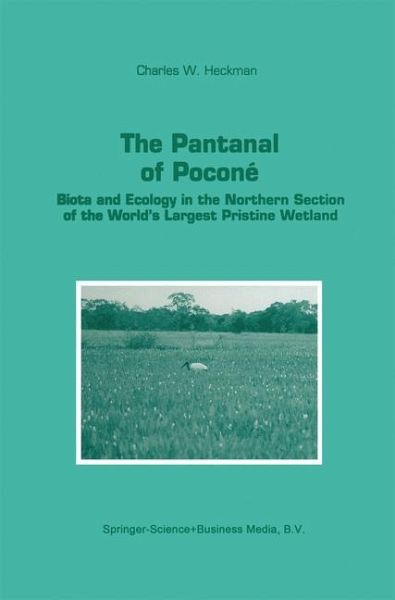
There are many famous wetlands in the world that have been deemed important for the homeostasis ofthe biosphere and accorded some form ofprotected status in view of the richness of their flora and fauna. T}1e Pantanal, located almost directly in the center ofthe South American continent, is among the largest such wetlands in the world. It is, in fact, the largest wetland that is still in a nearly natural state and has not been extensively modified by man for agriculture. The extent of the region covered by flood waters at the end of each rainy season varies from year to year, sometimes…mehr
There are many famous wetlands in the world that have been deemed important for the homeostasis ofthe biosphere and accorded some form ofprotected status in view of the richness of their flora and fauna. T}1e Pantanal, located almost directly in the center ofthe South American continent, is among the largest such wetlands in the world. It is, in fact, the largest wetland that is still in a nearly natural state and has not been extensively modified by man for agriculture. The extent of the region covered by flood waters at the end of each rainy season varies from year to year, sometimes considerably, so estimates of the exact area it occupies have varied enormously. The size of the 2 2 Pantanal has been reported to be between 80,000 km (Bonetto, 1975) and 250,000 km (Tundisi and Matsumura-Tundisi, 1985). The most co~on1y accepted estimates at the present time are approximately 130,000 to 140,000 km , supported by estimates made from Nimbus-7 satellite observations (Hamilton et al., 1996). However, Por (1995) suggested that the area extending into Bolivia and Paraguay has not been satisfactorily 2 surveyed, leading him to accept the figure of 200,000 km as the area of the entire Pantanal, ineluding all of its extensions. The main reason for the year to year variation in the extent of the flooding is the considerable difference in timing of the rainfall on the watershed.
The author, Dr. Charles W. Heckman, has performed ecological research in Laos, Thailand, Germany, Brazil, and the United States. His publications include books on rice field ecology in Thailand and the Pantanal wetland in western Brazil, as well as many monographs and shorter publications on various aspects of biology and environmental sciences. He undertook the preparation of the Encyclopedia of South American Aquatic Insects to produce a reference work with which researchers in South America can identify the species they encounter without having to first complete exhaustive searches of the literature, including papers published on several continents in different languages. The lack of such a tool has long impeded progress in faunal surveys, ecology, and other fields of science. Dr. Heckman's extensive experience identifying aquatic insect species using less than optimal literature has allowed him to develop an ability for recognizing the morphological features most useful for distinguishing one species from another, and this ability comes to the aid of the users of his keys to the South American aquatic insect species.