
Andere Kunden interessierten sich auch für
 Sacred Equations in the Global Village - Experience = L x C² - Energy-mesh - E=LC²28,99 €
 The Poverty Of Philosophy20,99 €
 The Poverty of Philosophy20,99 €
 The Nature of the Political Left & Right23,99 €
 The Philosophy of Welfare Economics of Dr.Amartya Sen and Jain Philosophy22,99 €
 The Logic of Hegel: Translated From the Encyclopaedia of the Philosophical Sciences With Prolegomena26,99 €
 The Poverty of Philosophy7,99 €



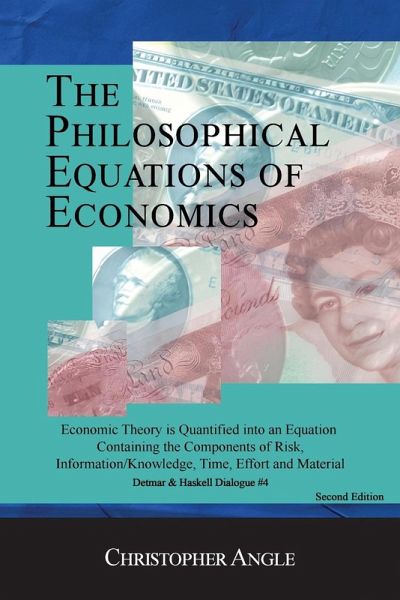
The Philosophical Equations of Economics Philosophy Mr. Angle's new nomograph is an ambitious book that challenges economic orthodoxy by applying a novel philosophy of free will and rational choice to the core aspects of economic decision-making. Ultimately, this approach leads to an argument for free enterprise that ties together ethical, aesthetic, and efficiency considerations. -James Sonda, Ph.D., Economist, JD (University of Michigan) This work posits that cooperation is an artful science wrapped within a cultural framework and, therefore, can have a quantifiable and descriptive logic. Mr. Angle explores this concept with a unifying equation, adding other significant theoretical insights-namely, the distribution of information as a key factor in cooperative systems, a new derivation of humanity's inherent right to property, and the economic entity's will to differentiate. Whether one agrees or not, this compelling work will be of interest to those concerned with the bridge between philosophy and economics. -Michael McClindurr, Ph.D., International Economics The Philosophical Equations of Economics is an Enhanced Explanation of Economic Theory. This book notes that Economic theory has:Defming its modular and quantifiable components Introducing a unifying equation that describes supply and demand Deriving the inherent right to property The decision-making is modular with specific components and this includes economic decisions. Hence, economic problems and issues can be analyzed and quantified by knowing these components. This work finally provides a quantitative definition of major economic debates, such as Mercantilism vs. Free Trade and Social Finance vs. Free Market Economics. The impact and influence on economic thought will be profound. Cover Design by Keely Edwards Published by RITE Report Inc.