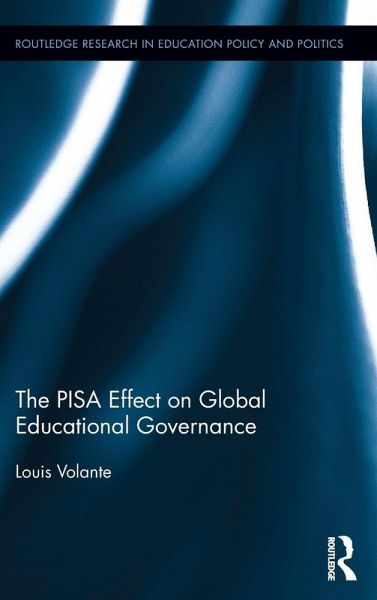
By presenting an in-depth examination of PISA's role in education governance and policy discourses, this book provides the reader with a critical analysis of the educational change process within our increasingly global educational policy environment.
By presenting an in-depth examination of PISA's role in education governance and policy discourses, this book provides the reader with a critical analysis of the educational change process within our increasingly global educational policy environment.
Louis Volante is Professor of Education at Brock University, Canada.
Inhaltsangabe
Part I: Introduction Chapter 1: PISA, Policy, and Global Educational Governance (Louis Volante and Xavier Fazio) Part II: Conceptual and Methodological Issues Chapter 2: Problematizing the Expansion of PISA's Explanatory Power (Clara Morgan) Chapter 3: The Dialectical Impact of PISA on International Educational Discourse and National Education Reform (Alexander W. Wiseman and Budi Waluyo) Chapter 4: Measurement and Evaluation Issues with PISA (Harvey Goldstein) Part III: Topical Issues within National and Transnational Contexts Chapter 5: Shanghai-China and the Emergence of a Global Reference Society (Charlene Tan and Vicente Chua Reyes, Jr.) Chapter 6: Regional Ethnic Diversity, School Ethnic Diversity, and PISA Performance across Europe (Sjaak Braster and Jaap Dronkers) Chapter 7: Socioeconomic Segregation in Secondary Schools: Evidence from Across the UK (John Jerrim, Nikki Shure, Rodrigo Torres, & Gabriel Gutiérrez) Chapter 8: Policy Implications of PISA in Germany: The Case of Teacher Education (Christine Sälzer and Manfred Prenzel) Chapter 9: The Role of PISA in Regional and Private/Public Debates in Italy (Daniele Checchi and Stefano Verzillo) Chapter 10: PISA, Policy, and Strategic Planning in Federal Switzerland (Jeanine Füeg, Vera Husfeldt, and Claudia Zahner Rossier) Chapter 11: The Use and Misuse of PISA Results in Poland (Maciej Jakubowski) Chapter 12: Using PISA to Monitor Trends and Evaluate Reforms in Australia (Geoff N. Masters) Chapter 13: A Vernacular Response: The Impact of PISA and the OECD on New Zealand Education (Martin Thrupp) Chapter 14: Disconnected Expectations? Labor Market Skill Content and Self-Expected Occupations of PISA 2015 Test Takers (Javier Luque) Part IV: Conclusion Chapter 15: PISA and the Future of Global Educational Governance (Sylke Viola Schnepf and Louis Volante)
Part I: Introduction Chapter 1: PISA, Policy, and Global Educational Governance (Louis Volante and Xavier Fazio) Part II: Conceptual and Methodological Issues Chapter 2: Problematizing the Expansion of PISA's Explanatory Power (Clara Morgan) Chapter 3: The Dialectical Impact of PISA on International Educational Discourse and National Education Reform (Alexander W. Wiseman and Budi Waluyo) Chapter 4: Measurement and Evaluation Issues with PISA (Harvey Goldstein) Part III: Topical Issues within National and Transnational Contexts Chapter 5: Shanghai-China and the Emergence of a Global Reference Society (Charlene Tan and Vicente Chua Reyes, Jr.) Chapter 6: Regional Ethnic Diversity, School Ethnic Diversity, and PISA Performance across Europe (Sjaak Braster and Jaap Dronkers) Chapter 7: Socioeconomic Segregation in Secondary Schools: Evidence from Across the UK (John Jerrim, Nikki Shure, Rodrigo Torres, & Gabriel Gutiérrez) Chapter 8: Policy Implications of PISA in Germany: The Case of Teacher Education (Christine Sälzer and Manfred Prenzel) Chapter 9: The Role of PISA in Regional and Private/Public Debates in Italy (Daniele Checchi and Stefano Verzillo) Chapter 10: PISA, Policy, and Strategic Planning in Federal Switzerland (Jeanine Füeg, Vera Husfeldt, and Claudia Zahner Rossier) Chapter 11: The Use and Misuse of PISA Results in Poland (Maciej Jakubowski) Chapter 12: Using PISA to Monitor Trends and Evaluate Reforms in Australia (Geoff N. Masters) Chapter 13: A Vernacular Response: The Impact of PISA and the OECD on New Zealand Education (Martin Thrupp) Chapter 14: Disconnected Expectations? Labor Market Skill Content and Self-Expected Occupations of PISA 2015 Test Takers (Javier Luque) Part IV: Conclusion Chapter 15: PISA and the Future of Global Educational Governance (Sylke Viola Schnepf and Louis Volante)
Es gelten unsere Allgemeinen Geschäftsbedingungen: www.buecher.de/agb
Impressum
www.buecher.de ist ein Internetauftritt der buecher.de internetstores GmbH
Geschäftsführung: Monica Sawhney | Roland Kölbl | Günter Hilger
Sitz der Gesellschaft: Batheyer Straße 115 - 117, 58099 Hagen
Postanschrift: Bürgermeister-Wegele-Str. 12, 86167 Augsburg
Amtsgericht Hagen HRB 13257
Steuernummer: 321/5800/1497
USt-IdNr: DE450055826