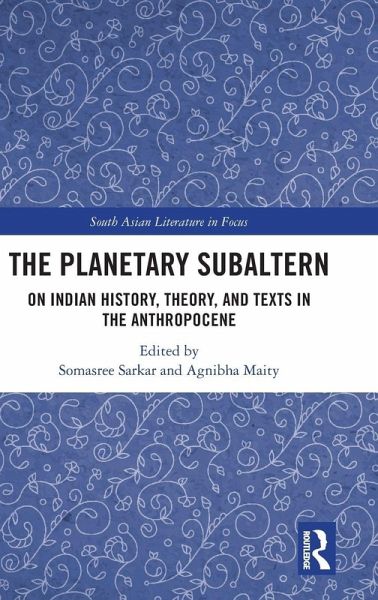
This book initiates a dialogue between two discursive fields of study: the Anthropocene and the Subaltern Studies. It highlights communities that bear the brunt of climate precarity and planetary crises and examines critiques of the Anthropocene discourse for grossly overlooking the subaltern communities and failing to integrate their historiography. The essays in the volume retrieve and amplify voices of subaltern communities amid planetary crises, especially in India, to set up new paradigms to engage and tackle the climate crises that confront our times. This volume will be of great…mehr
This book initiates a dialogue between two discursive fields of study: the Anthropocene and the Subaltern Studies.
It highlights communities that bear the brunt of climate precarity and planetary crises and examines critiques of the Anthropocene discourse for grossly overlooking the subaltern communities and failing to integrate their historiography. The essays in the volume retrieve and amplify voices of subaltern communities amid planetary crises, especially in India, to set up new paradigms to engage and tackle the climate crises that confront our times.
This volume will be of great interest to scholars and researchers of South Asian studies, literary criticism, especially ecocriticism, environmental studies and climate action.
Somasree Sarkar is an Assistant Professor at the Department of English, Ghoshpukur College, University of North Bengal, India. She has completed her PhD from the Department of English, University of North Bengal. Her areas of research interest include Environmental Humanities, Climate Fiction, Subaltern Studies and South Asian Literature. Her articles have been published in the Journal of Gender Studies, South Asian Review, Journal of Graphic Novels and Comics, and Journal of Environmental Planning and Management. She has also contributed chapters to several edited volumes published by internationally reputed publishing houses. Agnibha Maity is a faculty member of English at Surya Sen Mahavidyalaya, Siliguri, and a PhD Candidate at the Department of English, University of North Bengal. Previously, he served as a UGC Senior Research Fellow at the University of North Bengal. He obtained his M.A. and B.A. from the University of Calcutta. His research interests are in Subaltern Studies, Planetary Studies, and Ecopoetics.
Inhaltsangabe
Introduction: Theorising the Planetary Subaltern Part I: Planetary Crises and the Subaltern Subjects 1. Protests against the Farm Laws: The Political Ecology of the Green Revolution and the Limits of Agrarian Populism 2. Subaltern Climate, Climate Subaltern 3. The Gendered Subaltern and the Plachimada Struggle: Examining Capitalist Exploitation and Indigenous Women's Resistance in Mayilamma: The Life of a Tribal Eco-Warrior 4. Can The Subaltern Alternate? : Exploring Planetarity as Radical Alterity in The Netflix Docuseries The Hunt for Veerappan 5. The Subaltern in the Anthropocene: The Case of the Jarawas in The Last Wave Part II: The Planetary Subaltern and Narratives 6. Travails of Modernity and The Planetary Subaltern in Amitav Ghosh's The Living Mountain and Anuradha Sharma Pujari's The Forest Wails 7. Preparing the Earth: Diasporic Bildung and Planetary Ethics in K. S. Maniam's In a Far Country 8. Environmental Reproductive Justice in the Anthropocene: Narrating Subaltern Experiences from India 9. Anthropocene and the Deranged Others: Situating Planetary Subalterns in Literary Representations from Northeast India 10. Of Rivers, Roots and Resilience: Reflections of Subaltern Voices in Select Bengali River-writing 11. The Capitalocene, the Displaced Other, and Subaltern Environmentalism in Nila Madhab Panda's The Jengaburu Curse (2023) 12. Fairies, Mountains and the Anthropos: Exploring Strategies of Narrativising Nature in the Anthropocene
Introduction: Theorising the Planetary Subaltern Part I: Planetary Crises and the Subaltern Subjects 1. Protests against the Farm Laws: The Political Ecology of the Green Revolution and the Limits of Agrarian Populism 2. Subaltern Climate, Climate Subaltern 3. The Gendered Subaltern and the Plachimada Struggle: Examining Capitalist Exploitation and Indigenous Women's Resistance in Mayilamma: The Life of a Tribal Eco-Warrior 4. Can The Subaltern Alternate? : Exploring Planetarity as Radical Alterity in The Netflix Docuseries The Hunt for Veerappan 5. The Subaltern in the Anthropocene: The Case of the Jarawas in The Last Wave Part II: The Planetary Subaltern and Narratives 6. Travails of Modernity and The Planetary Subaltern in Amitav Ghosh's The Living Mountain and Anuradha Sharma Pujari's The Forest Wails 7. Preparing the Earth: Diasporic Bildung and Planetary Ethics in K. S. Maniam's In a Far Country 8. Environmental Reproductive Justice in the Anthropocene: Narrating Subaltern Experiences from India 9. Anthropocene and the Deranged Others: Situating Planetary Subalterns in Literary Representations from Northeast India 10. Of Rivers, Roots and Resilience: Reflections of Subaltern Voices in Select Bengali River-writing 11. The Capitalocene, the Displaced Other, and Subaltern Environmentalism in Nila Madhab Panda's The Jengaburu Curse (2023) 12. Fairies, Mountains and the Anthropos: Exploring Strategies of Narrativising Nature in the Anthropocene
Es gelten unsere Allgemeinen Geschäftsbedingungen: www.buecher.de/agb
Impressum
www.buecher.de ist ein Internetauftritt der buecher.de internetstores GmbH
Geschäftsführung: Monica Sawhney | Roland Kölbl | Günter Hilger
Sitz der Gesellschaft: Batheyer Straße 115 - 117, 58099 Hagen
Postanschrift: Bürgermeister-Wegele-Str. 12, 86167 Augsburg
Amtsgericht Hagen HRB 13257
Steuernummer: 321/5800/1497
USt-IdNr: DE450055826