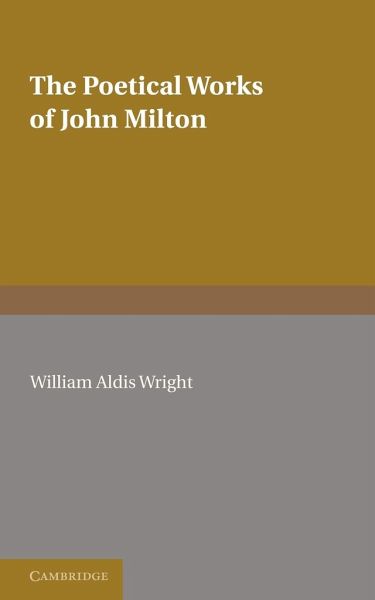
Originally published in 1903, this collection gathers together the poetry of John Milton in a single volume. The text is carefully edited by William Aldis Wright (1831-1914), a renowned scholar of the time and a Milton specialist. In the preface Wright explains the reasons behind favouring particular editions and various editorial judgements, the end result being an attempt to remain as close to Milton's original vision as possible. There are numerous critical notes, but in accordance with a generally unobtrusive approach, these are contained towards the end of the text. This remains a fine…mehr
Originally published in 1903, this collection gathers together the poetry of John Milton in a single volume. The text is carefully edited by William Aldis Wright (1831-1914), a renowned scholar of the time and a Milton specialist. In the preface Wright explains the reasons behind favouring particular editions and various editorial judgements, the end result being an attempt to remain as close to Milton's original vision as possible. There are numerous critical notes, but in accordance with a generally unobtrusive approach, these are contained towards the end of the text. This remains a fine edition that will be of value to anyone with an interest in Milton scholarship and the history of English literature.
John Milton (9 December 1608 - 8 November 1674) was an English poet, polemicist, man of letters, and civil servant for the Commonwealth of England under its Council of State and later under Oliver Cromwell. He wrote at a time of religious flux and political upheaval, and is best known for his epic poem Paradise Lost (1667), written in blank verse. Writing in English, Latin, Greek, and Italian, he achieved international renown within his lifetime, and his celebrated Areopagitica (1644), written in condemnation of pre-publication censorship, is among history's most influential and impassioned defences of freedom of speech and freedom of the press. His desire for freedom extended into his style: he introduced new words (coined from Latin) to the English language, and was the first modern writer to employ non-rhymed verse outside of the theatre or translations. William Hayley's 1796 biography called him the "greatest English author",[1] and he remains generally regarded "as one of the preeminent writers in the English language",[2] though critical reception has oscillated in the centuries since his death (often on account of his republicanism). Samuel Johnson praised Paradise Lost as "a poem which...with respect to design may claim the first place, and with respect to performance, the second, among the productions of the human mind", though he (a Tory and recipient of royal patronage) described Milton's politics as those of an "acrimonious and surly republican".[3] Poets such as William Blake, William Wordsworth and Thomas Hardy revered him. The phases of Milton's life parallel the major historical and political divisions in Stuart Britain. Milton studied, travelled, wrote poetry mostly for private circulation, and launched a career as pamphleteer and publicist under the increasingly personal rule of Charles I and its breakdown into constitutional confusion and war. The shift in accepted attitudes in government placed him in public office under the Commonwealth of England, from being thought dangerously radical and even heretical, and he even acted as an official spokesman in certain of his publications. The Restoration of 1660 deprived Milton, now completely blind, of his public platform, but this period saw him complete most of his major works of poetry.
Inhaltsangabe
1. A Paraphrase on Psalm CXIV 2. Psalm CXXXVI 3. On the Death of a Fair Infant Dying of a Cough 4. At a Vacation Exercise in the College 5. On the Morning of Christ's Nativity 6. Upon the Circumcision 7. The Passion 8. On Time 9. At a Solemn Music 10. Song on May Morning 11. On Shakespeare 12. On the University Carrier 13. Another on the Same 14. An Epitaph on the Marchioness of Winchester 15. L'Allegro 16. Il Penseroso 17. Arcades 18. Comus 19. Lycidias 20. Sonnets 21. Translations 22. Nine of the Psalms Done into Metre 23. Psalms Done into Verse, 1653 24. Paradise Lost 25. Paradise Regained 26. Samson Agonistes 27. Latin Poems 28. Epigrammata 29. Sylvarum Liber Notes.
1. A Paraphrase on Psalm CXIV 2. Psalm CXXXVI 3. On the Death of a Fair Infant Dying of a Cough 4. At a Vacation Exercise in the College 5. On the Morning of Christ's Nativity 6. Upon the Circumcision 7. The Passion 8. On Time 9. At a Solemn Music 10. Song on May Morning 11. On Shakespeare 12. On the University Carrier 13. Another on the Same 14. An Epitaph on the Marchioness of Winchester 15. L'Allegro 16. Il Penseroso 17. Arcades 18. Comus 19. Lycidias 20. Sonnets 21. Translations 22. Nine of the Psalms Done into Metre 23. Psalms Done into Verse, 1653 24. Paradise Lost 25. Paradise Regained 26. Samson Agonistes 27. Latin Poems 28. Epigrammata 29. Sylvarum Liber Notes.
Es gelten unsere Allgemeinen Geschäftsbedingungen: www.buecher.de/agb
Impressum
www.buecher.de ist ein Internetauftritt der buecher.de internetstores GmbH
Geschäftsführung: Monica Sawhney | Roland Kölbl | Günter Hilger
Sitz der Gesellschaft: Batheyer Straße 115 - 117, 58099 Hagen
Postanschrift: Bürgermeister-Wegele-Str. 12, 86167 Augsburg
Amtsgericht Hagen HRB 13257
Steuernummer: 321/5800/1497
USt-IdNr: DE450055826