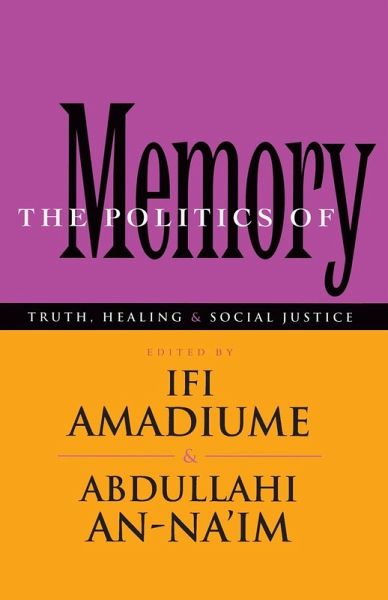
Why does conflict deteriorate into violence and war? How does collective memory influence healing and social justice in post-conflict situations? What is the role of judicial accountability - Crime Tribunals and Truth Commissions - for past violations of human rights? This book brings together a distinguished group of scholars, policy-makers, justice workers and social activists to answer these questions. In a creative engagement with issues of human rights in relation to truth, healing and social justice, they look at how people rebuild broken communities and the tensions between…mehr
Why does conflict deteriorate into violence and war? How does collective memory influence healing and social justice in post-conflict situations? What is the role of judicial accountability - Crime Tribunals and Truth Commissions - for past violations of human rights? This book brings together a distinguished group of scholars, policy-makers, justice workers and social activists to answer these questions. In a creative engagement with issues of human rights in relation to truth, healing and social justice, they look at how people rebuild broken communities and the tensions between reconciliation and social justice in post-conflict situations. The book is structured round the themes of social justice, the nature of conflict, judicial accountability and the role of truth commissions. Opening with Wole Soyinka's exploration of 'that burden of memory that a continent seeks to exorcise through the strategy of reparations', the first part of the book addresses questions of social justice as both ends and means of healing and reconciliation. The contributors go on to look at the nature and dynamics of conflict while parts three and four consider judicial accountability and the role of truth commissions as approachs to healing and social justice. The book concludes with a chapter on the pursuit of justice as an underlying cause of civil wars in Africa and elsewhere. Exploring the cases of Uganda, Sudan, Rwanda, South Africa, Nigeria, Latin America and the former Yugoslavia and including consideration of the gendered elements of conflict, this book is urgent reading for students and academics in peace and conflict and African Studies.
Ifi Amadiume is a award-winning poet and a political activist as well as an academic. She has lived in Nigeria and the UK and is currently associate professor at Dartmouth College, Hanover. There, she teaches in both the Department of Religion and the African-American Studies Programme. Professor Amadiume is author of the influential Male Daughters, Female Husbands (Zed Books, 1988) which won the Choice Outstanding Academic Book of the Year award in 1989. Ifi Amadiume is a award-winning poet and a political activist as well as an academic. She has lived in Nigeria and the UK and is currently associate professor at Dartmouth College, Hanover. There, she teaches in both the Department of Religion and the African-American Studies Programme. Professor Amadiume is author of the influential Male Daughters, Female Husbands (Zed Books, 1988) which won the Choice Outstanding Academic Book of the Year award in 1989.
Inhaltsangabe
Introduction: Facing Truth, Facing Justice - Ifi Amadiume and Abdullahi An-Na'im Part I: Social Justice 1.Memory, Truth and Healing - Wole Soyinka 2.The Politics of Memory: Biafra and Intellectual Responsibility - Ifi Amadiume 3.Biafran War Literature and Africa's Search for Social Justice - Akachi Ezeigbo Part II: The Nature of Conflict 4.Social Movements Revisited: Mediation of Contradictory Roles - Abdullahi Ahmed An-Na'im and Svetlana Peshkova 5.The Interface of Conflicts in West Africa: New Geopolitics and Emergence of Regional Powers - Tshikala Biaya 6.Post-Biafran Marginalization of the Igbo in Nigeria - Nnaemeka Ikpeze 7.Towards a Social History of Warfare and Reconstruction: The Nigerian-Biafran Case - Axel Harneit-Sievers and Sydney Emezue Part III: Judicial Accountability 8.Truth and Justice for Human Rights Crimes: Latin America and Accountability - Juan Mendez 9. Truth in a Box: The Limits of Justice through Judicial Mechanisms - Julie Mertus 10. Justice for Women Victims of Violence: A Look at Rwanda After the 1994 Genocide - Binaifer Nowrojee and Regan Ralph Appendix: Truth Commissions
Introduction: Facing Truth, Facing Justice - Ifi Amadiume and Abdullahi An-Na'im Part I: Social Justice 1.Memory, Truth and Healing - Wole Soyinka 2.The Politics of Memory: Biafra and Intellectual Responsibility - Ifi Amadiume 3.Biafran War Literature and Africa's Search for Social Justice - Akachi Ezeigbo Part II: The Nature of Conflict 4.Social Movements Revisited: Mediation of Contradictory Roles - Abdullahi Ahmed An-Na'im and Svetlana Peshkova 5.The Interface of Conflicts in West Africa: New Geopolitics and Emergence of Regional Powers - Tshikala Biaya 6.Post-Biafran Marginalization of the Igbo in Nigeria - Nnaemeka Ikpeze 7.Towards a Social History of Warfare and Reconstruction: The Nigerian-Biafran Case - Axel Harneit-Sievers and Sydney Emezue Part III: Judicial Accountability 8.Truth and Justice for Human Rights Crimes: Latin America and Accountability - Juan Mendez 9. Truth in a Box: The Limits of Justice through Judicial Mechanisms - Julie Mertus 10. Justice for Women Victims of Violence: A Look at Rwanda After the 1994 Genocide - Binaifer Nowrojee and Regan Ralph Appendix: Truth Commissions
Es gelten unsere Allgemeinen Geschäftsbedingungen: www.buecher.de/agb
Impressum
www.buecher.de ist ein Internetauftritt der buecher.de internetstores GmbH
Geschäftsführung: Monica Sawhney | Roland Kölbl | Günter Hilger
Sitz der Gesellschaft: Batheyer Straße 115 - 117, 58099 Hagen
Postanschrift: Bürgermeister-Wegele-Str. 12, 86167 Augsburg
Amtsgericht Hagen HRB 13257
Steuernummer: 321/5800/1497
USt-IdNr: DE450055826