
42,99 €
inkl. MwSt.
Versandkostenfrei*
Versandfertig in 1-2 Wochen
payback
21 °P sammeln
  • Broschiertes Buch

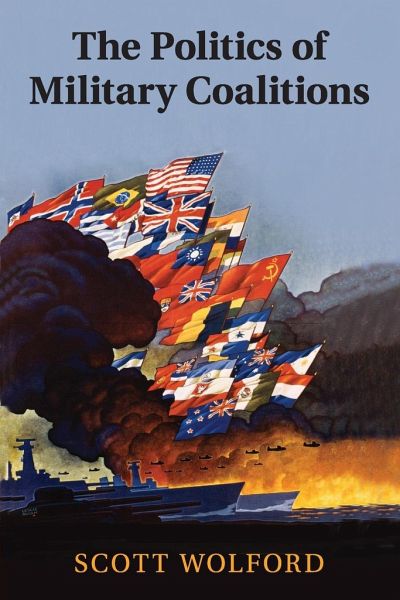
Military coalitions are ubiquitous. The United States builds them regularly, yet they are associated with the largest, most destructive, and consequential wars in history. When do states build them, and what partners do they choose? Are coalitions a recipe for war, or can they facilitate peace? Finally, when do coalitions affect the expansion of conflict beyond its original participants? The Politics of Military Coalitions introduces newly collected data designed to answer these very questions, showing that coalitions - expensive to build but attractive from a military standpoint - are very…mehr

Produktbeschreibung
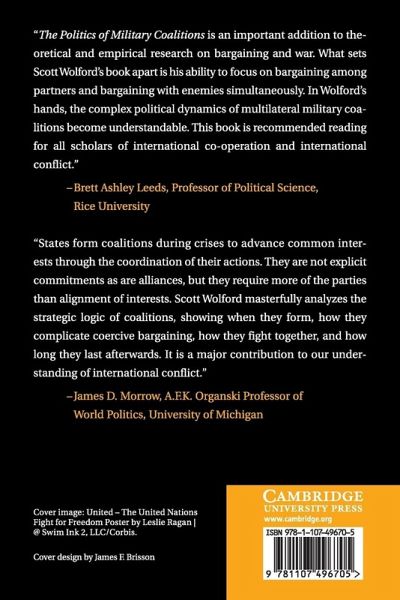
Military coalitions are ubiquitous. The United States builds them regularly, yet they are associated with the largest, most destructive, and consequential wars in history. When do states build them, and what partners do they choose? Are coalitions a recipe for war, or can they facilitate peace? Finally, when do coalitions affect the expansion of conflict beyond its original participants? The Politics of Military Coalitions introduces newly collected data designed to answer these very questions, showing that coalitions - expensive to build but attractive from a military standpoint - are very often more (if sometimes less) than the sum of their parts, at times encouraging war while discouraging it at others, at times touching off wider wars while at others keeping their targets isolated. The combination of new data, new formal theories, and new quantitative analysis will be of interest to scholars, students, and policymakers alike.
Autorenporträt
Scott Wolford is an Associate Professor of Government at the University of Texas, Austin. He has published articles in the American Journal of Political Science, the Journal of Politics, the Journal of Conflict Resolution and International Studies Quarterly, among others. He is a fellow of the Frank C. Irwin Chair in Government (2011-16) and a recipient of the Best Paper in International Relations Award from the Midwest Political Science Association (2009).