Rossana Castiglioni Nunez
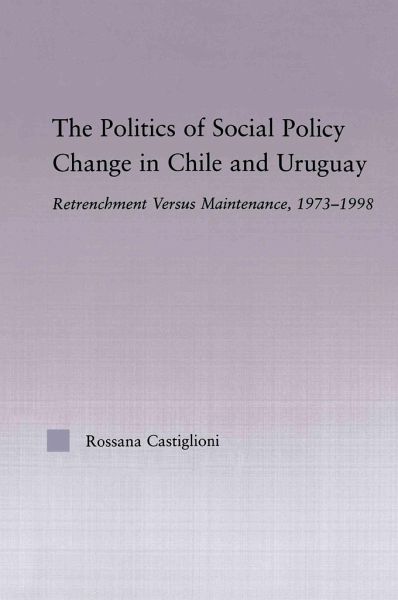
The Politics of Social Policy Change in Chile and Uruguay
Retrenchment versus Maintenance, 1973-1998
Rossana Castiglioni Nunez
The Politics of Social Policy Change in Chile and Uruguay
Retrenchment versus Maintenance, 1973-1998
- Broschiertes Buch
- Merkliste
- Auf die Merkliste
- Bewerten Bewerten
- Teilen
- Produkt teilen
- Produkterinnerung
- Produkterinnerung
This work explains the causes of social policy reform in Chile and Uruguay in the areas of health care, pensions and education. Until the 1970s, Chile and Uruguay shared striking similarities.
Andere Kunden interessierten sich auch für
Rossana Castiglioni NunezThe Politics of Social Policy Change in Chile and Uruguay171,99 €
Dennis GilbertOligarchy and the Old Regime in Latin America, 1880-1970127,99 €
George PendleUruguay52,99 €
The Rio de la Plata from Colony to Nations121,99 €
W. H. KoebelUruguay21,99 €
Benjamin Vicuna MackennaThe Girondins of Chile20,99 €
The Rio de la Plata from Colony to Nations121,99 €-
-
-
This work explains the causes of social policy reform in Chile and Uruguay in the areas of health care, pensions and education. Until the 1970s, Chile and Uruguay shared striking similarities.
Produktdetails
- Produktdetails
- Verlag: Routledge
- Seitenzahl: 168
- Erscheinungstermin: 1. Mai 2013
- Englisch
- Abmessung: 229mm x 152mm x 9mm
- Gewicht: 254g
- ISBN-13: 9780415653916
- ISBN-10: 0415653916
- Artikelnr.: 36539404
- Herstellerkennzeichnung
- Libri GmbH
- Europaallee 1
- 36244 Bad Hersfeld
- gpsr@libri.de
- Verlag: Routledge
- Seitenzahl: 168
- Erscheinungstermin: 1. Mai 2013
- Englisch
- Abmessung: 229mm x 152mm x 9mm
- Gewicht: 254g
- ISBN-13: 9780415653916
- ISBN-10: 0415653916
- Artikelnr.: 36539404
- Herstellerkennzeichnung
- Libri GmbH
- Europaallee 1
- 36244 Bad Hersfeld
- gpsr@libri.de
Rossana Castiglioni
Chapter 1. Introduction. Research Problem, Theory and Methods 1.1 Research
Problem 1.2 Relevance of the Cases and Topic 1.3 Leading Comparative
Theories on the Welfare State 1.4 Hypotheses and Theoretical Model 1.5
Methodology 1.6 Organization of this Dissertation Chapter 2. The Politics
of Retrenchment: The Quandaries of Social Protection Under Military Rule in
Chile, 1973-1990 2.1 Introduction 2.2 Soical Policy Retrenchment under
Military Rule 2.3 Concentrating Power and Displacing Veto Players 2.4
Ideology of the Policy-Makers: National Security, Gremialismo, and
Monetarism 2.5 Final Remarks Chapter 3. The Uruguayan Social Policy
Continuity Under Military Rule, 1973-1985 3.1 Introduction 3.2 Social
Policy Change During Military Rule 3.3 Dispersion of Power and the Absence
of Veto Players 3.4 Ideological Positions of Policy-Makers: The Preminence
of Statism 3.5 Final Remarks Chapter 4. Contrasting Social Policy Outcomes:
The Case of Uruguay, 1985-1998 4.1 Introduction 4.2 Social Policy Change
and Continuity since Re-Democratization 4.3 Dispersion of Power and
Multiple Veto Players 4.4 Ideology and Social Policy Change 4.5 Final
Remarks Chapter 5. The Unchallenged System: Social Policy Continuity in
Democratic Chile, 1990-1998 5.1 Introduction 5.2 Social Policy after the
Re-Installation of Democracy 5.3 Dispersion of Power and the Weakness of
Veto Players 5.4 Ideological Positions of Policy-Makers: the Continuity of
Market-Oriented Ideas 5.5 Final Remarks Chapter 6. Conclusions 6.1 Main
Findings and Contributions 6.2 The Road Ahead: Alternative Explanations and
Avenues for New Research 6.3 Final Remarks References
Problem 1.2 Relevance of the Cases and Topic 1.3 Leading Comparative
Theories on the Welfare State 1.4 Hypotheses and Theoretical Model 1.5
Methodology 1.6 Organization of this Dissertation Chapter 2. The Politics
of Retrenchment: The Quandaries of Social Protection Under Military Rule in
Chile, 1973-1990 2.1 Introduction 2.2 Soical Policy Retrenchment under
Military Rule 2.3 Concentrating Power and Displacing Veto Players 2.4
Ideology of the Policy-Makers: National Security, Gremialismo, and
Monetarism 2.5 Final Remarks Chapter 3. The Uruguayan Social Policy
Continuity Under Military Rule, 1973-1985 3.1 Introduction 3.2 Social
Policy Change During Military Rule 3.3 Dispersion of Power and the Absence
of Veto Players 3.4 Ideological Positions of Policy-Makers: The Preminence
of Statism 3.5 Final Remarks Chapter 4. Contrasting Social Policy Outcomes:
The Case of Uruguay, 1985-1998 4.1 Introduction 4.2 Social Policy Change
and Continuity since Re-Democratization 4.3 Dispersion of Power and
Multiple Veto Players 4.4 Ideology and Social Policy Change 4.5 Final
Remarks Chapter 5. The Unchallenged System: Social Policy Continuity in
Democratic Chile, 1990-1998 5.1 Introduction 5.2 Social Policy after the
Re-Installation of Democracy 5.3 Dispersion of Power and the Weakness of
Veto Players 5.4 Ideological Positions of Policy-Makers: the Continuity of
Market-Oriented Ideas 5.5 Final Remarks Chapter 6. Conclusions 6.1 Main
Findings and Contributions 6.2 The Road Ahead: Alternative Explanations and
Avenues for New Research 6.3 Final Remarks References
Chapter 1. Introduction. Research Problem, Theory and Methods 1.1 Research
Problem 1.2 Relevance of the Cases and Topic 1.3 Leading Comparative
Theories on the Welfare State 1.4 Hypotheses and Theoretical Model 1.5
Methodology 1.6 Organization of this Dissertation Chapter 2. The Politics
of Retrenchment: The Quandaries of Social Protection Under Military Rule in
Chile, 1973-1990 2.1 Introduction 2.2 Soical Policy Retrenchment under
Military Rule 2.3 Concentrating Power and Displacing Veto Players 2.4
Ideology of the Policy-Makers: National Security, Gremialismo, and
Monetarism 2.5 Final Remarks Chapter 3. The Uruguayan Social Policy
Continuity Under Military Rule, 1973-1985 3.1 Introduction 3.2 Social
Policy Change During Military Rule 3.3 Dispersion of Power and the Absence
of Veto Players 3.4 Ideological Positions of Policy-Makers: The Preminence
of Statism 3.5 Final Remarks Chapter 4. Contrasting Social Policy Outcomes:
The Case of Uruguay, 1985-1998 4.1 Introduction 4.2 Social Policy Change
and Continuity since Re-Democratization 4.3 Dispersion of Power and
Multiple Veto Players 4.4 Ideology and Social Policy Change 4.5 Final
Remarks Chapter 5. The Unchallenged System: Social Policy Continuity in
Democratic Chile, 1990-1998 5.1 Introduction 5.2 Social Policy after the
Re-Installation of Democracy 5.3 Dispersion of Power and the Weakness of
Veto Players 5.4 Ideological Positions of Policy-Makers: the Continuity of
Market-Oriented Ideas 5.5 Final Remarks Chapter 6. Conclusions 6.1 Main
Findings and Contributions 6.2 The Road Ahead: Alternative Explanations and
Avenues for New Research 6.3 Final Remarks References
Problem 1.2 Relevance of the Cases and Topic 1.3 Leading Comparative
Theories on the Welfare State 1.4 Hypotheses and Theoretical Model 1.5
Methodology 1.6 Organization of this Dissertation Chapter 2. The Politics
of Retrenchment: The Quandaries of Social Protection Under Military Rule in
Chile, 1973-1990 2.1 Introduction 2.2 Soical Policy Retrenchment under
Military Rule 2.3 Concentrating Power and Displacing Veto Players 2.4
Ideology of the Policy-Makers: National Security, Gremialismo, and
Monetarism 2.5 Final Remarks Chapter 3. The Uruguayan Social Policy
Continuity Under Military Rule, 1973-1985 3.1 Introduction 3.2 Social
Policy Change During Military Rule 3.3 Dispersion of Power and the Absence
of Veto Players 3.4 Ideological Positions of Policy-Makers: The Preminence
of Statism 3.5 Final Remarks Chapter 4. Contrasting Social Policy Outcomes:
The Case of Uruguay, 1985-1998 4.1 Introduction 4.2 Social Policy Change
and Continuity since Re-Democratization 4.3 Dispersion of Power and
Multiple Veto Players 4.4 Ideology and Social Policy Change 4.5 Final
Remarks Chapter 5. The Unchallenged System: Social Policy Continuity in
Democratic Chile, 1990-1998 5.1 Introduction 5.2 Social Policy after the
Re-Installation of Democracy 5.3 Dispersion of Power and the Weakness of
Veto Players 5.4 Ideological Positions of Policy-Makers: the Continuity of
Market-Oriented Ideas 5.5 Final Remarks Chapter 6. Conclusions 6.1 Main
Findings and Contributions 6.2 The Road Ahead: Alternative Explanations and
Avenues for New Research 6.3 Final Remarks References