
Andere Kunden interessierten sich auch für
 Flesh Mapping145,20 €
 Flesh Mapping40,50 €
 Booker T. Washington and the Art of Self-Representation40,50 €
 The Possibilities of Play in the Classroom28,75 €
 Curriculum and the Aesthetic Life44,45 €
 Curriculum and the Aesthetic Life158,30 €
 Youth Poets40,50 €

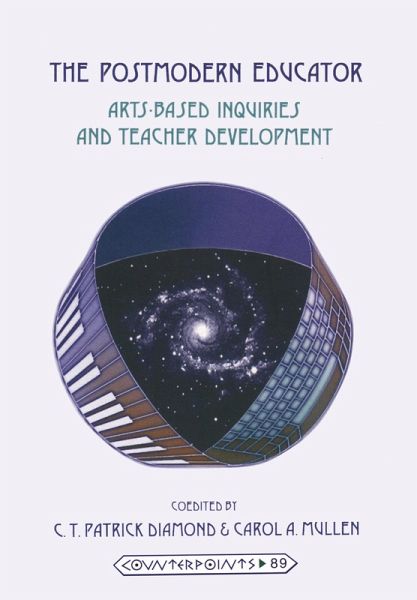
The Postmodern Educator offers research stories of teachers and teacher educators who explore their own artistic and analytic practices in many different settings. Typically, arts-based research is presented only in theoretical and expository terms in the educational literature. In this book, however, the authors promote the development of arts-based narrative inquiries by using many artistic forms (stories, poems, narratives, visuals) to shape their topics of interest and those of their teacher colleagues. Teacher-researchers are invited, more generally, to reimagine not only their own research inquiries as forms of art but also the field of teacher education and development. Demonstration is the heart of this book. Chapters consist of a series of examples that illustrate arts-based inquiry and teacher development; dissertation supervision and completion; preservice and inservice teacher education; and other, less conventional, schooling contexts (academe, prisons). The actual literary and artistic examples provided are varied in form and content. A postmodern form of arts-based inquiry and teacher development emerges that is playful, self-referential, provocative, self-conscious, politically sensitive, and committed to reform ethics.
"The editors of this book have performed at least two important services for those of us in the field of education. Diamond and Mullen have collected, written, and edited a set of essays that significantly advances our theoretical understanding of the possibilities of arts-based inquiry approaches for the professional growth of teachers. And perhaps more important, they have supplied us with intriguing examples of what postmodern forms of arts-based educational research can look like. Given the burgeoning interest in exploring how the social sciences might be augmented by the arts for learning and teaching about educational matters, these two contributions make this a terrific example of exactly the right book at exactly the right time." (Tom Barone, Professor of Education, College of Education, Arizona State University)
"In diverse and dynamic ways 'The Postmodern Educator' brings artists into education, educators into art, and art into research. Teachers and students will benefit immediately." (Terry Barrett, Professor of Art Education, Ohio State University; Author of 'Criticizing Art: Understanding the Contemporary and Talking about Student Art')
"Rich in metaphor and image, Diamond and Mullen's book opens windows of possibilities for educational researchers and teacher educators to transform their practices. I found I could not turn a page without the surprising 'shock' of an unexpected metaphor that raised new wonders about my work. The illustrations scattered throughout the book add a rich layer of texture to a thoroughly engaging book. The arts-based activities and questions offer powerful ways for readers to engage in thoughtful inquiry into their own practices." (D. Jean Clandinin, Director, Centre for Research for Teacher Education and Development, University of Alberta)
"This is a courageous book. The coeditors and their contributors have not entered into the often arid debate on the appropriateness of particular paradigms. Instead they have engaged with the act of describing the imaginative ways in which arts-based educators can contribute to research and to the development of emancipatory pedagogy. Rather than suppress the constructive energies of educational researchers, the various authors demonstrate the potential of adopting an arts-based approach to research. Their narratives are imbued with an appropriate degree of self-referentiality. I found the range of arts-based activities of particular interest, and I will use them with my doctoral students and also my staff development activities. The incorporation of texts by authors from the world of the arts is refreshing. The authors invite us to share with them their vision of a postmodern educator. In reading the book I was stimulated to reflect on my own vision. This represents one of the many important features of the book." (Professor Maureen Pope, Dean of the Faculty of Education and Community Studies, University of Reading)
"In diverse and dynamic ways 'The Postmodern Educator' brings artists into education, educators into art, and art into research. Teachers and students will benefit immediately." (Terry Barrett, Professor of Art Education, Ohio State University; Author of 'Criticizing Art: Understanding the Contemporary and Talking about Student Art')
"Rich in metaphor and image, Diamond and Mullen's book opens windows of possibilities for educational researchers and teacher educators to transform their practices. I found I could not turn a page without the surprising 'shock' of an unexpected metaphor that raised new wonders about my work. The illustrations scattered throughout the book add a rich layer of texture to a thoroughly engaging book. The arts-based activities and questions offer powerful ways for readers to engage in thoughtful inquiry into their own practices." (D. Jean Clandinin, Director, Centre for Research for Teacher Education and Development, University of Alberta)
"This is a courageous book. The coeditors and their contributors have not entered into the often arid debate on the appropriateness of particular paradigms. Instead they have engaged with the act of describing the imaginative ways in which arts-based educators can contribute to research and to the development of emancipatory pedagogy. Rather than suppress the constructive energies of educational researchers, the various authors demonstrate the potential of adopting an arts-based approach to research. Their narratives are imbued with an appropriate degree of self-referentiality. I found the range of arts-based activities of particular interest, and I will use them with my doctoral students and also my staff development activities. The incorporation of texts by authors from the world of the arts is refreshing. The authors invite us to share with them their vision of a postmodern educator. In reading the book I was stimulated to reflect on my own vision. This represents one of the many important features of the book." (Professor Maureen Pope, Dean of the Faculty of Education and Community Studies, University of Reading)