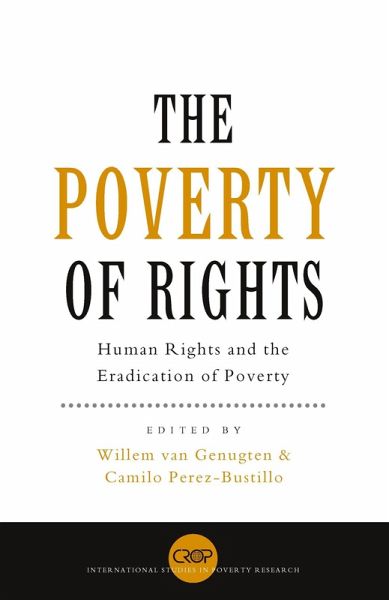
Political leaders, social scientists and lawyers are nowadays paying more attention to two, not necessarily related, issues: concrete measures to reduce poverty and practical steps to respect human rights enshrined in international and national legal systems. The innovative contribution of this volume is its bringing together of these two questions. The authors, who are mainly Latin American, are deeply aware of their own continent's particular history vis-a-vis grave human rights violations on the one hand, and the coexistence of great wealth alongside immense inequality on the other. Law,…mehr
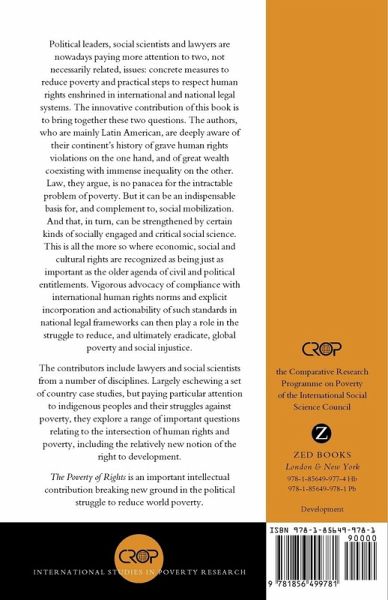
Political leaders, social scientists and lawyers are nowadays paying more attention to two, not necessarily related, issues: concrete measures to reduce poverty and practical steps to respect human rights enshrined in international and national legal systems. The innovative contribution of this volume is its bringing together of these two questions. The authors, who are mainly Latin American, are deeply aware of their own continent's particular history vis-a-vis grave human rights violations on the one hand, and the coexistence of great wealth alongside immense inequality on the other. Law, they argue, is no panacea for the intractable problem of poverty. But it can be an indispensable basis for, and complement to, social mobilization, which, in turn, can be strengthened by certain kinds of socially engaged and critical social science. This is all the more so where economic, social and cultural rights are recognized as being just as important as the older agenda of civil and political entitlements. Vigorous advocacy of compliance with international human rights norms and explicit incorporation and actionability of such standards in national legal frameworks can then play a role in the struggle to reduce, and ultimately eradicate, global poverty and social injustice. The contributors include lawyers and social scientists from a number of disciplines. Largely eschewing a set of country case studies, but paying particular attention to indigenous peoples and their struggles against poverty, they explore a range of important questions relating to the intersection of human rights and poverty, including the relatively new notion of the right to development. An important intellectual contribution breaking new ground in the political struggle to reduce world poverty.
Willem van Genugten is professor of international law at Tilburg University and professor of human rights at Nijmegen University. In addition he is, inter alia, chair of the board of the Dutch Research School of Human Rights, which is a joint initiative of the Universities of Maastrich, Utrecht, Rotterdam and Tilburg. He is also member of the Advisory Council on International Affairs of the Dutch government . He has published a series of books and articles, mainly in the field of human rights. Camilo Perez-Bustillo is research professor at the State of Mexico campus of the 'Instituto Tecnologico y de Estudios Superiores de Monterrey' (ITESM), where he gives courses in media studies, law and international relations. He is also a resident scholar at the Permanent Seminar on Chicano and Border Studies of the Social Anthropology Division of Mexico's National Institute of Anthropology and History (DEAS-INAH), and the Mexico representative for the US-based National Lawyers' Guild. >Camilo Perez-Bustillo is research professor at the State of Mexico campus of the 'Instituto Tecnologico y de Estudios Superiores de Monterrey' (ITESM), where he gives courses in media studies, law and international relations. He is also a resident scholar at the Permanent Seminar on Chicano and Border Studies of the Social Anthropology Division of Mexico's National Institute of Anthropology and History (DEAS-INAH), and the Mexico representative for the US-based National Lawyers' Guild.
Inhaltsangabe
Preface - Camilo Perez-Bustillo Part I: Citizenship, Democracy and Participation: Contemporary Challenges and New Paradigms 1. Expansion of Citizenship and Democratic Construction - Eduardo S. Bustelo 2. Human Rights: A New Paradigm - Patricia Helena Massa Arzabe 3. Natural History and Social History: Limits and Urgent Priorities which Condition the Exercise of Human Rights - Juan Antonio Blanco Part II: The Vicious Circles of Poverty 4. Poverty and Human Rights in the Light of the Philosophy and Contributions of Father Joseph Wresinski - Marco Aurelio Ugarte Ochoa 5. The Promotion of Economic, Social and Cultural Rights as a Formula to Face Poverty: The Case of Panama - Maribel Gordon Part III: Indigenous Struggles against Poverty 6. Indigenous Peoples and Mega Projects: Hydroelectric Dams in the Land of the Pehuenches in the Highlands of the Bio Bio River, Chile - Claudio Gonzalez-Parra 7. Human Rights, Poverty and Indigenous Peoples' Struggles in the Americas: New Directions and Case Studies from Colombia, Guatemala, Mexico, and Nicaragua - Camilo Perez-Bustillo 8. Indigenous Poverty and Social Mobilisation - Luiz Hernandez Navarro Part IV: Solutions from a Human Rights Perspective 9. Poverty and Social Justice in Latin America: Economic and Social Rights and the Material Conditions Necessary to Render Them Effective - Hector Gros Espiell 10. The Right to Development as a Programming Tool for Development Co-Operation - Patrick van Weerelt 11. The Human Rights Challenge to Global Poverty - Chris Jochnick Conclusion: Human Rights as Source of Inspiration and Instrument for the Eradication of Extreme Poverty: The Need for an Integrated Economic, Political and Legal Approach - Willem van Genugten and Camilo Perez-Bustillo
Preface - Camilo Perez-Bustillo Part I: Citizenship, Democracy and Participation: Contemporary Challenges and New Paradigms 1. Expansion of Citizenship and Democratic Construction - Eduardo S. Bustelo 2. Human Rights: A New Paradigm - Patricia Helena Massa Arzabe 3. Natural History and Social History: Limits and Urgent Priorities which Condition the Exercise of Human Rights - Juan Antonio Blanco Part II: The Vicious Circles of Poverty 4. Poverty and Human Rights in the Light of the Philosophy and Contributions of Father Joseph Wresinski - Marco Aurelio Ugarte Ochoa 5. The Promotion of Economic, Social and Cultural Rights as a Formula to Face Poverty: The Case of Panama - Maribel Gordon Part III: Indigenous Struggles against Poverty 6. Indigenous Peoples and Mega Projects: Hydroelectric Dams in the Land of the Pehuenches in the Highlands of the Bio Bio River, Chile - Claudio Gonzalez-Parra 7. Human Rights, Poverty and Indigenous Peoples' Struggles in the Americas: New Directions and Case Studies from Colombia, Guatemala, Mexico, and Nicaragua - Camilo Perez-Bustillo 8. Indigenous Poverty and Social Mobilisation - Luiz Hernandez Navarro Part IV: Solutions from a Human Rights Perspective 9. Poverty and Social Justice in Latin America: Economic and Social Rights and the Material Conditions Necessary to Render Them Effective - Hector Gros Espiell 10. The Right to Development as a Programming Tool for Development Co-Operation - Patrick van Weerelt 11. The Human Rights Challenge to Global Poverty - Chris Jochnick Conclusion: Human Rights as Source of Inspiration and Instrument for the Eradication of Extreme Poverty: The Need for an Integrated Economic, Political and Legal Approach - Willem van Genugten and Camilo Perez-Bustillo
Es gelten unsere Allgemeinen Geschäftsbedingungen: www.buecher.de/agb
Impressum
www.buecher.de ist ein Internetauftritt der buecher.de internetstores GmbH
Geschäftsführung: Monica Sawhney | Roland Kölbl | Günter Hilger
Sitz der Gesellschaft: Batheyer Straße 115 - 117, 58099 Hagen
Postanschrift: Bürgermeister-Wegele-Str. 12, 86167 Augsburg
Amtsgericht Hagen HRB 13257
Steuernummer: 321/5800/1497
USt-IdNr: DE450055826