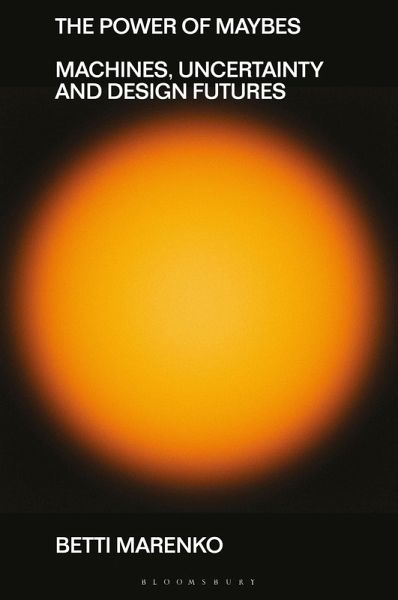
In a world of endless predictions and precision algorithms The Power of Maybes offers a daring new way forward. What if uncertainty isn't a problem to solve, but a gift? This book reclaims hesitation, ambiguity, and not-knowing as powerful tools to resist the rigid control of digital systems. The Power of Maybes explores the radical idea that embracing uncertainty is essential in our age of planetary computation. Where machines seek to lock down knowledge, capture potential, dictate futures, and foreclose possibilities, The Power of Maybes argues for the cultivation of doubt, ambiguity, and…mehr
In a world of endless predictions and precision algorithms The Power of Maybes offers a daring new way forward. What if uncertainty isn't a problem to solve, but a gift? This book reclaims hesitation, ambiguity, and not-knowing as powerful tools to resist the rigid control of digital systems. The Power of Maybes explores the radical idea that embracing uncertainty is essential in our age of planetary computation. Where machines seek to lock down knowledge, capture potential, dictate futures, and foreclose possibilities, The Power of Maybes argues for the cultivation of doubt, ambiguity, and un-knowing as forms of resistance. By reframing the unknown as a powerful resource, The Power of Maybes presents a bold approach to living and thinking alongside machines without surrendering to their grip. Blending philosophy, design, and critical tech studies, The Power of Maybes challenges dystopian fears and utopian hopes about technology, and champions new ways of being open, ungridded, unscaled. It's a call to cultivate the unknown and nurture potential. For those ready to reclaim their agency in an algorithmic age, this book is a guide to living with oceanic uncertainty -and finding power in it.
Betti Marenko is a transdisciplinary theorist, academic and educator working across process philosophies, design studies and critical technologies. She is Reader in Design and Techno-Digital Futures at Central Saint Martins, University of the Arts London, UK, where she founded and directs the Hybrid Futures Lab, a transversal research initiative that focuses on developing speculative-pragmatic interventions at the intersection of philosophy, design, technology and future-crafting practices. She is also WRHI Appointed Professor at the Tokyo Institute of Technology, Japan. With Marco Rozendaal and Will Odom, she co-edited Designing Smart Objects in Everyday Life (Bloomsbury, 2021).
Inhaltsangabe
Foreword, Adam Nocek Acknowledgements Introduction: Hybrid Futures A Note on Method Part I 1. Machines Work 2. Algorithmic Subjects 3. Resisting Reduction Part II 4. Metic Wayfinding 5. Oceanic Uncertainty 6. Unknowing Stratagems Conclusion: Whatever Designs Bibliography Index
Foreword, Adam Nocek Acknowledgements Introduction: Hybrid Futures A Note on Method Part I 1. Machines Work 2. Algorithmic Subjects 3. Resisting Reduction Part II 4. Metic Wayfinding 5. Oceanic Uncertainty 6. Unknowing Stratagems Conclusion: Whatever Designs Bibliography Index
Es gelten unsere Allgemeinen Geschäftsbedingungen: www.buecher.de/agb
Impressum
www.buecher.de ist ein Internetauftritt der buecher.de internetstores GmbH
Geschäftsführung: Monica Sawhney | Roland Kölbl | Günter Hilger
Sitz der Gesellschaft: Batheyer Straße 115 - 117, 58099 Hagen
Postanschrift: Bürgermeister-Wegele-Str. 12, 86167 Augsburg
Amtsgericht Hagen HRB 13257
Steuernummer: 321/5800/1497
USt-IdNr: DE450055826