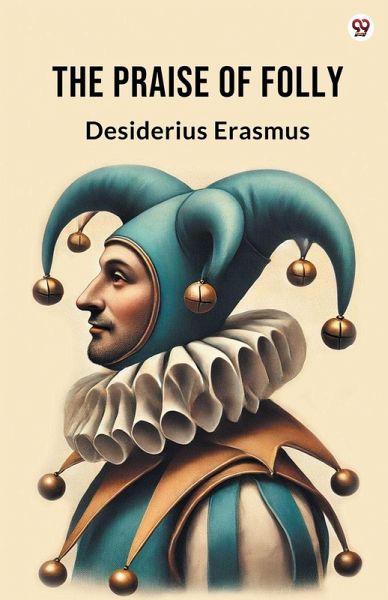
The Praise Of Folly is a humorous and satirical work in which Folly herself speaks, extolling her virtues and critiquing the foolishness inherent in human behavior. Through a lighthearted tone, Erasmus invites readers to reflect on the value placed on wisdom and seriousness in life, using Folly as a symbol of joy and human folly. Folly presents herself as a deity with power over both gods and men, arguing that her presence brings happiness by exposing the absurdities of wisdom, self-importance, and social pretensions. The work explores how traits like self-love, pleasure, and laziness form…mehr
The Praise Of Folly is a humorous and satirical work in which Folly herself speaks, extolling her virtues and critiquing the foolishness inherent in human behavior. Through a lighthearted tone, Erasmus invites readers to reflect on the value placed on wisdom and seriousness in life, using Folly as a symbol of joy and human folly. Folly presents herself as a deity with power over both gods and men, arguing that her presence brings happiness by exposing the absurdities of wisdom, self-importance, and social pretensions. The work explores how traits like self-love, pleasure, and laziness form part of Folly's household, illustrating the far-reaching impact of these qualities on relationships and societal norms. With a mixture of wit and profundity, Erasmus suggests that a life led by folly embracing joy and imperfection might be more fulfilling than a relentless pursuit of wisdom. The playful critique of human nature, combined with the suggestion that folly can lead to a more meaningful existence, challenges traditional views on virtue and knowledge.
Desiderius Erasmus Roterodamus, widely known as Erasmus of Rotterdam, was born in Rotterdam, Netherlands, and died on July 12, 1536, in Basel, Switzerland. He was a renowned Dutch Christian humanist, Catholic priest, theologian, educationalist, satirist, and philosopher. Erasmus is best known for his work in the field of education and for his contributions to the Renaissance humanist movement. He was deeply influenced by prominent figures like Martin Luther, Thomas More, and Aristotle. Throughout his life, Erasmus focused on the importance of education, advocating for the improvement of Christian society through a more enlightened understanding of scripture and the humanities. His works, including The Praise of Folly, critiqued the church and society, using satire to call attention to the shortcomings of both. Erasmus influenced many thinkers, including William Tyndale and Philip Melanchthon, and his legacy continues to shape Western thought. His parents were Margaretha Rogerius and Roger Gerard, and his intellectual and theological contributions have left a lasting mark on philosophy, religion, and education.
Es gelten unsere Allgemeinen Geschäftsbedingungen: www.buecher.de/agb
Impressum
www.buecher.de ist ein Internetauftritt der buecher.de internetstores GmbH
Geschäftsführung: Monica Sawhney | Roland Kölbl | Günter Hilger
Sitz der Gesellschaft: Batheyer Straße 115 - 117, 58099 Hagen
Postanschrift: Bürgermeister-Wegele-Str. 12, 86167 Augsburg
Amtsgericht Hagen HRB 13257
Steuernummer: 321/5800/1497
USt-IdNr: DE450055826